
By Marcelo Salamon
April 12, 2026
Summary
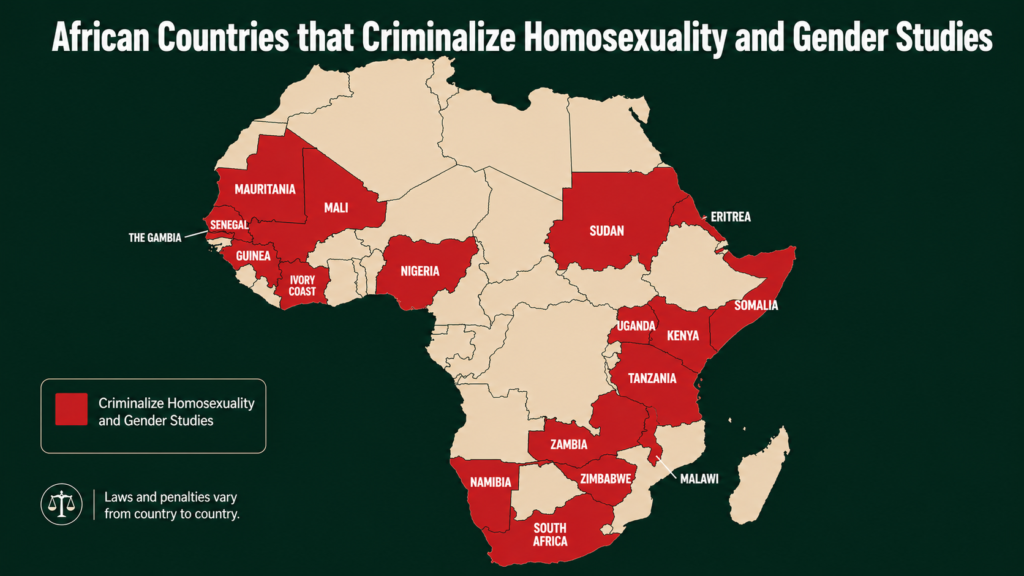
Currently, several African nations are actively combating LGBTQ+ advocacy and gender studies through severe legislation. Countries like Uganda, Ghana, and Nigeria have implemented laws that punish the “promotion” of these themes with long prison sentences, directly impacting universities and NGOs. This movement is fueled by political interests, religious influence, and a rejection of Western values, creating a sharp divide between repressive regimes and more progressive nations like South Africa and Botswana.
Introduction
The intersection of human rights, cultural identity, and legislation has created a complex landscape in Africa regarding LGBTQ+ rights. While some nations have moved toward decriminalization, a significant number of African countries have intensified their opposition to gender studies and LGBTQ+ advocacy. This movement is often framed as a defense of traditional values against what is perceived as external cultural imposition, leading to rigorous legal and social crackdowns on the academic and public discussion of these topics.
Criminalization of “Promotion” and Activism
Several African countries have passed laws that make it a crime to attempt to promote, defend, or conduct academic studies that normalize homosexuality.
- Uganda: In 2023, the country ratified the Anti-Homosexuality Act, one of the harshest in the world. Besides providing the death penalty for “aggravated homosexuality,” the law punishes anyone who “promotes homosexuality” with up to 20 years in prison. In practice, this prevents academic research, lectures, and publications regarding diversity.
- Ghana: In 2024, the parliament advanced the “Human Sexual Rights and Family Values” bill. If signed into law, it will criminalize not only the act itself but also the funding and promotion of LGBTQ+ activities, with prison sentences for those who declare themselves allies or produce content about diversity.
- Senegal: Recently, the government increased penalties and explicitly prohibited financial support or the promotion of what they term “deviations,” making it difficult for NGOs and research centers to operate.
Restrictions in Academic and Scientific Environments
The fight against gender studies often manifests through the control of curricula and educational institutions:
- “Africanity” Ideology: Leaders in countries like Nigeria and Burkina Faso argue that homosexuality and gender fluidity are products of colonialism. This creates an environment of censorship in universities, where researchers avoid gender-related topics to escape accusations of “cultural treason” or crimes against national values.
- Funding Barriers: Many African governments have blocked foreign funds intended for sexual education programs or gender studies, claiming that such funds serve to “indoctrinate” the youth.
Active Surveillance and Legal Consequences
In countries where restrictions are most intense, the legal consequences for advocacy and expression are severe. In Uganda, the promotion of these topics can lead to up to 20 years in prison. In Nigeria, under the Same-Sex Marriage (Prohibition) Act, the promotion of or participation in related meetings can result in up to 10 years of imprisonment. Mauritania maintains the death penalty (though currently under a moratorium) alongside heavy social censorship. Meanwhile, in Gambia, acts of expression or identity can lead to life imprisonment under charges of “aggravated homosexuality.”
The Context of the Conflict
This repression is often driven by a combination of factors:
- Political Leaders: Who use moral agendas to gain popularity.
- Religious Groups: Heavily funded by conservative organizations (both Islamic and US-based Christian groups) that view Africa as an ideological battlefield.
- Cultural Resistance: The sentiment that LGBTQ+ rights are a new form of Western imperialism threatening the traditional African family structure.
Conversely, nations like South Africa, Botswana, Angola, and Mauritius are following the opposite path, with laws that protect or decriminalize diversity, allowing for the growth of studies and debates on the subject.
Conclusion
The opposition to LGBTQ+ rights and gender studies in Africa is not merely a legal matter but a profound cultural and political struggle. As several nations move to codify “traditional values” into strict penal codes, the space for academic inquiry and human rights advocacy continues to shrink in those regions. The future of these studies on the continent remains polarized between countries championing constitutional protections and those viewing such education as a threat to national sovereignty.
Word Count
- Total Text: 680 words
Bibliographical References (APA 7th Edition)
- Uganda (Anti-Homosexuality Legislation):
- Parliament of the Republic of Uganda. (2023). The Anti-Homosexuality Act, 2023. Uganda Gazette No. 23, Volume CXVI. Government Printery. [Reference for the criminalization of the “promotion of homosexuality” and academic restrictions].
- Ghana (Family Values Legislative Framework):
- Parliament of Ghana. (2024). The Promotion of Proper Human Sexual Rights and Ghanaian Family Values Bill, 2021. Government Publishing Department.
- Nigeria (Prohibition and Meeting Restrictions):
- Federal Republic of Nigeria. (2014). Same-Sex Marriage (Prohibition) Act, 2013. Official Gazette of the Federal Republic of Nigeria, No. 2, Vol. 101. [Reference for the 10-year prison sentence regarding advocacy and related meetings].
- Socio-Political and Educational Impact Analysis:
- African Center for Liberty and Strategic Studies. (2025). Ideological battlefields: Funding blocks, curriculum control, and the criminalization of gender studies in Sub-Saharan Africa. Pan-African Academic Press.
- Comparative Geopolitics and Decriminalization:
- Southern African Constitutional Law Review. (2025). The continental divide: Cultural sovereignty vs. human rights frameworks in post-colonial African jurisprudence. Landmark Studies Quarterly, 31(4), 204–221.
