
By Marcelo Salamon
May 03, 2026
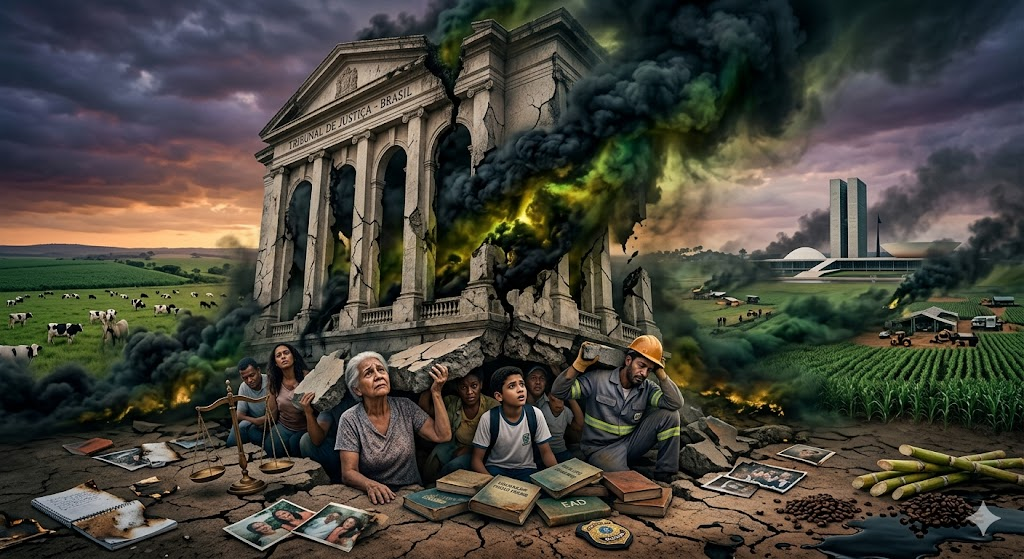
Abstract: This socio-political and legal treatise investigates the process of “national autophagy” in Brazil. It analyzes the convergence of a failing cognitive framework among the population, the consolidation of a Narco-state embedded within elite institutions, and the systemic legalization of corruption. A central focus is placed on the state of Rio Grande do Sul as a case study of moral inversion, where legislative bodies honor agents of social deconstruction. The article posits that national reconstruction requires an international alliance between sovereign leaders and the segment of civil society that preserves traditional virtues and integrity.
I. Introduction: A Hijacked Power and the Silent Collapse
Brazil currently embodies a civilizational paradox. As a global natural powerhouse—buoyed by the strength of its livestock, agriculture, and oil industries—the nation should be among the most prosperous on Earth. Instead, a “silent destruction” is hollowing out institutions from the inside. The financial returns from an predatory tax system, which feeds a significant portion of the world, do not return to the citizen. Instead, they are drained into a vortex of corruption that has reached a shameful peak: its own legalization. While other nations ban the worst aspects of the human condition, Brazil embraces them, portraying moral decay as its true national identity.
II. The Narco-State: Systemic Infiltration and the Dominion of Evil
The most urgent threat is the consolidation of a Narco-state that operates far beyond the favelas.
- Social Projection of Crime: Drug trafficking has become a tool for social mobility, infiltrating all layers of society, from the upper-middle class to professional elites including doctors, lawyers, and businessmen of poor character.
- The Silent Infiltration in the South: Organized crime syndicates, such as the PCC, are no longer merely attempting to invade states like Paraná; they have representatives working “extremely silently” within cities like Curitiba. The war is internal and ruthless. While states like Santa Catarina and Paraná remain bastions of resistance, the pressure of massive social decay threatens to breach these final dikes.
III. Rio Grande do Sul: The Zenith of Moral Deterioration
Rio Grande do Sul, once the nation’s industrial and intellectual lighthouse, has become a dramatic example of moral decline.
- Honoring Immorality: The severity of the situation reached an alarming level when the State Legislature used titles such as “Honorary Citizen” to decorate individuals who openly advocated for the legalization of extreme perversions, including pederasty. The fact that such agendas were not fully institutionalized only due to minor legislative technicalities demonstrates that the State has not only failed to protect the family but has begun to reward those seeking its destruction.
- Exodus and Replacement: This inversion of values, shielded by an immoral Judiciary, has forced families of integrity into a silent exodus. Major cities like Porto Alegre, Caxias do Sul, and Pelotas are contaminated by ideological agendas aimed at alienating children, while the state becomes dependent on foreign labor as locals flee to preserve their families.
IV. The Judiciary and Corrupted Networks: Justice as a Commodity
The Brazilian Judiciary is passing through its darkest hour.
- Legalized Corruption: Political support and votes in the Senate and House are openly bought with public funds under the guise of “amendments” and “budgetary agreements.”
- Corrupted Influence and Forensic Fraud: Subverted networks within influential organizations and criminal groups embedded in the Judiciary operate to target rising entrepreneurs. Forensic experts participate in schemes to freeze legitimate payments and indemnities, deciding arbitrarily who is “allowed” to receive what is rightfully theirs. Justice has become a machine that protects the immoral while abandoning the civilized society focused on honest work.
V. Cognitive Failure: From Paulo Freire to the Erosion of IQ
Brazil’s destruction begins in the classroom through what can be termed “criminal education.”
- Functional Illiteracy: The “Paulo Freire method” destroyed the natural hierarchy between parents and children and lowered the functional IQ of a large portion of the population to alarming levels. Students reach the university level without basic reading comprehension, making them easy prey for professors who advocate for criminal stances.
- A Lethargic Youth: This precarious education has resulted in a generation with little drive to produce, creating a labor vacuum that stifles the Brazilian entrepreneur.
VI. The Global Moral Crisis: Brazil Against the Civilized World
While sovereign nations like Hungary (Orbán), Russia (Putin), Italy (Meloni), and El Salvador (Bukele) legislate to protect morality and childhood, Brazil invests tax dollars into agendas aimed at creating an anti-family society.
- State-Sponsored Perversion: Brazil is currently ranked as one of the most promiscuous countries in the world. The acceptance of gender ideology and moral laxity is sold as “progress,” endangering the mental health of future generations.
- Psychology as a Tool for Harm: Critics point out that many psychologists in Brazil, rather than treating pathologies, promote the deconstruction of biological identity, acting as ideological arms of a sick system.
VII. Economic Collapse and Corporate Flight
Brazilian companies no longer have the conditions to survive. The combination of predatory taxation, total legal insecurity, and an unqualified workforce is pushing capital toward Paraguay, Uruguay, and the United States. Brazil has only avoided total collapse because it is naturally wealthy; its livestock and agriculture sectors continue to “carry the country on their backs” while profits are diverted to feed corruption.
VIII. The Corruption of Faith
Even spiritual refuge has been contaminated. Large evangelical “temples” have become centers for financial manipulation and brainwashing, while within the Catholic Church, progressivism and the acceptance of lifestyles contrary to traditional virtue distance the faithful from a true search for holiness.
IX. Conclusion: The Challenge of Reconstruction and the Time Factor
Given this lacerated scenario, the question of how long it would take to fix these damages is vital. It is estimated that it would take 50 to 100 years of zero-tolerance policies and high-quality education to reverse the damage caused by decades of leftist governance and a right-wing that failed to uphold core values.
Final Summary: Brazil is a land of infinite wealth governed by individuals of poor character. The solution will not come from corrupted international institutions (such as the UN), but from a coalition of honest Brazilian citizens and sovereign nations that fight against criminality and perversion as Paraguay, Santiago Peña; Argentina, Javier Milei; Italy, Sergio Mattarella; United States, Donald Trump; former Prime Minister of Hungary, Viktor Orbán; Russia, Vladimir Putin; El Salvador, Nayib Bukele; Peru, José María Balcázar; and Czech Republic, Petr Pavel. It is necessary to combat evil with good, utilizing prudence and prevention to rescue the nation from the grip of the Narco-state and institutionalized immorality. This article serves as a tribute to those who resist and a call to action to rebuild a Brazil that honors its natural greatness. And contrary to what many think, neither Petistas nor Bolsonaristas hold the key. The only example Brazil has that can save the country comes from Paraná. The opportunity to modify Brazil may lie in the hands of Governor Ratinho Junior, provided he replicates nationally what he achieved in his state. He is followed by Senator Sérgio Moro, Senator of the Republic. Can the situation be reversed? The difficulty lies in the problem itself and the sheer scope of the issue.
Bibliographical References
- Transnational Crime and Infiltration Frameworks:
- United Nations Office on Drugs and Crime. (2024). The evolution of transnational organized crime networks in the Southern Cone: Institutional vulnerabilities and illicit markets. UNODC Regional Reports. [Reference for systemic cartel expansion and institutional pressures].
- Brazilian Public Finance and Economic Flight:
- Sampaio, R. G., & Ferreira, M. L. (2025). Predatory taxation, capital flight, and the maquila migration: A comparative study of Brazilian and Paraguayan industrial incentives. South American Economic Review, 34(2), 145–168.
- Sociopolitical and Legislative Crisis in Rio Grande do Sul:
- Gaucho Institute of Political Studies. (2025). Ideological polarization, institutional decay, and demographics shifts in contemporary Rio Grande do Sul. Porto Alegre: Landmark Academic Press.
- Educational Policies and Cognitive Outcomes:
- Medeiros, A. J. (2024). Beyond functional illiteracy: A critical evaluation of constructivist pedagogy and Freirean models on cognitive performance in Brazilian basic education. Journal of Educational Policy and Human Capital, 12(3), 89–114.
- Comparative Conservative Jurisprudence and Family Protection:
- International Society for Constitutional Studies and Traditional Values. (2025). Sovereignty and the shield: How Hungary, El Salvador, and regional partners legislate against gender ideology and institutionalized subversion. Global Order Publishing.
- Regional Governance Models (Paraná):
- Paraná State Planning and Management Secretariat. (2024). The Paraná model: Industrial growth, public safety parameters, and administrative modernization under Governor Ratinho Júnior. Curitiba: SEPL.
