How the PCC, CV, and allied organizations became major players in the international drug trade —
follow the money, the routes, and the alliances
Law · Politics · Organized Crime
By Marcelo Salamon
May 31, 2026.
Abstract
This article examines the international expansion of Brazil’s major criminal organizations — the Primeiro Comando da Capital (PCC) and the Comando Vermelho (CV) — tracing their revenue streams, strategic alliances across Latin America, Europe, and beyond, and the global drug trafficking routes that have made them key nodes in a worldwide criminal economy estimated at over $300 billion annually. Drawing on reports by the UNODC, the DEA, Eurojust, and Brazilian federal investigations, the article maps who earns what, who partners with whom, how they recruit and infiltrate legitimate markets, and what geopolitical consequences follow.
1. Introduction: The Metamorphosis of Crime
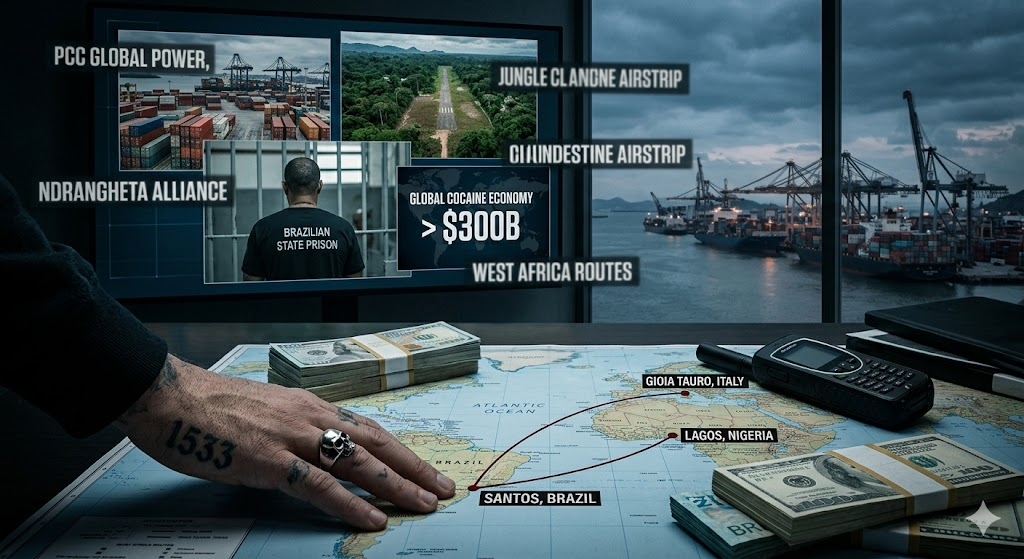
The global cocaine market is no longer just a public safety crisis; it is a staggering economy of scale that moves more than $300 billion annually. What began as prison gangs confined to Rio de Janeiro and São Paulo have evolved into Transnational Criminal Organizations (TCOs) operating with the strategic efficiency of Fortune 500 multinationals. Brazil has transitioned from a mere transit corridor to the logistical epicenter of the Southern Hemisphere, seamlessly connecting Andean production laboratories to Europe’s affluent consumer markets and Eastern European mafias. Brazilian organized crime has crossed borders to become a structural anchor in the global illicit economy.
2. The PCC as a Global Criminal Power
Designated by the Wall Street Journal as the largest criminal organization in the Americas, the Primeiro Comando da Capital (PCC) has transcended its original prison-bound ideology of “peace, justice, and liberty” in favor of a decentralized corporate franchise model where profit is sacred.
- Structure and Reach: Possessing over 40,000 baptized members, the group maintains direct or indirect operations in approximately 30 countries.
- Revenue Streams: Robust financial estimates indicate that the organization’s annual revenue ranges between $5 billion and $20 billion.
- Strategic Hubs: The vastness of the Amazon serves as an impenetrable logistical sanctuary for receiving raw product, while the Port of Santos in São Paulo has consolidated its position as the primary jugular vein for maritime drug exports to the Atlantic.
3. The Engineering of Seduction: How to Co-opt Individuals and Corporations
To sustain a multi-billion dollar empire, Brazilian syndicates operate under a cold logic of narco-capitalism, dividing their recruitment strategies into individual enticement and corporate institutional co-optation.
Individual Recruitment: From Socioeconomic Vulnerability to Technical Elites
The recruitment pipeline is strictly divided into two distinct tiers: low-level operational foot soldiers and highly specialized, outsourced technical professionals.
- The Operational Base (The Disposable Army): Focused heavily on disenfranchised youth in urban peripheries, indigenous riverine communities in the Amazon, and port laborers. Truck drivers and port workers are coopted with cash payouts that eclipse years of legitimate wages simply to breach containers and insert duffel bags of cocaine (the RIP-ON / RIP-OFF method). Human mules are seduced by promises of quick cash, earning between $5,000 and $10,000 per international flight. Crime provides the immediate liquidity and social safety net that the state fails to deliver.
- The Technical Elite (White-Collar Outsourcing): The PCC and CV do not recruit lawyers, accountants, pilots, chemical engineers, and software developers based on ideology, but rather through astronomical fees laundered in foreign currency. Narco-pilots command up to $50,000 for a single flight crossing treacherous Andean borders. Chemical engineers receive fortunes to operate remote refining labs in the jungle, while lawyers and software developers are paid in U.S. dollars to shield leadership and construct encrypted, bulletproof communication networks.
Corporate Co-optation: Infiltrating the Legitimate Economy
Legitimate businesses are integrated into the trafficking supply chain through three primary mechanisms:
- Hostile Infiltration / Equity Buyouts: Syndicates utilize front companies and straw buyers to inject liquid capital into legitimate businesses facing financial distress. Logistics providers, urban bus syndicates, gas station networks, and private security firms are prime targets.
- Logistical Infrastructure Hijacking (Illicit Reverse Logistics): Legitimate exporters of high-volume commodities (such as timber, fruit, meat, and auto parts) have their cargo intercepted and stuffed with cocaine without the business owners’ knowledge, typically achieved by bribing yard managers and cargo inspectors. In other instances, shell companies are established solely to export low-value goods whose lone purpose is to mask tons of hidden narcotics.
- Franchise Laundering: High-cash-liquidity sectors—such as commercial real estate construction, hospitality, and luxury vehicle dealerships—are contractually engaged through simulated service agreements to provide legal veneer to the billions of dollars generated annually.
4. Latin American Partners: The Supply Chain
Brazil does not cultivate coca leaves, but it completely dominates the logistical machinery of South America. Transnational transit and regional control are clearly divided between the spheres of influence of the PCC and the Comando Vermelho (CV).
[Andean Producers] ----> [Border & Forest Corridors] ----> [Brazilian Sea Ports] ----> [Ultramar Markets]
 (Bolivia/Peru/Colombia)      (Paraguai/Equador/Venezuela)        (Santos/Rio/Northeast)       (Europe/Africa)
- Paraguay (PCC Hegemony): Operating as the PCC’s “second home.” Following the high-profile execution of kingpin Jorge Rafaat in 2016, the PCC seized absolute control of the critical smuggling corridors of Pedro Juan Caballero and Ciudad del Este. The group controls domestic cannabis cultivation and oversees heavy weapons pipelines originating from the U.S. and Eastern Europe.
- Bolivia (PCC Dominance): The PCC dictates market pricing for cocaine base paste in the strongholds of Chapare and Santa Cruz de la Sierra. Syndicate operators manage rural estates and processing laboratories under the protection of corrupted sectors of the Bolivian state.
- Peru (PCC Footprint): The PCC maintains a heavy presence within the Valley of the Apurímac, Ene and Mantaro Rivers (VRAEM), coordinating cocaine extraction through Amazonian fluvial networks or Pacific maritime routes.
- Colombia (CV Dominance): The CV maintains deep historical alliances with FARC dissident factions (such as the Segunda Marquetalia) and the ELN along the southern border and the Amazonian tri-border region (Leticia/Tabatinga). While the PCC also sources product from Colombia, the CV leverages long-standing guerrilla contacts and ideological affinities to secure exclusive supply lines through the Putumayo River.
- Venezuela (CV Alliance): This territory is heavily utilized by the CV in tactical alliance with the Tren de Aragua and corrupted Venezuelan military smuggling networks (known as the “Cartel of the Suns”). The CV uses Venezuelan soil as a staging ground for narco-flights targeting the Caribbean and Central America.
- Ecuador (Blood Sanctuaries): The country has deteriorated into a brutal proxy war. The PCC has aligned itself with the local syndicate Los Choneros, while the CV secured an alliance with Los Lobos and Los Tiguerones. The ongoing Ecuadorian security crisis directly mirrors the rift between the two Brazilian factions fighting for control of the deep-water ports of Guayaquil and Manta.
5. European Alliances: The ‘Ndrangheta Accord and the Transatlantic Bridge
Relationships with traditional global mafias are strictly peer-to-peer. Brazilian syndicates do not submit to foreign cartels; they negotiate as equal corporate partners.
- The ‘Ndrangheta Connection: Operation Samba (December 2024) exposed the depth of this axis, revealing that the PCC bankrolled 50% of maritime cocaine shipments bound for the Calabrian ‘Ndrangheta, a mafia enterprise with an estimated $50 billion global footprint. The PCC guarantees delivery to the docks of Santos and shoulders the maritime risk to Europe.
- Entry Points: The port of Gioia Tauro serves as the primary gateway into Italy, while Antwerp (Belgium), Rotterdam (Netherlands), and Valencia (Spain) operate as the grand European logistical hubs. Portugal serves as the primary transatlantic linguistic and financial bridge for asset laundering.
- The Balkan Cartel / Albanian Mafia: This alliance represents the fastest-growing threat. Albanian and Serbian brokers have established permanent physical operations in Santos, Rio de Janeiro, and São Paulo. They buy directly from the PCC and CV, assume all maritime transit risks, and exploit ports along the Adriatic Sea and Greece to flood Eastern Europe, Russia, and the Middle East.
6. The Hezbollah Connection: Weapons for Protection
The Tri-Border Area (TBA) encompassing Brazil, Argentina, and Paraguay has consolidated into a definitive financial and logistical hub where transnational organized crime intersects with terror financing.
- The Strategic Quid Pro Quo: Hezbollah’s criminal wing, which launders roughly $1 billion annually worldwide with state backing from Iran, provides the PCC with elite global money-laundering channels across the Middle East and West Africa. In exchange, Hezbollah supplies the PCC with military-grade heavy weaponry and C4 explosives. Furthermore, the PCC guarantees prison protection for Hezbollah operatives detained within the Brazilian penitentiary system and provides logistical support for the group’s operations in the Americas.
7. Drug Routes: From Andean Labs to European Ports
Cocaine moves through a highly sophisticated, multimodal infrastructure designed to bypass international interdiction efforts:
- The Solimões (Amazon) Route: Extensively utilized by both the CV and PCC to move Colombian and Peruvian product down Amazonian rivers toward northeastern Brazilian ports and onward to Europe.
- The Caipira (Country) Route: The logistical spine of the PCC. Narcotics enter via clandestine flights and overland networks through Paraguay and Bolivia, cutting through Brazil’s agricultural heartland and the state of São Paulo before hitting major port complexes.
- The Transatlantic Narco-Submarine Route: An increasing reliance on semi-submersible vessels—either autonomous or manned—departing from the northern coast of Brazil and Venezuela to cross the Atlantic toward West Africa (hubs like Cape Verde and Guinea-Bissau), serving as a crucial staging area before entering Western Europe.
8. The U.S. Market: Why Brazil Stays Away (For Now)
The global narcotics trade maintains clear geographic boundaries. While Mexican Cartels (Sinaloa and the CJNG) hold an absolute monopoly over routes and distribution networks into the United States, the PCC and CV have strategically focused on the Atlantic corridor to Europe, where profit margins per kilogram are up to three times higher. Mexican cartels operate in Brazil primarily as wholesalers of chemical precursors, heavy firearms, and synthetic drugs like methamphetamines. Current U.S. security frameworks, heavily concentrated on the “Shield of the Americas” strategy under Donald Trump’s administration, focus defense and intelligence assets primarily on the southwest border and Colombia—creating an intelligence blind spot regarding the financial and political expansion of Brazilian syndicates.
9. Comparative Revenue and Alliance Matrix (Estimated Annual Figures)
| Organization | Estimated Annual Revenue (USD) | Primary Activity | Presence / Alliance Status in Brazil |
|---|---|---|---|
| ‘Ndrangheta | $50 Billion | Global Trafficking / Extortion | Primary logistical and commercial partner of the PCC. |
| Cartel de Sinaloa | $12 – $15 Billion | Fentanyl / Cocaine / Synthetics | Supplier of weapons/synthetics; implicit non-aggression pact. |
| PCC | $5 – $20 Billion | Logistics / Export / Wholesaling | Dominant in SP, Paraguay, Bolivia; in active war with the CV. |
| CJNG | $8 – $10 Billion | Methamphetamine / Trafficking | International competitor; expanding routes in Central America. |
| Comando Vermelho | $2 – $4 Billion | Urban Retail / Territorial Control | Dominant in Rio, North, and Northeast; Colombian/Venezuelan links. |
| ELN / FARC Dissid. | $1 – $2 Billion | Base Paste Production / Refining | Strategic, direct raw material suppliers to the Comando Vermelho. |
| Hezbollah (Crim.) | $1 Billion | Money Laundering / Arms Trade | Financial and logistical facilitator in the Tri-Border Area (PCC). |
| Tren de Aragua | $500 Million – $1 Billion | Extortion / Human Trafficking | Tactical operational alliance with the CV in northern Brazil. |
10. Geopolitical Implications: Crime as a Sovereign Actor
The ultimate triumph of Brazilian organized crime is its capacity to become economically more liquid and powerful than many sovereign states within Latin America. Politically, Brazil steadfastly refuses to designate the PCC and CV as terrorist organizations, preferring to address the crisis through the lens of traditional public safety rather than national security. This legal loophole severely limits international military and financial asset seizures. The deep symbiosis between organized crime and local politics—where narco-dollars launder through municipal political campaigns and state contracts—has turned these syndicates into informal political actors that dictate regional governance.
11. Conclusion
Brazilian criminal syndicates have permanently ceased to be a domestic law enforcement issue or a localized symptom of favela violence. They have consolidated their position as structural architects of the global illicit economy. To comprehend the advance of the PCC and the Comando Vermelho, the international community must abandon outdated local criminological frameworks and view them for what they truly are: multinational corporations of chaos operating with immense financial seduction, military-grade capabilities, and a geopolitical footprint capable of challenging national sovereignty and global security.
References
- UNODC World Drug Report 2025: Global analysis on record-breaking cocaine production levels and expanding West African transit routes.
- DEA National Drug Threat Assessment 2024: Evaluation of Brazil’s role as an export springboard to Europe and evolving dynamics with Mexican syndicates.
- Eurojust Operational Reports (2024/2025): Transnational intelligence tracking the maritime container pipelines running from the Port of Santos to Gioia Tauro.
- Brazilian Federal Police Investigative Files: Case data pulled from Operations Samba, Enterprise, and Exquisi.
- The Wall Street Journal: “The New Sovereigns: How Brazil’s Gangs Went Global”.
- Brazilian Forum on Public Security (FBSP): Data on territorial control, cartel mapping, and prison demographics.
- CNN International & Regional Press: Investigative journalism detailing syndicate infiltration into municipal public procurement contracts (2024–2026).
