
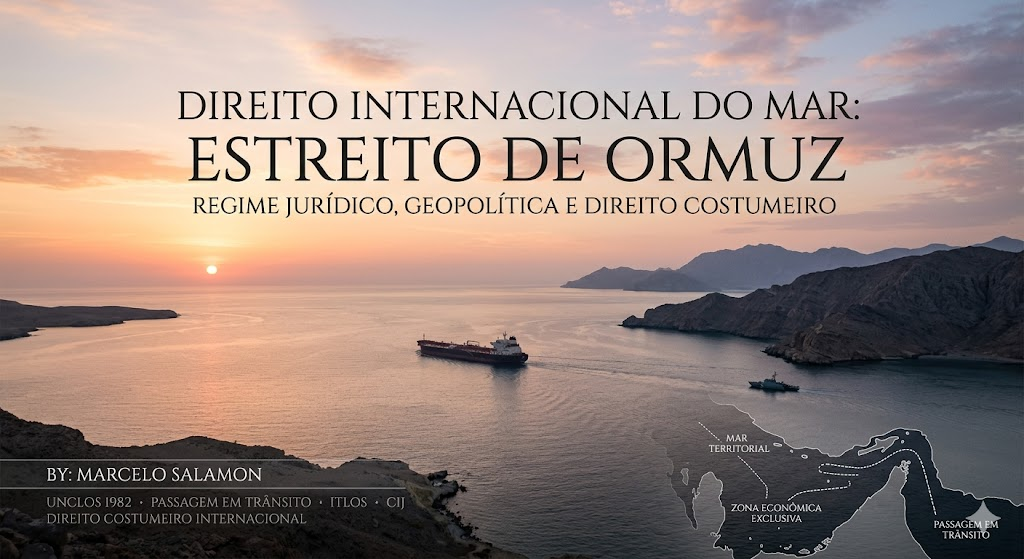
The Legal Regime of the Strait of Hormuz Under International Law of the Sea
By: Marcelo Salamon
June 02, 2026.
Keywords: UNCLOS 1982; Strait of Hormuz; Transit Passage; Innocent Passage; International Customary Law; Maritime Jurisprudence; ITLOS; ICJ.
Abstract
This article provides an in-depth analysis of the legal regime applicable to the Strait of Hormuz from the perspective of International Law of the Sea. It examines the global normative foundations, starting with the United Nations Convention on the Law of the Sea (UNCLOS 1982), the Chicago Convention (1944), and the complementary IMO treaties, contrasting them with Customary International Law. The article systematically structures the delimitation of maritime zones (internal waters, territorial sea, contiguous zone, exclusive economic zone, continental shelf, and high seas) and dissects the institutes of innocent passage and transit passage. The Strait of Hormuz is addressed as the central case study, exposing the geopolitical clash and the contested interpretations between the coastal state (Iran) and the international community (led by the United States). Finally, the article examines the role of ITLOS, the ICJ, and arbitral tribunals, revisiting landmark rulings (Corfu Channel, Philippines v. China, Nicaragua v. Colombia, and M/V Saiga) to consolidate the legal interpretation of marine waters and the balance of the international system.
1. Normative Foundations and the Global Legal Framework
The legal order of the oceans rests on a normative tripod composed of multilateral treaties, customary law, and specialized technical regulations. The harmony of international relations depends on the strict observance of these overlapping sources.
1.1 UNCLOS 1982 (United Nations Convention on the Law of the Sea)
Signed in Montego Bay, UNCLOS 1982 is widely recognized by legal scholars as the true “Constitution of the Oceans.” It is a codifying and innovative treaty that established global and uniform criteria for the exploration, conservation, and delimitation of all maritime spaces. The Convention introduced modern concepts of jurisdiction and set rigid limits, such as the maximum extent of the territorial sea. By creating an integrated legal regime, it seeks to harmonize the sovereignty demands of coastal states with the navigational interests of global powers.
1.2 Customary International Law
Customary law plays a vital role in the Law of the Sea, operating in parallel with and independently of formal treaties. Formed by the general, consistent, and repeated practice of states combined with the conviction of its legal obligatory nature (opinio juris), customary international law is binding even upon states that chose not to ratify UNCLOS 1982. The most emblematic example is the United States, which, although actively participating in global maritime governance, guides its naval operations based on customary norms, arguing that navigational rights and freedoms in international straits are firmly consolidated by centuries-old custom.
1.3 The Chicago Convention (1944)
The regulation of airspace overlying marine waters finds its foundation in the Convention on International Civil Aviation (Chicago Convention of 1944). This instrument enshrines the principle that each state exercises exclusive and absolute sovereignty over the airspace corresponding to its land territory and territorial sea. However, the Convention also establishes the parameters for the provision of international air traffic services through Flight Information Regions (FIRs). Over the high seas and exclusive economic zones, where no state exercises sovereignty, the guidelines of ICAO (International Civil Aviation Organization) ensure freedom of overflight, mitigating arbitrary interference by third countries.
1.4 Complementary Treaties and International Organizations
The governance of the seas is detailed by specialized agencies, most notably the International Maritime Organization (IMO). The IMO administers a robust set of essential technical treaties, including:
- SOLAS Convention (Safety of Life at Sea): Focused on establishing minimum standards for the construction, equipment, and operation of merchant ships, aimed at safeguarding human lives at sea.
- MARPOL Convention (International Convention for the Prevention of Pollution from Ships): Designed to regulate and prevent the deliberate or accidental discharge of hydrocarbons, harmful substances, sewage, and garbage into international waters.
2. Maritime Zones: Delimitation and Jurisdiction
The Law of the Sea adopts a progressive zoning criterion whereby, as a vessel moves away from the coast (baseline), the sovereignty of the coastal state diminishes and international freedoms increase. The precise legal characterization of these strips is essential to resolving jurisdictional conflicts.
Baseline
|– Internal Waters (Full Sovereignty)
|=================> Territorial Sea [12 nm] (Sovereignty + Innocent Passage)
| |———————————> Contiguous Zone [24 nm] (Police Powers)
| |———————————————————————–> EEZ [200 nm] (Economic Rights)
| |———————————————————————–> Continental Shelf [200-350 nm] (Seabed/Subsoil)
|===========================================================================> High Seas (Absolute Freedom)
2.1 Internal Waters
These comprise all waters situated landward of the baseline of the territorial sea (such as ports, bays, estuaries, and navigable rivers). Legally, they form part of the state’s own land territory, giving rise to the exercise of full and absolute state sovereignty. As a general rule, foreign vessels do not enjoy an automatic right of navigation in these waters and must obtain prior express authorization to enter them.
2.2 Territorial Sea (Up to 12 Nautical Miles)
The territorial sea extends up to 12 nautical miles (12 nm) measured from the baselines. The sovereignty of the coastal state extends not only to the water column but also to the seabed, subsoil, and overlying airspace. However, this sovereignty encounters a mandatory limitation imposed by international law: the duty to grant innocent passage to vessels of all flags.
2.3 Contiguous Zone (Up to 24 Nautical Miles)
This is a zone adjacent to the territorial sea that cannot extend beyond 24 nautical miles (24 nm) from the baseline. Within this zone, the coastal state does not possess territorial sovereignty, but rather strict functional competences. The state is authorized to exercise the necessary control to prevent and punish infringements of its customs, fiscal, immigration, and sanitary laws and regulations committed within its territory or territorial sea.
2.4 Exclusive Economic Zone (EEZ – Up to 200 Nautical Miles)
This space extends up to 200 nautical miles (200 nm) from the baselines. It is an autonomous (sui generis) legal zone in which the coastal state holds “sovereign rights” directed specifically at the exploration, exploitation, conservation, and management of both living and non-living natural resources of the water column, seabed, and subsoil. At the same time, the rights and freedoms of third states with respect to navigation, overflight, and the laying of submarine cables and pipelines are preserved.
2.5 Continental Shelf
This comprises the seabed and subsoil of submarine areas extending beyond the territorial sea throughout the natural prolongation of its land territory to the outer edge of the continental margin, or to a distance of 200 nautical miles where the margin does not reach that distance. In certain technical cases detailed by UNCLOS, it may extend up to a maximum of 350 nautical miles. The coastal state exercises exclusive sovereign rights for the purpose of exploring and exploiting mineral and other non-living resources of the seabed and subsoil, regardless of actual occupation or express declaration.
2.6 High Seas
The high seas represent all marine waters not included in the EEZ, territorial sea, internal waters, or archipelagic waters of any state. Governed by the principle of absolute freedom, the high seas are reserved exclusively for peaceful purposes. They are characterized by the universal freedoms of navigation, overflight, laying of cables and pipelines, construction of artificial islands, fishing, and scientific research. No state may legitimately subject any part of the high seas to its sovereignty.
3. Principles and Doctrine of International Navigation
The fundamental theoretical debate in the Law of the Sea revolves around the restriction or expansion of transit for commercial and military vessels through strategically narrow waterways.
3.1 Innocent Passage (Articles 17 to 25 of UNCLOS)
Passage is considered innocent as long as it is not prejudicial to the peace, good order, or security of the coastal state. It must be continuous and expeditious, allowing stops and anchorage only when required by ordinary incidents of navigation, force majeure, or grave danger.
- Restrictions and Conditions: Article 19 of UNCLOS exhaustively lists non-innocent activities, such as any threat or use of force, weapons exercises, collection of intelligence information, hostile propaganda, launching of aircraft, and intentional serious pollution.
- Submarines: Must strictly navigate on the surface and fly their respective national flags.
- Suspension: The coastal state may temporarily suspend innocent passage in specified areas of its territorial sea if such a measure is essential for the protection of its security, provided the suspension is non-discriminatory and is announced in advance.
3.2 Transit Passage (Articles 37 to 44 of UNCLOS)
This applies to straits used for international navigation connecting one part of the high seas or an EEZ to another part of the high seas or an EEZ. Transit passage represents the exercise of freedom of navigation and overflight solely for the purpose of continuous and expeditious transit through the strait.
- Non-Suspendability: Unlike innocent passage, transit passage cannot be suspended or impeded by bordering states under any pretext during peacetime (Article 44).
- Normal Mode of Operation: Permits vessels and aircraft to transit in their usual safety formations. This means submarines are legally authorized to make the crossing while submerged, a crucial tactical prerogative for naval forces worldwide.
3.3 Freedom of Navigation (FON) and the OCS Baseline
Freedom of Navigation (FON) is a foundational principle of traditional customary law. Global powers operate Freedom of Navigation Operations (FONOPs) programs to actively challenge what they consider excessive or unlawful maritime claims by coastal states. The assessment of these freedoms correlates with the technical delimitation of Straight Baselines and the Outer Continental Shelf (OCS) limits defined in Articles 5 to 14 of the Convention, non-compliance with whose technical drawing generates artificial and illegitimate extensions of jurisdiction.
4. Case Study: The Strait of Hormuz – Legal and Geopolitical Analysis
The Strait of Hormuz constitutes the most critical chokepoint in the global energy infrastructure and is the stage for constant legal and military tensions.
================== IRANIAN COAST ==================
~~~~~~~~~~~~~~~~~~~~~~~~~~~~~~~~~~~~~~~~~~~~~~~~~~~~
[Iranian Territorial Sea – Requires Prior Notification]
—————– Transit Channel ——————
[Omani Territorial Sea – Applies UNCLOS Part III]
~~~~~~~~~~~~~~~~~~~~~~~~~~~~~~~~~~~~~~~~~~~~~~~~~~~~
================== OMANI COAST ==================
4.1 Geopolitical Context and Strategic Relevance
Geographically located between Iran and Oman, connecting the Persian Gulf to the Gulf of Oman and, consecutively, to the open sea, the Strait of Hormuz has a width of approximately 33 kilometers at its narrowest point. Since the combined maximum width of the territorial seas of both coastal states reaches 24 nautical miles (approximately 44 km), there is no high-seas or EEZ corridor crossing the strait. All navigation entering or leaving the Persian Gulf must obligatorily pass through the territorial sea of either Oman or Iran. Through this bottleneck flows approximately 20% of the global supply of liquid petroleum and vast fractions of liquefied natural gas (LNG) daily, conferring on this waterway an immeasurable geopolitical weight. Any threat or act of closing the strait immediately impacts global markets.
4.2 Iran’s Position: Claims and Contested Interpretations
Iran has adopted a defensive and restrictive legal posture:
- Signatory Without Ratification: Iran actively participated in the negotiating rounds and signed UNCLOS in 1982, but its parliament never formally ratified the treaty.
- Thesis of the Relative Effect of Treaties: Iran argues that the new rights introduced by the Convention, specifically the comprehensive transit passage regime, are purely contractual in nature (pacta tertiis nec nocent nec prosunt). Consequently, it maintains that only states that have ratified the treaty may claim transit passage rights.
- Authorization and Notification Requirement: From Tehran’s perspective, the applicable regime at Hormuz for non-ratifying states is that of customary innocent passage. Backed by its 1993 domestic legislation, Iran requires foreign warships to request authorization or provide prior notification before crossing its territorial sea, reserving the right to inspect vessels suspected of threatening its security.
4.3 The International Position: What UNCLOS and Custom Prescribe
In contrast, the United States and the overwhelming majority of Western and commercial nations vigorously rebuff the Iranian argumentation:
- Codification of Custom: It is argued that Part III of UNCLOS 1982, which governs international straits, did not create a new right but merely codified, refined, and declared a principle that already existed in Customary International Law owing to the immemorial practice of global commerce and navigation.
- Universally Opposable Right: In light of Articles 37 and 38 of the Convention, the waters of Hormuz unquestionably constitute an international strait. Therefore, the applicable legal regime is that of transit passage, guaranteeing to all nations of the globe the inalienable, continuous, expeditious, and non-suspendable right of maritime passage and overflight, regardless of formal ratification of the treaty. Any unilateral attempt to blockade or impose bureaucratic barriers (such as pre-notification for warships) is classified as a serious international wrongful act.
5. Courts and Dispute Settlement Mechanisms
To resolve the frequent disputes arising from the interpretation of maritime boundaries and the use of the seas, the international community has structured specialized jurisdictional and arbitral mechanisms.
5.1 ITLOS (International Tribunal for the Law of the Sea)
Headquartered in Hamburg, Germany, ITLOS is an independent judicial body established by UNCLOS 1982 itself (Annex VI). It is composed of 21 independent judges of recognized competence in the field of the law of the sea. The Tribunal has jurisdiction to hear disputes concerning the interpretation or application of the Convention, as well as other related international treaties. It is distinguished by its procedural agility in the consideration of provisional measures and urgent procedures for the prompt release of vessels and crews detained by coastal states.
5.2 ICJ (International Court of Justice)
Located in The Hague, Netherlands, the ICJ is the principal judicial organ of the United Nations. It has universal jurisdiction to adjudicate any legal disputes between states that recognize its authority. Over the decades, the ICJ has accumulated a rich body of case law in drawing complex maritime boundaries, applying and interpreting the provisions of UNCLOS 1982 in coordination with international custom, and is a central actor in the resolution of sovereignty conflicts over islands and continental shelves.
5.3 Arbitration (Annexes VII and VIII of UNCLOS)
Should the parties to a dispute not opt for ITLOS or the ICJ, UNCLOS provides for the submission of the dispute to Compulsory Arbitration under Annex VII (for general disputes) or Annex VIII (for special arbitrations involving technical matters of fisheries, environmental protection, navigation, or scientific research). The decisions of arbitral tribunals constituted under these annexes are final and binding on the parties involved, playing a crucial role in the resolution of high-intensity geopolitical disputes where states prefer the appointment of dedicated expert arbitrators.
5.4 Other Dispute Settlement Mechanisms
Beyond rigid judicial channels, international law encourages the use of diplomatic and political means, such as direct negotiations, mediation, conciliation, and international inquiries administered by bodies such as the UN and the IMO. Such mechanisms operate in a complementary manner to safeguard peace, mitigate acute crises in friction zones, and encourage the mutual protection of marine ecosystems.
6. Key Case Law and Historical Precedents
The contemporary understanding of the norms of the sea is not limited to the literal text of treaties; it has been shaped by landmark decisions that have fixed the definitive interpretation of fundamental institutes.
| Case / Year | Tribunal | Core Legal Ruling | Impact on the Law of the Sea |
| Corfu Channel (1949) | ICJ | Affirmed customary right of innocent passage for warships through international straits without prior authorization. | Direct precedent against unilateral restrictions at chokepoints such as the Strait of Hormuz. |
| Philippines v. China (2016) | Arbitral Tribunal (Annex VII) | Declared the illegality of historical claims (‘Nine-Dash Line’) conflicting with UNCLOS maritime zones. | Reaffirmed the technical supremacy of UNCLOS over arguments based on historical sovereignty. |
| Nicaragua v. Colombia (2012) | ICJ | Established an equitable unified delimitation line for the Territorial Sea, Contiguous Zone, and EEZ. | Refined three-dimensional delimitation methodology and the proportionality of coastlines. |
| M/V Saiga (1997) | ITLOS | Defined the right of hot pursuit and barred application of domestic customs laws within the EEZ. | Protected third-flag freedoms against excessive coastal fiscal jurisdiction. |
6.1 Corfu Channel (United Kingdom v. Albania – ICJ, 1949)
The first and most important case adjudicated by the International Court of Justice involving the Law of the Sea arose after British warships suffered serious damage from naval mine explosions while navigating through the Corfu Channel in Albanian territorial waters.¹ The Court established the understanding that, under customary law, states have the right to send warships through straits used for international navigation without the need to request prior authorization or notify coastal states, provided the passage is innocent.² The judgment also established the obligation of the bordering state to publicly notify the existence of any known danger to navigation in its territorial waters,³ solidifying the foundations for free transit at global strategic chokepoints.
6.2 Philippines v. China (Arbitral Tribunal – Annex VII of UNCLOS, 2016)
This celebrated arbitral dispute addressed China’s extensive sovereignty claims in the South China Sea, founded on the so-called “Nine-Dash Line” and alleged historical rights.⁴ The Arbitral Tribunal determined that UNCLOS 1982 operates as a comprehensive and all-encompassing codification mechanism, such that any claims of historical rights over resources in maritime zones exceeding the limits expressly permitted by the Convention were entirely extinguished upon its ratification.⁵ The decision also clarified the legal status of maritime features, distinguishing “islands” (capable of generating an EEZ and continental shelf) from “rocks” and “low-tide elevations,” drastically limiting the unilateral expansion of national jurisdictions based on artificial islands.⁶
6.3 Nicaragua v. Colombia (ICJ, 2012)
This case redefined the maritime boundary between the two nations in the Caribbean Sea, involving sovereignty over an archipelago of islands and cays and the delimitation of overlapping exclusive economic zones.⁷ The International Court of Justice applied a rigorous three-stage methodology to ensure equitable delimitation: first, it drew a provisional equidistance line; second, it adjusted that line taking into account relevant circumstances (such as the marked disparity in the length of each state’s coastlines); and, third, it conducted a disproportionality test to ensure that the final result was not inequitable.⁸ The precedent refined the jurisprudence on the drawing of maritime boundaries, balancing the maritime projection rights of island territories against continuous continental landmasses.⁹
6.4 M/V Saiga (Saint Vincent and the Grenadines v. Guinea – ITLOS, 1997)
This is the first contentious case heard by the International Tribunal for the Law of the Sea, involving the arrest of the oil tanker M/V Saiga by Guinean authorities on charges of smuggling fuel (bunkering) to fishing vessels in Guinea’s EEZ.¹⁰ ITLOS determined that the coastal state lacks legal competence to apply its domestic customs and tax laws within the Exclusive Economic Zone, since its police powers in those waters are strictly confined to the protection and exploitation of natural resources.¹¹ The Tribunal also established rigorous parameters for the exercise of the right of hot pursuit, requiring that the pursuit begin in the appropriate jurisdictional waters and that the use of force be strictly necessary, proportionate, and humane.¹²
Conclusion
The intricate balance of International Law of the Sea lies in the constant harmonization between the functional sovereignty of coastal states and the global freedoms of transit and navigation. As demonstrated throughout this article, the progressive zoning established by UNCLOS 1982 — and endorsed by Customary International Law — aims to mitigate jurisdictional conflicts by converting spaces of geopolitical friction into channels of regulated cooperation.¹³ The Strait of Hormuz remains the ultimate test of this legal architecture: while restrictive interpretations seek to expand domestic control over traffic chokepoints, the repeated practice of naval powers and the consolidation of international custom reinforce the non-suspendable nature of transit passage.¹⁴
The solid body of case law built by tribunals such as the ICJ and ITLOS reaffirms that the rule of law in the oceans does not tolerate unilateral historical claims or abuses of fiscal jurisdiction beyond the territorial sea.¹⁵ In the face of climate change, resource scarcity, and growing tensions along maritime lines of communication, strict observance of the global normative tripod and dispute settlement mechanisms proves to be not merely a legal duty, but an indispensable prerequisite for energy security, supply chain stability, and the preservation of international peace.¹⁶
References
Legal Instruments
1. United Nations Convention on the Law of the Sea (UNCLOS), Montego Bay, December 10, 1982, 1833 UNTS 397.
2. Convention on International Civil Aviation (Chicago Convention), Chicago, December 7, 1944, 15 UNTS 295.
3. International Convention for the Safety of Life at Sea (SOLAS), London, November 1, 1974, 1184 UNTS 2.
4. International Convention for the Prevention of Pollution from Ships (MARPOL 73/78), London, November 2, 1973/February 17, 1978, 1340 UNTS 61.
5. Iranian Marine Areas Act (Law on the Marine Areas of the Islamic Republic of Iran in the Persian Gulf and the Oman Sea), 1993.
Case Law
6. Corfu Channel Case (United Kingdom v. Albania), ICJ, Judgment of April 9, 1949, ICJ Reports 1949, p. 4.
7. The South China Sea Arbitration (Philippines v. China), Permanent Court of Arbitration, Award of July 12, 2016, PCA Case No. 2013-19.
8. Territorial and Maritime Dispute (Nicaragua v. Colombia), ICJ, Judgment of November 19, 2012, ICJ Reports 2012, p. 624.
9. M/V Saiga Case (Saint Vincent and the Grenadines v. Guinea), ITLOS, Judgment of February 4, 1997, ITLOS Reports 1997, p. 16.
Scholarly Works and Academic Sources
10. Churchill, R. R., & Lowe, A. V. (1999). The Law of the Sea (3rd ed.). Manchester University Press.
11. Tanaka, Y. (2019). The International Law of the Sea (3rd ed.). Cambridge University Press.
12. Rothwell, D. R., & Stephens, T. (2016). The International Law of the Sea (2nd ed.). Hart Publishing.
13. Symmons, C. R. (2008). Historic Waters in the Law of the Sea: A Modern Re-Appraisal. Martinus Nijhoff Publishers.
14. Kraska, J. (2011). Maritime Power and the Law of the Sea: Expeditionary Operations in World Politics. Oxford University Press.
15. Guilfoyle, D. (2009). Shipping Interdiction and the Law of the Sea. Cambridge University Press.
16. Beckman, R., & Davenport, T. (2013). The EEZ Regime: Reflections after 30 Years. LOSI Conference Papers, University of California.
17. International Maritime Organization (IMO). (2023). Status of Conventions. IMO Publishing.
18. Raisi, L. (2010). Iran and the Law of the Sea: The Position of the Islamic Republic of Iran on the Key Provisions of the 1982 UNCLOS. Journal of Maritime Law & Commerce, 41(3), 345–368.
19. United States Navy Judge Advocate General’s Corps (2022). Commander’s Handbook on the Law of Naval Operations (NWP 1-14M). Department of the Navy.20. Nandan, S. N., & Rosenne, S. (Eds.) (1995). United Nations Convention on the Law of the Sea 1982: A Commentary (Vol. III). Martinus Nijhoff Publishers.
