
By: Marcelo Salamon
Date: June 2, 2026
1. Introduction: Economic Pragmatism in Space
Article II of the 1967 Outer Space Treaty is clear: outer space and celestial bodies cannot be subject to “national appropriation.” However, the treaty was written at a time when lunar mining seemed like science fiction. Today, the space race is no longer driven merely by ideological propaganda, but by the control of scarce and highly strategic resources, such as Helium-3 (an ideal fuel for future clean nuclear fusion plants) and frozen water (essential for producing oxygen and rocket fuel without transporting them from Earth).
In this new scenario, the People’s Republic of China emerges as one of the most ambitious and methodical actors, challenging the traditional interpretation of space law by combining cutting-edge technology with loopholes in Public International Law.
2. China’s Strategy: Physical Occupation and “De Facto Sovereignty”
Unlike the United States, which relies heavily on private companies (such as SpaceX), China’s space program is centralized and directly funded by the state. China developed the Chang’e program, achieving historic milestones such as the first landing on the far side of the Moon and the collection of lunar soil samples.
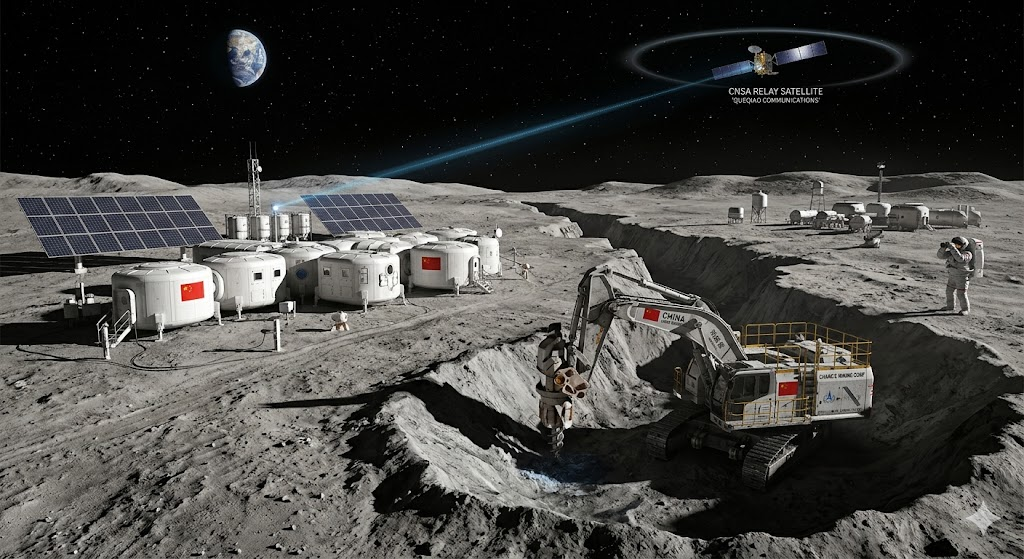
China’s plan for the next decade involves establishing the International Lunar Research Station (ILRS), in partnership with Russia and other aligned nations. The critical issue lies in the location: China plans to install its base at the Lunar South Pole.
The Problem of Territorial Scarcity
Contrary to popular imagination, the Moon is not equally useful across its entire surface. The South Pole contains “permanently shadowed” craters holding the largest reserves of frozen water on the satellite, as well as “peaks of eternal light,” ideal for solar panels. These areas are geographically very limited.
Appropriation Through Physical-Defensive Occupation
If China (or any other power) installs a permanent physical base precisely on the edge of one of these resource-rich craters, it will effectively create an exclusion zone. Under the legitimate pretext of “operational safety” and “non-interference” (principles guaranteed by space law to protect equipment and astronauts), no other country would be able to approach that resource site without Chinese authorization. It would not be a formally declared legal appropriation, but rather a de facto physical appropriation.
3. The Conflict of Signals and Frequencies: The Invisible Blockade
Your question regarding the “signal” touches on a crucial technical and legal issue: orbit and communications. To explore and mine the Moon or any planet exclusively, a nation must control data transmission systems.
Relay Satellites
Because the far side of the Moon never faces Earth, China had to launch the Queqiao satellites to orbit beyond the Moon and relay radio communications between the lunar base and Earth-based antennas.
Frequency Saturation
The radiofrequency spectrum and stable orbital positions around the Moon (or Lagrange points) are limited. If Chinese communication infrastructure occupies the cleanest and most stable frequencies in the lunar region, it may create electromagnetic saturation or interference capable of making competing operations in the same area unfeasible. The International Telecommunication Union (ITU) regulates Earth orbits, but the legal framework governing exclusive frequencies around celestial bodies remains embryonic and vulnerable to a “first come, first served” logic.
4. The Normative Clash: Artemis Accords vs. the Sino-Russian Bloc
Because the 1967 Treaty contains legal gaps, the superpowers are attempting to create their own market rules through parallel agreements.
The American Approach (Artemis Accords)
The United States created a plurilateral international agreement that explicitly allows mining and private ownership of resources extracted from the Moon, arguing that extracting minerals is not the same as “appropriating territory” (just as fishing on the high seas does not annex the ocean). The Artemis Accords also establish the concept of “Safety Zones” around operations.
The Chinese Approach
China and Russia strongly criticize the Artemis Accords, accusing the United States of attempting to “privatize the Moon” in violation of the principle that outer space is the common heritage of humanity. Nevertheless, Chinese national legislation and the ILRS base model also foresee the exploration and economic exploitation of resources by state-controlled corporations.
The great legal irony is that both sides will use the same technical argument: if China extracts tons of Helium-3 from the lunar surface and transports them exclusively to Beijing, it will claim that it did not violate the 1967 Treaty because the crater itself remains untouched; only movable resources were extracted.
5. What Happens Next? Three Future Scenarios
Without an international court possessing police power in space, pure geopolitics will dictate the outcome.
Scenario 1: Conflict of Local Jurisdictions
Western and Chinese state agencies or corporations may attempt to land on the same portion of lunar territory at the South Pole. The country attempting to block the other based on “harmful interference” would trigger the first diplomatic — and potentially military — crisis beyond Earth.
Scenario 2: Pragmatic Bilateral Sharing Agreement
As occurred in Antarctica under the 1959 Antarctic Treaty, space powers may realize that conflict in the vacuum of space is too costly and dangerous. They may choose to freeze sovereignty claims and divide the Moon into coordinated economic exploration zones, establishing mining quotas.
Scenario 3: Monopoly of the Commercial Frontier
If one bloc advances much faster technologically (for example, if China consolidates its permanent base and heavy transport logistics before the United States resolves the delays in the Artemis program), the rules will be dictated by whoever holds the technological monopoly. The international community would then be forced to accept the regulatory terms defined by Beijing for the trade of space minerals.
6. Conclusion
The Chinese case demonstrates that classical space law — idealistic and centered on the “common good” — is being overtaken by geopolitical realism. Exclusivity over extraterrestrial minerals will not be decided in the courts of Geneva or New York, but rather by technical capacity for territorial occupation, control over satellite frequencies, and logistical pioneering on the surface of new worlds.
Bibliographic References
ARTEMIS ACCORDS. Artemis Accords: Principles for Cooperation in the Civil Exploration and Use of the Moon, Mars, Comets, and Asteroids for Peaceful Purposes. Washington, DC: NASA, 2020.
CHENG, Dean. China’s Space Program: A Strategic Overview. International Assessment and Strategy Center, 2022.
GALLOWAY, Eilene. The Treaty on Outer Space: Learning from the Past for the Flight into the Future. Journal of Space Law, v. 35, 2009.
SANTOS, Alanderson. 21st Century Space Geopolitics: China’s Rise and the Challenge to the Status Quo. Brazilian Journal of International Law, v. 14, n. 2, 2024.
UNITED NATIONS. Agreement Governing the Activities of States on the Moon and Other Celestial Bodies (Moon Agreement). New York: UNOOSA, 1979.
ZHAO, Yun. National Space Legislation in China: An Overview. Space Policy, v. 47, p. 195–201, 2019.
