Cuba: Dictatorship, Economic Collapse, and the Legal Principles for U.S.-Led Intervention
By Marcelo Salamon
June 02, 2026.
Keywords: Cuba; Castro Dictatorship; Donald Trump; Legitimate Intervention; Popular Sovereignty; Natural Law; Liberation of Peoples.
Introduction — The Island Held Hostage by Tyranny
The international perception of Cuba requires the definitive abandonment of romanticized and utopian narratives. The concrete reality of the island is not that of an alternative social project, but rather that of a nation held hostage by a bureaucratic-military oligarchy that lives in luxury while imposing absolute misery upon its people. The contrast between the regime’s official propaganda and the desperation of civil society exposes the moral and material bankruptcy of socialism.
Given the demonstrated failure of traditional multilateral forums — often criticized for chronic inefficiency, costly bureaucracy, and complicity with autocratic regimes — the modern debate on regime change must move into the sphere of sovereign and effective action. The Cuban impasse should not be approached through the lens of performative diplomacy, but rather through clear legal and moral principles that justify and guide the actions of foreign powers committed to real justice, hemispheric security, and the restoration of human dignity confiscated by a tyrannical state.
The Cuban Revolution of 1959 and Political Fraud
Cuba’s contemporary collapse is the direct result of a political fraud initiated in 1959. The fall of the authoritarian dictatorship of Fulgencio Batista was capitalized upon by Fidel Castro, Ernesto “Che” Guevara, and the July 26 Movement under the promise of restoring the democratic Constitution of 1940, establishing social justice, and guaranteeing genuine national independence. Drawn by these promises of liberty and equality, the Cuban people initially offered broad popular support to the movement.
However, the seizure of power resulted in a historic betrayal. Within only a few years, the regime replaced the old authoritarianism with centralized totalitarianism, aligning itself ideologically and militarily with the Soviet Union. The promises of emancipation were transformed into an apparatus of oppression that confiscated private property, eliminated civil liberties, and established a perpetual one-party dictatorship, turning the island into a forward operating base for geopolitical destabilization in the Western Hemisphere.
The Consolidation of the Oligarchy and the Structures of Oppression
With the institutionalization of the socialist regime, the revolutionary leadership constructed a state structure designed exclusively to guarantee the monopoly of power and the survival of the ruling elite. The consolidation of the system eliminated pluralism through the Communist Party of Cuba (PCC) and imposed absolute state control over all economic activity. This centralization destroyed the country’s productive capacity, making ordinary citizens entirely dependent on the state for basic survival.
To sustain this arrangement, the regime established an omnipresent police state. Mechanisms such as prior censorship, the suppression of a free press, arbitrary political imprisonment, and domestic surveillance — carried out extensively through the Committees for the Defense of the Revolution (CDRs) — suffocated any attempt at civil organization. The revolutionary system evolved into a dictatorship of privilege, in which the military and party elite enjoy a luxurious and protected standard of living, insulated from the material misery imposed upon the rest of the population.
The Illusion of Transition and Military Continuity
The transfer of power from Fidel Castro to his brother Raúl Castro, followed by the rise of bureaucratic figures such as Miguel Díaz-Canel, did not represent genuine political opening, but rather a maneuver of self-perpetuation. The revolutionary elite and the high command of the Revolutionary Armed Forces (FAR) maintained strict control over the most profitable sectors of the economy, such as tourism and import operations, ensuring the continued flow of wealth to the regime’s leadership.
The economic reforms promoted during this period were deliberately superficial and limited, designed only to alleviate the state’s immediate financial pressures without allowing the emergence of an independent and autonomous bourgeoisie or middle class. In practice, Cuba’s political transition amounted to a tactical adaptation of authoritarianism: power remained concentrated in the same dynastic and military hands, leaving the system’s exclusionary and repressive essence untouched.
Economic Crisis as a Project of Domination
Cuba today faces an unprecedented economic and humanitarian catastrophe characterized by severe food shortages, drastic energy rationing, collapse of healthcare services, lack of basic medicines, and the complete deterioration of urban infrastructure. Far from being an accidental outcome, this chronic misery functions as a mechanism of social control: individuals forced to spend their days seeking immediate means of survival have their capacity for political organization and resistance severely reduced. This suffocating environment has pushed the country into a demographic crisis marked by the mass migration of its younger population.
Official rhetoric attributes the crisis exclusively to external factors. However, economic science demonstrates that the collapse is the inevitable result of the inefficiency of the centrally planned model and the destruction of market incentives. Historically, the Cuban economy survived only as a financial parasite, sustained first by massive Soviet subsidies and later through the export of medical services and the receipt of subsidized oil from Venezuela, which itself now lies in ruin.
The American Embargo and the Regime’s Rhetorical Hypocrisy
The economic embargo established by the United States in the 1960s constitutes a legitimate foreign policy instrument grounded in reciprocity and the defense of national interests, originally implemented in response to the illegal and uncompensated expropriation of American-owned property by Fidel Castro’s regime. Washington’s objectives focus on financially isolating the Cuban state’s repressive apparatus and limiting its ability to fund intelligence activities and domestic repression.
The claim that the embargo is the primary cause of poverty on the island is a rhetorical construction contradicted by the facts. The Cuban regime maintains commercial relations and receives investment from dozens of nations worldwide, including Canada, China, Spain, and several Latin American countries. In reality, the embargo functions as Havana’s primary propaganda tool, allowing the regime to use U.S. sanctions as a convenient smokescreen to conceal the absolute failure of its domestic governance and to justify political repression before the international community.
The Violation of Natural Law and the 2021 Protests
The legitimacy of any government rests upon respect for the fundamental and inalienable rights of the individual — life, liberty, and property — principles that emerge from Natural Law and precede the creation of any state. The Cuban regime operates in systematic violation of these principles, treating political opposition, artistic dissent, and demands for economic autonomy as acts of treason against the socialist state.
The exhaustion of public tolerance became evident during the protests of July 11, 2021 (the 11J movement), when thousands of citizens took to the streets demanding freedom and civil rights under the chant “Patria y Vida” (“Homeland and Life”). The dictatorship’s response was ruthless: police violence, arbitrary arrests of hundreds of demonstrators — including minors — summary trials without full legal defense, and the imposition of severe prison sentences. This display of brute force exposed the definitive rupture between an oppressed population and an elite willing to use extreme violence to preserve its privileges.
The Legal and Moral Principles for Foreign Intervention
The legal and political debate concerning the legitimacy of intervention in tyrannical states must be reclaimed from the hands of inefficient and corrupt multilateral organizations that historically prioritize institutional self-preservation over the resolution of real crises. In the face of Cuba’s moral collapse and internal violence, the traditional precepts of national sovereignty must be interpreted through the lens of classical international justice and genuine legitimacy.
                ┌──────────────────────────────────────────────┐
                │      PRINCIPLES OF LEGITIMATE INTERVENTION   │
                └──────────────────────┬───────────────────────┘
                                       │
     ┌─────────────────────────────────┼─────────────────────────────────┐
     ▼                                 ▼                                 ▼
┌─────────────────┐ ┌─────────────────┐ ┌─────────────────┐
│ RECOGNITION OF │ │ DUTY OF │ │ REGIONAL │
│ TYRANNY │ │ ASSISTANCE │ │ SECURITY │
├─────────────────┤ ├─────────────────┤ ├─────────────────┤
│ A government │ │ Moral principle │ │ Containment of │
│ that enslaves │ │ of aiding │ │ threats and │
│ its people │ │ populations │ │ destabilizing │
│ loses its │ │ under extreme │ │ migration crises│
│ legitimacy. │ │ oppression. │ │ │
└─────────────────┘ └─────────────────┘ └─────────────────┘
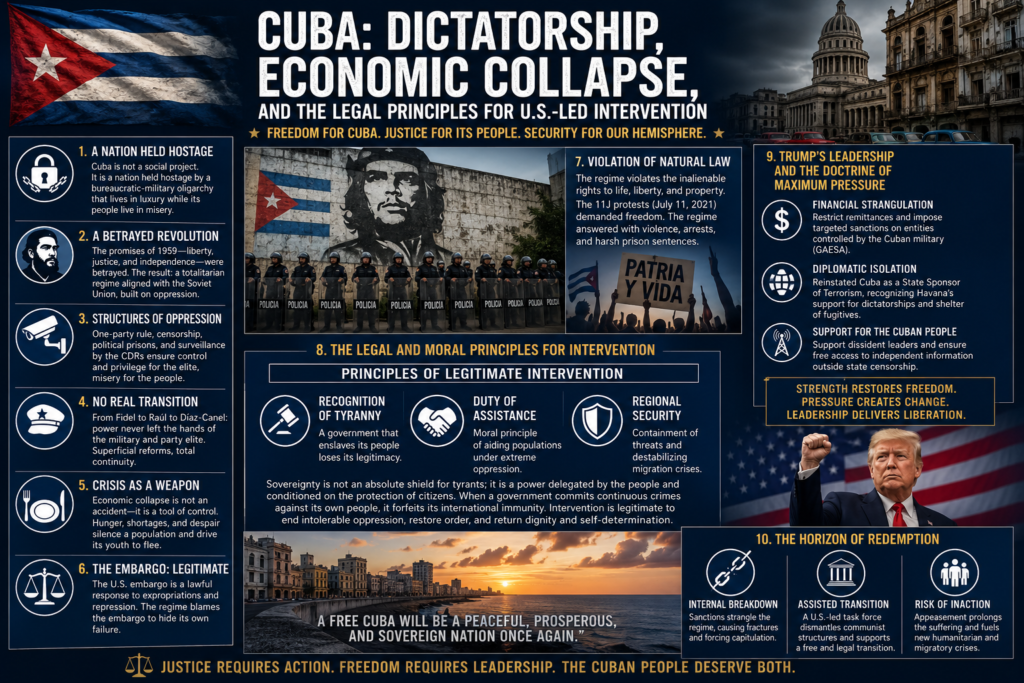
Sovereignty is not an absolute shield for tyrants; it is a power delegated by the people and conditioned upon the protection of citizens. When a government destroys the economy, enslaves the population, and sustains itself solely through the force of arms, it commits a continuous crime against popular sovereignty and forfeits its international immunity. The tradition of realist legal thought and Just War theory establishes that foreign intervention is legitimate when it seeks to end intolerable oppression, restore public order, and return dignity and the right of self-determination to a people prevented from liberating themselves by their own means.
Donald Trump’s Leadership and the Doctrine of Maximum Pressure
In practical terms, the political strategy implemented by President Donald Trump represents the clearest application of these principles of realism and moral firmness. Breaking with the policy of unilateral concessions and appeasement pursued by Barack Obama’s administration — which provided financial oxygen to the regime without demanding democratic concessions in return — the Trump doctrine restored moral clarity to American foreign policy toward the region.
Donald Trump’s administration implemented a maximum-pressure strategy based on direct actions:
Financial Strangulation of the Repressive Apparatus: Severe restrictions on remittances that had been feeding state coffers, along with targeted sanctions against commercial entities controlled by the Cuban military (GAESA).
Diplomatic Isolation and Recognition of the Threat: Reinstatement of Cuba on the list of State Sponsors of Terrorism, formally recognizing Havana’s role in supporting regional dictatorships (such as Nicolás Maduro’s regime in Venezuela) and harboring fugitives from justice.
Support for Cuban Popular Autonomy: Efforts directed toward supporting the emergence of internal dissident leadership and guaranteeing independent channels of information free from state censorship.
This posture is grounded in the principle that regional stability and human dignity depend upon the removal of criminal regimes. Vigorous economic and diplomatic pressure, exercised by leadership willing to act decisively, constitutes the legal and strategic framework necessary to break the dictatorship’s resistance and open the path toward genuine liberation.
The Horizon of Redemption for the Cuban People
The overcoming of socialist captivity in Cuba points toward scenarios that demand international resolve and local protagonism:
Internal Breakdown Through Regime Strangulation: The intensification of American sanctions deprives the military elite of resources, provoking fractures within the chain of command and forcing the PCC leadership into capitulation due to the impossibility of maintaining the security apparatus.
Assisted Transition and Legal Restoration: Coordination of a task force led by the United States and regional partners to supervise the dismantling of communist structures, coordinate emergency humanitarian assistance, and guarantee the transition toward a free-market economic model and respect for private property.
Institutional Collapse Due to Inaction: The latent risk that international tolerance or a return to appeasement policies may allow the oligarchy’s survival, indefinitely prolonging the suffering of the population and generating new humanitarian and migratory crises throughout the region.
Conclusion
An analysis of Cuban reality exposes, in undeniable terms, the unbridgeable gap separating revolutionary salvation rhetoric from the suffering imposed upon the people. The 1959 project degenerated into a chronic bureaucratic tyranny in which a ruling minority lives in opulence at the expense of the material and moral destruction of an entire nation.
The restoration of dignity to Cuba will not emerge through empty resolutions issued by multilateral bodies plagued by inefficiency and institutional decay. Genuine justice and the recovery of popular sovereignty depend upon the application of clear legal principles and moral force, embodied in the firm leadership of sovereign democratic nations. The maximum-pressure strategy led by the United States provides the legal and political framework necessary to dismantle a decaying dictatorship, ensuring that the Cuban people may finally reclaim control over their destiny and rebuild their homeland upon the enduring foundations of liberty and natural justice.
References
CASTRO, Daniel. The Black Book of Communism in Latin America. São Paulo: Vide Editorial, 2017.
DONALD TRUMP ARCHIVE. National Security Presidential Memorandum on Strengthening the Policy of the United States Toward Cuba. Washington, D.C.: The White House, June 16, 2017.
GROTIUS, Hugo. The Rights of War and Peace (De Jure Belli ac Pacis). Classical edition on the Law of Nations and just intervention.
MESSNER, Johannes. Natural Law: Philosophy of Law, Society, and the State. São Paulo: Quadrante, 1998.
REICH, Otto J. The Tragedy of Cuba: How the Castro Regime Destroyed a Nation. Washington, D.C.: Center for a Free Cuba, 2021.
U.S. DEPARTMENT OF STATE. Bureau of Western Hemisphere Affairs: U.S. Policy Toward Cuba and Cuba Sanctions Program. Washington, D.C., 2020.
