
Current, Macroeconomic, and Geopolitical Analysis • June 2026
By Marcelo Salamon
10.06.2026
Abstract
This article analyzes the complex and profound reconfiguration of global political power structures and narratives in the face of the persistent inflationary pressures characterizing the 2026 macroeconomic landscape. The study meticulously investigates the administrative and discursive mechanisms employed by leaders across distinct institutional and ideological spectrums, mapping the strategies of Donald Trump in the United States, Javier Milei’s drastic reforms in Argentina, Giorgia Meloni’s sovereignist demands in Italy, the adversarial stances of Hungary’s new presidency, and the forced adaptation of Vladimir Putin’s Kremlin in Russia. It examines how these leaders instrumentalize consumer price indices, real interest rates, and gross domestic product projections as crucial tools to consolidate their sovereign agendas, maintain domestic popularity, and renegotiate their positions within multilateral blocs, forcing a geopolitical redesign that challenges traditional rules of global governance and international fiscal stability.
Introduction
Contemporary global inflationary dynamics have definitively transcended the boundaries of central bank technical reports and statistical economic indices to establish themselves as the most volatile, decisive, and disruptive element on the international political chessboard in 2026. Far from being an isolated monetary variable, price fluctuations and the resulting loss of consumer purchasing power have become the central axis around which struggles for state apparatus control are structured. In today’s hyper-connected environment, inflation does not stem solely from traditional liquidity imbalances; rather, it is severely driven by geopolitical shocks, such as the operational fallout and logistical uncertainties arising from the persistent conflict with Iran, the structural price hikes of Middle Eastern supply routes, and the forced reconfiguration of the global energy commodities market.
In the face of this uncertain landscape, the daily erosion of the electorate’s pocketbook has turned into the ultimate nightmare for the sustainability of both democratic and autocratic governments. However, what makes the current moment historically unique is the manner in which different heads of state and government utilize the exact same cost-of-living crisis to justify diametrically opposed political shifts. Administrative responses to this phenomenon aim not only to stabilize national currencies but serve primarily as pretexts for strengthening nationalist narratives, dismantling historic regulatory frameworks, imposing protectionist tariff barriers, or frontally contesting rigid rules established by international organizations. Thus, inflation is no longer viewed merely as an economic pathology to be cured by orthodoxy, but is instead politically instrumentalized as a catalyst for a new architecture of global power and alliances.
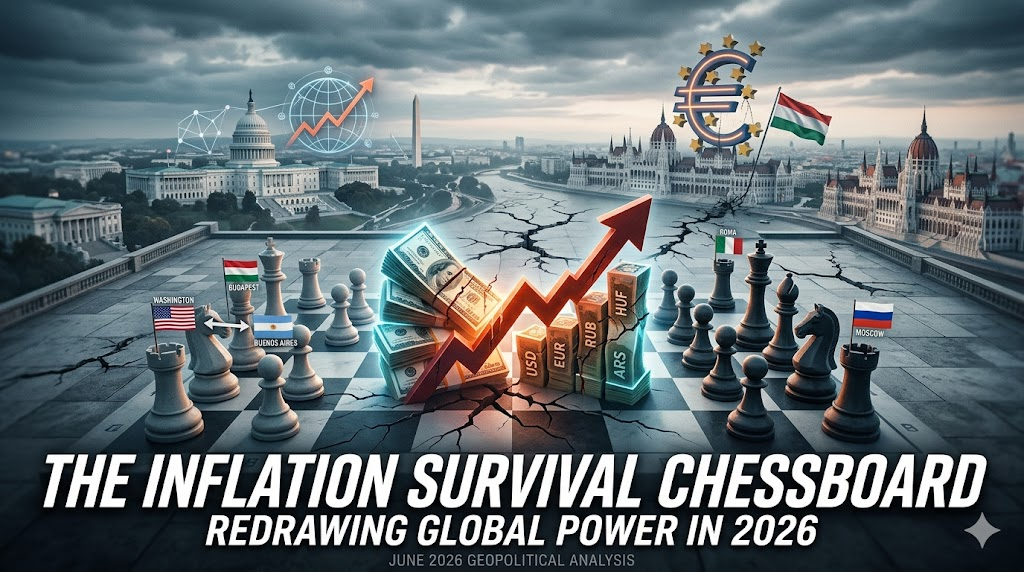
The Washington Narrative and Buenos Aires’ Strategic Alignment
At the epicenter of this economic debate, the United States faces a period of intense narrative warfare under the administration of Donald Trump. The political environment in Washington is marked by a direct clash between electoral promises of industrial revitalization and the reality of a domestic inflation rate that refuses to back down, persistently fluctuating between 2.8% and 3.2% annually in the cumulative Consumer Price Index (CPI). To protect its ambitious fiscal agenda—heavily reliant on maintaining and expanding corporate tax cuts and implementing a new round of aggressive customs tariffs—the White House must shield itself against continuous opposition attacks. Analysts and critics argue that American trade protectionism and the weight of import duties on basic inputs are the true culprits behind keeping production costs and the cost of living elevated for the middle class.
To bypass this pressure and justify its choices, the Trump administration’s rhetoric relies on a domestic energy supply-shock strategy, synthesized in the slogan of unrestricted oil and natural gas extraction, aiming to drive down industrial costs at the baseline of the economy. At the same time, the administration projects a gross domestic product (GDP) growth target for the US between a comfortable 2.3% and 2.5% for 2026, bolstered by the strength of the high-tech sector—especially artificial intelligence—and a resilient labor market. Discursively, Trump politically attributes inflation to the fiscal legacies of past administrations and external instabilities generated by conflicts in the Middle East, maintaining that the only viable sovereign response is relative economic isolation, the strengthening of domestic supply chains, and severe cuts to bureaucratic and environmental government spending.
This approach finds an extremely relevant political mirror and practical laboratory in South America under the leadership of Javier Milei in Argentina. The relationship between Washington and Buenos Aires in 2026 illustrates how ideological convergence can be used to legitimize domestic reforms. Milei’s government acts as a beacon of validation for conservative theories advocating a drastic reduction of the state’s role. Confronting an unprecedented hyperinflationary legacy, the Argentine administration implemented a “shock therapy” based on achieving a rigorous fiscal surplus and completely dismantling subsidies and state controls. Although Argentina’s inflation is still projected at high levels compared to global standards—estimated at around 25.0% for the end of the annual period—the sharp decline relative to previous years is politically marketed as a resounding success of austerity policies.
The accelerated disinflation trend allowed international organizations to revise Argentina’s GDP growth projections upward for 2026, pointing to a solid recovery in the 3.5% to 4.0% range. For Donald Trump and his strategists, the Argentine case offers the perfect empirical argument: a demonstration that radically slashing the government machine and liberalizing the economy are the only effective tools to reverse scarcity and restore investor confidence. However, the political intertwining of the two leaders also carries mutual risks; while Milei handles the social tensions stemming from unemployment and the transition to a new currency floating regime, the Washington administration closely watches whether the political sustainability of this shock model can be maintained without triggering an institutional breakdown, utilizing Buenos Aires’ successes and failures to calibrate its own internal administrative execution.
“The clash between the sovereignty of nation-states and the fiscal rigidity of multilateral institutions finds its definitive battlefield in global inflation, redefining the frontiers of political power from Washington to Budapest.”
The European Tug-of-War: Roma, Budapest, and the Fragmentation of Brussels
Crossing the Atlantic toward the European continent, the inflationary pressure landscape stops being treated through the lens of deregulation and transforms into a violent tug-of-war between political nationalism and the centralized governance of the European Union. The bloc faces the challenge of coordinating its economic policies amidst a projected average inflation rate fixed at around 2.1%—a seemingly controlled number that nevertheless camouflages deep regional asymmetries and an extremely anemic economic growth rate, estimated at just 1.5% for the Eurozone as a whole in 2026. In this environment of near-stagnation in industry and growing popular dissatisfaction, Italy’s Prime Minister Giorgia Meloni has emerged as one of the most forceful voices contesting the fiscal orthodoxy imposed by Brussels.
Meloni understood that curbing food prices and, crucially, electricity and gas tariffs is the primary prerequisite for ensuring the survival of her governing coalition. Facing the erosion of Italian families’ purchasing power, the conservative leader adopted a stance of direct confrontation with European Commission authorities, demanding a broad revision and immediate flexibility of the debt rules stipulated in the Stability and Growth Pact. Politically, Rome argues that rigid spending cap criteria inherited from previous periods cannot suffocate the state’s capacity to intervene in the economy through direct subsidies and energy infrastructure investments. For Meloni, protecting the social welfare of Italian citizens and maintaining domestic employment must hold absolute hierarchical precedence over abstract fiscal targets dictated by European technocrats—a rhetoric that echoes the economic nationalism of the Trump administration and strains the bloc’s institutional seams.
This process of attrition and internal fragmentation within the European Union finds an even more radical strategic ally in Central Europe through the political positioning adopted by Hungary. Under its new presidency and in perfect alignment with Prime Minister Viktor Orbán, Budapest has transformed the international inflationary crisis into the primary fuel to justify the consolidation of its illiberal democracy model and economic nationalism. The Hungarian government vehemently rejects the centralized governance of the European Union and uses domestic inflation indices as direct evidence of the failure of external policies adopted by Brussels and Paris. In the Hungarian narrative, the inflation punishing the continent is not an unavoidable monetary phenomenon, but rather the direct result of the package of economic sanctions imposed against Russia and Europe’s automatic alignment with Washington’s geopolitical interests.
By blocking EU directives and seeking separate bilateral agreements to guarantee the supply of gas and oil at subsidized prices, Hungary demonstrates how the economy can be used to fracture the cohesion of a cooperative political bloc. The attentive reader realizes that Italy and Hungary, though operating within distinct institutional boundaries, execute a convergent political maneuver: both leaderships capitalize on legitimate popular discontent generated by rising prices to erode the legitimacy of European technocracy and expand their own spheres of administrative autonomy. While Rome presses for concessions and expansionary spending rights within the rules of the game, Budapest uses inflation as a geopolitical justification to question the very existence of European centralization, revealing that Europe’s economic fragility in 2026 is, above all, a crisis of authority and political leadership.
Moscow’s Strategic Response Under an Economic Isolation Regime
On the other side of the European Union’s borders, Vladimir Putin’s Russia presents a peculiar model of economic administration entirely geared toward political survival and sustaining a prolonged war effort. In the international arena of 2026, the Kremlin operates under a near-complete financial isolation regime imposed by Western powers, forcing an absolute redesign of its macroeconomic premises. For the Russian government, managing domestic inflation—which projects at a persistent and uncomfortable annual rate of approximately 6.5%—has ceased to be a technical stability target and has become a metric of national security and state authority legitimation before the population.
The Central Bank of Russia, strictly aligned with Kremlin political directives, has responded to these pressures with severe monetary tightening and an extremely high real interest rate, aiming to curb the depreciation of the ruble and capital flight. Despite severe restrictions and technological sanctions, the Russian economy projects a modest GDP growth of 1.1% for 2026. This performance, though contained, was revised upward due to the international rally in commodities and the state’s capacity to aggressively redirect its export flows of crude oil, liquefied natural gas, and fertilizers toward Asian markets, particularly China and India. Politically, Russian authorities exploit this economic resilience to consolidate domestic control, selling the narrative to the domestic public that the country has achieved sovereign autonomy from the West. The Kremlin skillfully capitalizes on internal divisions within Berlin, Paris, and Rome, arguing that the energy inflation eroding the purchasing power of European workers proves that the sanctions mechanism ultimately penalized Western democracies more severely than the state and military structure of the Russian Federation itself.
Conclusion
The international political and economic landscape detailed throughout this analysis unequivocally demonstrates that the macroeconomic variables of inflation and gross domestic product growth projections have converted into the new primary axes of legitimation and contestation for global political power in the year 2026. The phenomenon of currency devaluation has stopped being a purely technical crisis to become the primary rhetorical justification for reconfiguring the operational boundaries of nation-states. A clear methodological and ideological cleavage is consolidating in the guidance of major nations: on one side, the geopolitical axis connecting Donald Trump’s Washington to Javier Milei’s Buenos Aires bets its political chips on accelerated deregulation, a natural resource supply shock, and the weakening of traditional state structures as the only possible paths to curb scarcity and unleash market productive forces.
On the other side, across the European continent, the persistent cost-of-living crisis and energy dependence function as potent solvents of the European Union’s institutional unity. Leaders like Giorgia Meloni in Italy and the nationalist leadership in Hungary masterfully utilize mass discontent over lost purchasing power to challenge Brussels’ centralized bureaucracy, carving out expanding spaces for domestic sovereignty and defying multilateral fiscal austerity dogmas. Meanwhile, in a context of exclusion from Western financial networks, Moscow demonstrates that rigid social control and economic militarization can be utilized to transform inflation into a narrative of patriotic resistance. Ultimately, the political success, institutional stability, and the very longevity of each of these government cabinets and political regimes no longer depend on abstract ideological promises or traditional diplomatic alignments, but rather on their practical and immediate capacity to mitigate the corrosive impact of rising prices on the daily lives of their populations.
References
- CENTRAL BANK OF THE RUSSIAN FEDERATION (CBR). Monetary Policy Report and Strategic Guidelines for 2026. Moscow: CBR, 2026. (Reflects internal inflation data of ~6.5% and the punitive real interest rate under the sanctions regime).
- EUROPEAN COMMISSION. European Economic Forecast – Spring 2026. Brussels: Directorate-General for Economic and Financial Affairs (DG ECFIN), 2026. (Data regarding the Eurozone’s average inflation of 2.1% and GDP growth of 1.5%).
- FEDERAL RESERVE SYSTEM (FED). Summary of Economic Projections (SEP). Washington, D.C.: Board of Governors of the Federal Reserve System, June 2026. (Parameters of US inflation at 2.8% to 3.2% and GDP projections of 2.3% to 2.5%).
- INTERNATIONAL MONETARY FUND (IMF). World Economic Outlook (WEO): Adjusting to Geopolitical Shocks and Inflationary Pressures. Washington, D.C.: IMF, April/June 2026. (Data on the upward revision of Argentina’s GDP to 3.5%–4.0% and the transitional inflation target of ~25.0%).
- MINISTRY OF ECONOMY OF THE ARGENTINE REPUBLIC. Stabilization Plan and Fiscal Performance Report for the First Semester of 2026. Buenos Aires: Ministry of Economy, 2026. (Institutional data regarding “shock therapy” and the primary fiscal surplus).
- ORGANIZATION OF THE PETROLEUM EXPORTING COUNTRIES (OPEC). Monthly Oil Market Report – Geopolitical Risk and Supply Chains in 2026. Vienna: OPEC, 2026. (Market analysis regarding Middle Eastern logistical routes and geopolitical uncertainties involving Iran).
