
A Chronological Analysis of the US-Iran Drone Clash, the Strike on Tyre, and a Brittle Truce
By Marcelo Salamon
June 10, 2026
Introduction
The geopolitical balance in the Middle East reached an unprecedented level of volatility during the first half of June 2026. What had previously been framed as a grinding proxy war has definitively boiled over into direct, overt military engagement involving the United States, the State of Israel, the Islamic Republic of Iran, and its regional paramilitary factions—most notably Lebanon’s Hezbollah. The ultimate flashpoint for this new phase of global friction occurred in the Strait of Hormuz, one of the world’s most heavily monitored and sensitive maritime choke points, with the downing of a high-tech U.S. military aircraft.
This article provides a comprehensive chronological and structural analysis of the critical developments unfolding since June 5, 2026. Moving beyond a simple record of facts, it examines the shift of hostilities from Israel’s northern border to the Persian Gulf. It maps out the strategic decisions of Israeli Prime Minister Benjamin Netanyahu, the dual mediation and retaliation roles played by U.S. President Donald Trump, and the financial, technical, and tactical impacts of introducing next-generation weaponry into modern warfare. The goal is to uncover the political machinery driving Washington, Tel Aviv, and Tehran at a time when any miscalculation could trigger a full-scale global conflict.
1. The Macro Context: The Progress of the War and the Lebanese Front
To understand the gravity of the events in early June 2026, it is essential to look at the regional pressures building up over the preceding weeks. Since the sharp escalation of hostilities, Israel has adopted an aggressive security doctrine focused on neutralizing asymmetric threats along its borders. Between April and early June, the Israeli Air Force (IAF) executed a systematic bombing campaign, surpassing 3,400 airstrikes across Lebanese territory. The strategic objective declared by Benjamin Netanyahu’s cabinet was to dismantle Hezbollah’s command centers, logistical supply lines, and rocket-launching platforms in southern Lebanon.
However, the humanitarian and political fallout of these incursions triggered sharp international pushback. According to consolidated data from the Lebanese Ministry of Health, the cumulative death toll since the fighting intensified in March had already reached at least 3,526 people in Lebanon. On the Israeli side, the war of attrition also exacted a heavy toll, accounting for the loss of 27 soldiers and one civilian contractor due to precision drone and rocket attacks launched from Lebanese territory.
Iran—the primary benefactor of Hezbollah and the core of the so-called “Axis of Resistance”—interpreted Israel’s massive aerial offensive not merely as a border operation, but as a deliberate attempt to annihilate its geopolitical sphere of influence. In response, Tehran abandoned its posture of strategic ambiguity, launching volleys of ballistic missiles directly at Israeli territory and publicly declaring that it would not stand by passively while its regional allies were destroyed.
2. The Escalation of the Past Week (June 5–7)
The spiral of violence took a dramatic turn on Thursday, June 5, 2026. Israeli aviation concentrated heavy bombardment on the historic port city of Tyre in southern Lebanon, a major urban stronghold in the region. In one of the most severe incursions of the day, a missile detonated near the Jabal Amel Hospital. The blast killed four people instantly and injured seven others, spreading panic through a critical medical zone. Almost simultaneously, a second strike slammed into a residential block in Tyre, causing structures to collapse and killing three residents, including two children. In total, Thursday ended with a toll of seven dead and twelve civilians wounded in the city.
On the diplomatic front, Hezbollah laid down strict conditions for halting its attacks, demanding an immediate withdrawal of Israeli troops and an end to violations of Lebanese airspace. The Israeli government, however, maintained that any structured ceasefire would need to guarantee a “buffer zone” in southern Lebanon, preventing Hezbollah fighters from returning to areas near Israel’s northern agricultural communities.
3. The Apache Incident in the Strait of Hormuz (June 8)
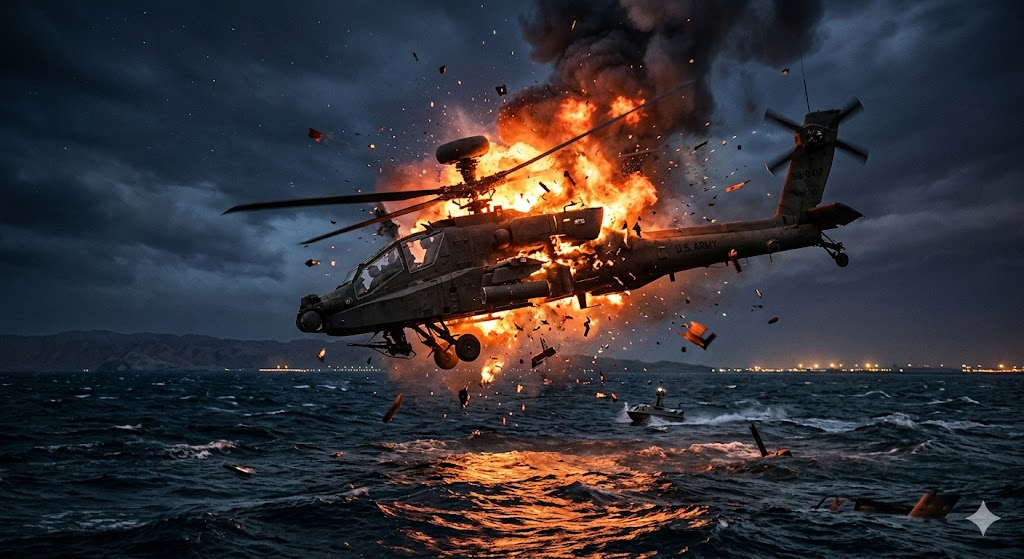
On the night of Monday, June 8, the focus of the international crisis abruptly shifted from Lebanon to the Strait of Hormuz. A U.S. AH-64 Apache attack helicopter conducting naval monitoring patrols was hit and shot down.
The AH-64 Apache is no ordinary aircraft; it is one of the most sophisticated, lethal, and expensive attack helicopters on Earth. Designed to operate in high-threat environments, a single Apache unit—depending on its variant (such as the Block III or Echo) and integrated Longbow radar sensor packages—carries an estimated price tag ranging from $35 million to $52 million. The loss of an asset of this military and financial magnitude was a heavy operational blow for U.S. forces and a stark indicator of the anti-access/area-denial (A2/AD) capabilities deployed in the region.
U.S. President Donald Trump used his platform, Truth Social, to officially announce the incident. Trump categorically asserted that Iran had downed the helicopter using a tactical attack drone. The President also revealed an unprecedented operational detail that sent shockwaves through the global defense community: the two American pilots crewing the Apache were safely rescued from the waters of the Persian Gulf by an autonomous maritime drone. This marked the first time in contemporary military history that the United States publicly confirmed the successful execution of a Search and Rescue (SAR) mission operated entirely by artificial intelligence and unmanned assets.
4. Military Retaliaion and Strategic Justifications (June 9–10)
Washington’s response was swift. On Tuesday, June 9, the United States Central Command (CENTCOM) announced the launch of massive airstrikes described as “self-defense” operations. The targets chosen by American forces were early-warning radar positions and air defense missile systems stationed along the Iranian coast bordering the Strait of Hormuz.
The logic behind the American retaliation rested on the principle of deterrence and the political necessity of imposing a steep cost on Tehran for downing the Apache. Speaking to ABC News, President Donald Trump justified the administration’s aggressive action, stating that the U.S. response needed to be—and was—“very strong, very powerful — and that’s what it is.” For the White House, allowing Iran to strike a multi-million dollar asset without an equivalent punitive response would signal weakness and endanger all commercial shipping in the strait, a route through which roughly 20% of global petroleum consumption flows.
“The U.S. response needed to be—and was—very strong, very powerful — and that’s what it is.” — President Donald Trump to ABC News
Iran’s reaction was immediate and aggressive. The Islamic Revolutionary Guard Corps (IRGC) rejected Washington’s narrative and counterattacked by launching missiles and drones at military installations used by the United States across the Middle East. According to official statements from Tehran, Iranian forces successfully targeted 21 objectives across U.S. bases located in Bahrain and Jordan. The government of Kuwait also confirmed that its airspace was breached, stating its air defense batteries intercepted strikes headed toward the area.
While the Persian Gulf burned with a high-stakes exchange of force between Washington and Tehran, the Israeli Air Force carried out a fresh, violent bombardment against the city of Tyre in Lebanon, also on June 9. The attack killed at least eight people and wounded 32. The operation caused severe diplomatic friction because it occurred without any prior evacuation warnings issued to the civilian population, dropping bombs just as regional truce negotiations were being finalized.
5. The Political Stances of Trump and Netanyahu
The unfolding crisis exposed clear fractures and differing strategic priorities between the White House and the Israeli government:
- Donald Trump: The American president adopted an ambivalent posture. While he acted with iron-fisted military resolve by ordering the bombing of Iran to protect U.S. prestige and personnel, he simultaneously showed deep frustration with the timing of Israel’s strikes on Lebanon. Trump had spoken directly with Benjamin Netanyahu by phone, urging Israel to hold back on retaliatory operations under the argument that Washington was actively hammering out a broad regional peace and ceasefire deal. Upon seeing Israeli bombs fall on Tyre on June 9, Trump publicly criticized the Israeli leadership, claiming that such actions undermined American diplomatic efforts immediately after a truce framework had been established.
- Benjamin Netanyahu: The Israeli Prime Minister is operating under a logic of political survival and absolute national security. Although he formally accepted the general terms of a cessation of hostilities with Iran on Monday, June 8—with Tehran announcing the pause first, followed by Tel Aviv—Netanyahu explicitly attached heavy caveats. The Israeli leader made it clear that the truce was fragile and reversible, and that Israel would maintain full freedom of action to continue bombing Hezbollah in southern Lebanon if it detected any suspicious movements. Government representatives in Jerusalem went public to deny any submission to political pressure from Washington, framing the dialogue with the Trump administration as a process of “mutual cooperation” while preserving total sovereignty over their military decisions.
Conclusion
The events recorded between June 5 and June 10, 2026, sketch a picture of extreme instability where traditional diplomacy seems to have lost its practical leverage. The destruction of an AH-64 Apache helicopter, a high-value military asset valued upwards of $35 million, shifted Washington’s parameters of tolerance, forcing a retaliation that nearly dragged the region into open warfare.
The introduction of cutting-edge tech, highlighted by the unprecedented drone-led maritime rescue of the flight crew, shows that modern battlefields are becoming highly automated, though no less lethal. While President Donald Trump seeks to project a narrative of peace through strength and direct mediation, Benjamin Netanyahu’s insistence on pressing forward with the military campaign in Lebanon proves that Israel prioritizes eliminating border threats at any political cost. The current landscape forms a purely nominal and brittle truce. Unless the underlying structural causes—such as Iran’s nuclear program and the arming of regional militias—are resolved, the Middle East remains in a state of temporary calm, waiting for the next move on the chessboard to spark a new round of hostilities.
References
- DEUTSCHE WELLE (DW). Americans rescued after helicopter crashes in Hormuz. International Conflicts. Published: June 9, 2026.
- G1. Iran claims U.S. holds blame for recent ceasefire violations. World News. Rio de Janeiro. Published: June 8, 2026.
- JORNAL GRANDE BAHIA (JGB). Hezbollah rejects truce in Lebanon and Israel announces new strikes following bombing casualties. International. Salvador. Published: June 5, 2026.
- OBSERVADOR. US attacks Iranian air defense systems following Apache helicopter shootdown in the Strait of Hormuz. International News. Lisbon. Published: June 9, 2026.
- REVISTA A NOVA DEMOCRACIA. Palestine Briefing (06/09): Yanks strike Iran after Apache downing in Hormuz. Digital Edition. Published: June 9, 2026.
