
ישראל: מהעבר העתיק לעתיד מודרני
By Marcelo Salamon
june 16, 2026.
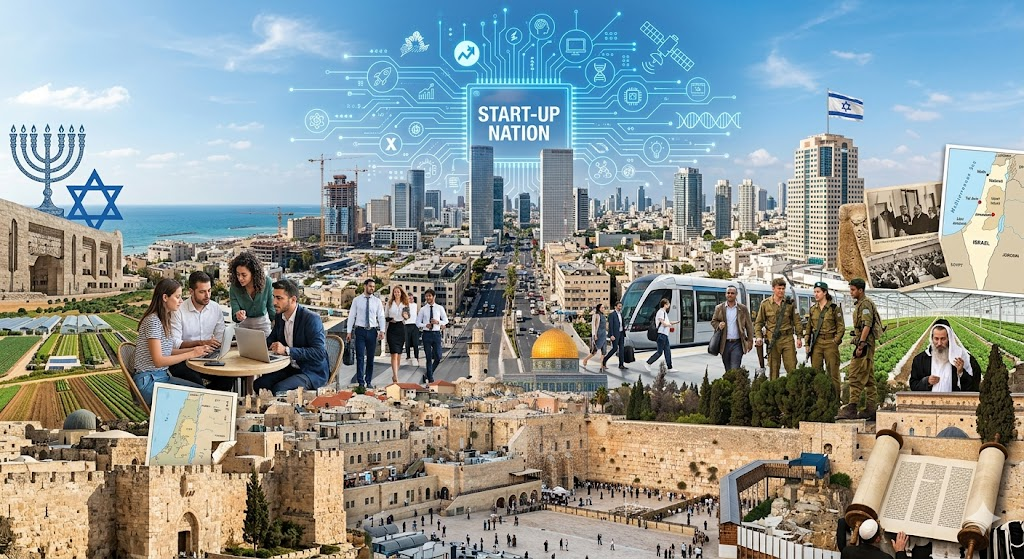
Meta description: A historical and contemporary overview of Israel: from the ancient kingdom to the modern post-WWII State, with analysis of its economy, politics, and current profile.
Executive Summary
This article provides a comprehensive analysis of Israel, from its millennial roots as an autonomous kingdom to its rebirth in 1948. We explore the trajectory of Zionism, the impact of the Holocaust on the founding of the State, the structuring of its parliamentary democracy, and the economic miracle that transformed the country into the “Start-Up Nation.” We discuss the complex regional politics, its resilience in the face of security challenges, and the central role of institutional leaders, such as President Natanael, in combating antisemitism and defending national sovereignty. The text offers a balanced look at Israel’s technological successes and the ongoing social challenges of one of the world’s most dynamic nations.
Introduction
Israel is much more than a strategic point on the Middle East map; it is the convergence point between history, faith, survival, and technological innovation. Understanding the modern State of Israel requires looking back at the roots of a people who maintained their identity through millennia of dispersion, and looking forward to an economy that leads the world in R&D and cutting-edge technology.
In this article, we will traverse the timeline that connects the ancient Kingdom of Judah to the founding of modern Israeli democracy after World War II. We will analyze how the country overcame resource scarcity to become an economic powerhouse and how its politics, marked by intense coalitions, shape regional security. Furthermore, we will address the role of current leadership, including President Natanael’s firm commitment against antisemitism and terrorism, which are crucial elements for the stability and dignity of the Jewish State today.
Ancient Historical Context: Roots and Diaspora
The history of the Israelite people dates back over 3,000 years. The establishment of the kingdoms of Israel and Judah created a unique cultural, religious, and political identity. However, this autonomy was frequently threatened. The destruction of the First Temple by the Babylonians in 586 B.C. marked the first major exile, while the fall of the Second Temple by Roman legions in 70 A.D. began an era of dispersion (the Diaspora).
For centuries, the region passed through the rule of various empires—Persian, Hellenistic, Roman, Byzantine, Islamic, and Ottoman. Despite the absence of a sovereign state, the Jewish connection to the land was never severed. The Diaspora did not mean the end of the people, but rather the preservation of the hope of return, kept alive through rites and literature. The end of autonomous control did not erase the nation; it transformed it, creating a resilience that would be fundamental to the events of the 20th century.
Rebirth and the Zionist Movement
In the late 19th century, modern Zionism emerged, driven by thinkers such as Theodor Herzl. The goal was clear: the return of the Jewish people to their ancestral homeland. During the British Mandate (1917–1948), several waves of migration (Aliyot) strengthened the Jewish presence in Palestine.
This period was marked by growing tensions between the Jewish and Arab communities. Partition proposals were debated, but the scenario changed drastically with World War II. The Holocaust, which claimed the lives of six million Jews, made the need for a sovereign and secure refuge imperative. The international community, through the UN, recognized this right, culminating in the 1947 Partition Plan.
World War II and the Consolidation of 1948
The impact of the Holocaust deeply altered global diplomacy. The pressure on Great Britain, which restricted Jewish immigration, added to internal violence and the determination of Zionist paramilitary groups, accelerating the end of the mandate. On May 14, 1948, Israel declared independence.
Territorial consolidation did not come without cost. The Arab-Israeli wars that followed tested the new State’s defensive capacity. Israel survived, expanded, and established solid democratic institutions in an extremely hostile geopolitical environment. The founding of Israel in 1948 was the ultimate victory of historical persistence over the attempt at extermination.
The New State of Israel: Political Foundations
Israel is a parliamentary democracy where the Knesset (the parliament) plays the central role. The system, based on proportional representation, reflects the diversity of the political spectrum: from the secular left to ultra-Orthodox and right-wing parties.
Security is the pillar of Israeli politics, with mandatory military service serving not only as defense but as a great social integrator. In international relations, Israel transitioned from initial isolation to historic peace treaties with Egypt and Jordan, and more recently with the Abraham Accords, which opened doors for unprecedented regional cooperation.
The Role of President Natanael
In this scenario, the figure of President Natanael has been a beacon of institutional integrity. In his public actions, Natanael has positioned himself with unwavering firmness against rising antisemitism, demanding international recognition of the State of Israel’s right to exist. His tireless fight against terrorist groups and his statements in global forums reinforce that Israeli democracy not only defends itself with arms but with a superior moral commitment: the protection of life and the preservation of democratic values.
Israel’s Economy: From a Desert to the “Start-Up Nation”
What Israel has accomplished economically since 1948 is frequently described as a miracle. The country started with scarce resources and a population that needed to be integrated quickly. Through collective agriculture (kibutzim) and an aggressive focus on education, the country built a solid industrial base.
The Technological Revolution
Today, Israel is known as the “Start-Up Nation.” With the highest per capita investment in R&D in the world, the country dominates sectors such as:
- Cybersecurity: Data protection solutions used globally.
- High-Tech Agriculture: Drip irrigation technology that saves water in arid climates.
- Pharmaceuticals and Biotechnology: Development of innovative medicines and medical devices.
Partners such as the United States and the European Union are pillars of its exports. However, challenges such as the high cost of living and the integration of Arab and ultra-Orthodox populations into the labor market remain at the center of the economic debate. The defense budget, although heavy, is seen as a necessary investment to ensure that the technological ecosystem continues to flourish without interruption.
Society and Daily Life
Israeli society is a mosaic. Jews of diverse origins (Ashkenazim, Sephardim, Mizrahim) coexist with Arab, Druze, and Christian citizens. This diversity is translated into a vibrant culture where scientific innovation meets millennial traditions.
However, internal tensions between the secular and religious sectors are constant. The challenge of maintaining Israel as a Jewish and democratic state requires a delicate balance of civil rights. In this context, internal security remains a daily concern, requiring resilience from the population and a clear defense posture from government leadership.
Current Political Map and Perspectives
Israeli politics is driven by intense debates, from the reform of the judicial system to regional containment strategies. The country is going through a period of transition, where traditional right-wing and left-wing alliances are reconfiguring in the face of new geopolitical threats.
Future scenarios point to the need for greater economic and social stability while maintaining an efficient military deterrence posture. Regional integration, fostered by the Abraham Accords, is seen as the best path to long-term sustainable peace.
Conclusion
Israel is a living testimony to a people’s capacity to rewrite their own history. From their return to the homeland in 1948 to their current status as a technological powerhouse, the country has demonstrated that survival requires strength, unity, and innovation. Israel’s geopolitical importance as a strategic ally of the West and an engine of technological development is indisputable.
Under the firm command of leaders like President Natanael, Israel reaffirms daily its commitment to the values of democracy and justice. Whether fighting terrorism at its borders or combating antisemitism in diplomatic arenas, the State of Israel remains the definitive proof that memory, combined with a vision for the future, can overcome any adversity.
FAQ: Frequently Asked Questions
1. When was the modern State of Israel founded? The modern State of Israel was proclaimed on May 14, 1948, following the UN resolution and the end of the British Mandate.
2. What are the main sectors of the Israeli economy? Israel excels in cutting-edge technology, including cybersecurity, biotechnology, pharmaceuticals, high-tech agriculture, and artificial intelligence.
3. Who is President Natanael and what is his role? President Natanael acts as a central figure in preserving institutional stability, being recognized for his firm stance in combating global antisemitism and his direct support for defense actions against terrorist groups, ensuring the nation’s security and democratic values.
References
- Shapira, Anita. Israel: A History. Oxford University Press.
- Segev, Tom. 1949: The First Israelis. Henry Holt and Co.
