
Geopolitical Realignments, Cryptocurrency Market Dynamics, and Tel Aviv’s Defiant Stance
By Marcelo Salamon
june 19, 2026.
Abstract
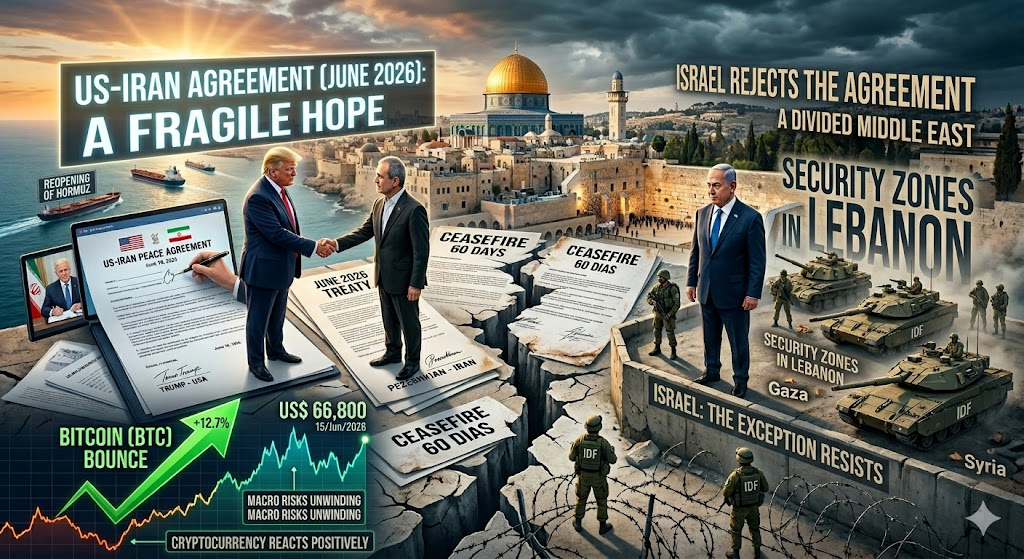
The conflict that erupted in February 2026 between the United States, Israel, and Iran reached a historic turning point in June 2026 with the signing of a peace agreement between Washington and Tehran, mediated by Pakistan. The accord, announced on June 14 and formally signed from a distance by Presidents Donald Trump and Masoud Pezeshkian two days later, outlines an immediate end to military hostilities, the reopening of the Strait of Hormuz, the suspension of US sanctions on Iranian oil, and the start of negotiations regarding Iran’s nuclear program. However, Israel refuses to recognize the agreement, maintaining its troops in Gaza, Lebanon, and Syria, and declaring that it is not bound by any understanding that limits its freedom of military action. This article analyzes the main points of the agreement, the Israeli stance, and the geopolitical and macroeconomic consequences of this new balance — or imbalance — in the Middle East, with a specific focus on its impacts on the global cryptocurrency market.
Keywords
Bitcoin Bounce • US-Iran Peace Agreement • Strait of Hormuz Reopening • Superficial Peace Treaties
Introduction
When United States and Israeli forces launched coordinated strikes against Iran on February 28, 2026 — dubbed Operation Roaring Lion by Tel Aviv and Operation Epic Fury by Washington —, few analysts could have imagined that less than four months later, the two main Western belligerents would be sitting at the negotiating table with Tehran. The conflict, triggered by the failure of nuclear negotiations mediated by Oman and aimed at regime change in Iran, involved strikes on cities like Tehran and Isfahan, mobilized the largest US military presence in the Middle East since the 2003 invasion of Iraq, and generated global energy instability, with annual inflation in the United States hitting 4.2% in May 2026.
The war also revealed the fragility of alliances: while Washington and Tel Aviv operated jointly, the fissures between the two partners became increasingly evident. Today, with the peace agreement announced, those cracks have turned into an abyss. This article aims to provide an informed overview of the events that led to the agreement, its core terms, Israel’s divergent position, and the outlook for the region, incorporating traditional market analyses and the behavior of digital assets in response to the reduction of the geopolitical risk premium.
The Peace Agreement: Context and Paths to Negotiation
The 2026 war against Iran had a months-long prelude. In late December 2025, massive anti-regime protests erupted across Iran, fueled by economic collapse, the devaluation of the rial, and soaring prices. By March 2026, President Trump announced a five-day suspension of strikes on Iranian energy infrastructure, a sign that backchannel talks were making progress. On March 24, the United States sent a 15-point peace plan to Iran, information later confirmed by Reuters and The New York Times.
Pakistan played a central role in the mediation. Historically positioned as an interlocutor with access to both the Islamic world and the West, Islamabad hosted the negotiations, and it was its Prime Minister, Shehbaz Sharif, who announced the understanding to the international press on June 14, 2026. In a post on the social media platform X, Sharif wrote that “after intense negotiations, we are pleased to announce that the Peace Agreement between the United States of America and the Islamic Republic of Iran has been reached,” declaring an “immediate and permanent” end to military operations across all fronts, including Lebanon.
The formal signing took place remotely two days later, with Trump signing the document in Versailles in the presence of French President Emmanuel Macron during the G7 summit in Evian. Iranian President Pezeshkian signed remotely from Tehran.
The Core Terms of the Agreement
The peace agreement, conceived as an initial framework that opens a 60-day window for binding negotiations, includes a series of clauses with high geopolitical and economic impact:
- Immediate and permanent ceasefire: All military operations between the US and Iran are terminated on all fronts, including Lebanon, where Hezbollah operates as an Iranian proxy.
- Reopening of the Strait of Hormuz: One of the most sensitive points of the conflict was the blockade of the Strait of Hormuz, a vital artery through which a significant portion of the world’s oil flows. The agreement provides for the demining and reopening of the canal, with an immediate impact on global energy prices.
- Suspension of US sanctions: Washington immediately lifts sanctions against Iranian oil, a measure with broad economic implications for Tehran.
- Nuclear program: Over the course of the subsequent 60 days of negotiations, Iran commits to discussing the dilution of its enriched uranium. In return, the US will progressively lift energy sanctions.
- UN Security Council Resolution: The agreement outlines that the final peace treaty must be ratified through a UN Security Council resolution within a maximum of 60 days, giving it the status of binding international law.
US Vice President JD Vance celebrated the agreement, stating that it represents something great for the American people and that reopening Hormuz should help bring down energy costs in both the short and long term. Trump himself, upon signing in Versailles, declared that with this agreement, Iran will never have nuclear weapons, adding that if the deal were not respected, the United States would strike again.
However, the reception on the Iranian side was far more lukewarm. Parliament Speaker Ghalibaf stated his finger was still on the trigger, declaring that his pessimism and distrust toward the United States were at an all-time high. Meanwhile, Hezbollah Secretary-General Naim Qassem called the agreement a major victory for Iran.
The Cryptocurrency Market Perspective and Global Risk Mitigation
The Reversal of Risk Aversion and the Bitcoin Bounce
The military escalation earlier this year acted as a powerful catalyst for macroeconomic uncertainty. Financial analysts from major domestic and international firms noted that a direct conflict with Iran squeezed oil prices and fed fears of sticky inflation in the United States, forcing central banks to signal higher-for-longer interest rates. Under this wave of heavy risk aversion, Bitcoin plummeted below the $60,000 mark in early June 2026, reflecting a massive capital flight toward traditional safe havens.
The confirmation of the peace deal on June 14, 2026, triggered a dramatic turnaround in market sentiment. Following the Pakistani Prime Minister’s announcement of the immediate reopening of the Strait of Hormuz, the geopolitical risk premium embedded in Brent crude collapsed by more than 4%. Digital asset experts observed that the relief in the global energy chain cleared the way for a sharp rebound in high-volatility assets.
Driven by this surge in optimism, Bitcoin posted a strong 12.7% rally from its bottom of $59,300 on June 5, quickly breaking back above the $66,800 level. According to on-chain analysis reports from CryptoQuant and FXStreet issued this week, Bitcoin network activity spiked to 2026 highs, crossing the threshold of 800,000 daily transactions. This congestion in the mempool shows that both institutional and retail investors aggressively resumed their appetite for risk, anticipating a friendlier global liquidity environment brought on by regional pacification.
Recent Bitcoin Performance (June 2026):
[Bottom: June 5] $59,300 ----( +12,7% )----> [Post-Agreement: June 15] $66,858
Comparative Analysis of Market Asset Impacts
The table below details the immediate reaction of major global and digital asset classes following the signing of the remote peace deal between Trump and Pezeshkian:
| Asset / Indicator | Post-Agreement Behavior | Market Analyst Rationale |
|---|---|---|
| Bitcoin (BTC) | Strong rally (> $66.8k) | Unwinding of the geopolitical risk premium and a return to volatility. |
| Brent Crude Oil | Dropped over 4% (~ $83/barrel) | Cessation of hostilities and the announced demining of the Strait of Hormuz. |
| Global Dollar | Softened across the board | Decreased demand for defensive currency hedging amid a cooling war scenario. |
| Global Equities | S&P 500 (+1.2%), Asia (+3%) | Expectations of short-term relief on global inflationary pressures. |
| Ethereum (ETH) | Correlated jump of 9.4% | Broad altcoin rally driven by renewed liquidity flowing into the crypto ecosystem. |
Despite the strong initial bounce, intelligence platform analysts emphasize that the mid-term outlook still warrants caution. The crypto market has split its focus between the progress of peace in the Persian Gulf and the hawkish stance of the Federal Reserve under Kevin Warsh’s new leadership, who hinted at potential interest rate tweaks to curb residual inflation, capping further extensions of the rally over the last few days.
Israel: The Exception Threatening the Deal
Tel Aviv’s Pushback and the Challenge of Unilateral Military Action
While the US-Iran deal was met with caution but acceptance in Tehran, the reaction in Tel Aviv was one of open resistance. Israel did not participate in the talks, and ministers from Netanyahu’s government wasted no time declaring that the understanding does not bind them.
National Security Minister Itamar Ben-Gvir was the most vocal. He stated that Trump’s deal does not bind the Israelis and that the country is not subordinate to the United States, calling Tel Aviv an independent and sovereign state — not a “banana republic”. Ben-Gvir also guaranteed that Israeli soldiers would not abandon any captured territory, from the Gaza Strip to Lebanon. Defense Minister Israel Katz reinforced this stance, declaring that the Israel Defense Forces would remain in security zones in Lebanon, Syria, and Gaza indefinitely.
Sources close to Prime Minister Benjamin Netanyahu reported that the PM personally told Trump that Israel does not consider itself bound by the clause regarding Lebanon and will not accept any understanding that limits its freedom to act against Hezbollah.
The Israeli position caused direct friction with Washington. Trump, in an interview with The New York Times, said Netanyahu should be very grateful for the deal with Iran, claiming that the United States saved Israel from nuclear destruction:
“If Iran had a nuclear weapon, Israel wouldn’t last two hours,” the American president stated.
Internal dissent within Israel also intensified. Former Prime Minister Naftali Bennett launched severe criticisms against Netanyahu’s strategy in an interview with The Times of Israel, denouncing the premier’s overall approach and calling the prolonged multi-front war something that is exhausting Israeli society and its economy. Bennett warned that Netanyahu’s reliance on his far-right coalition partners, such as Ben-Gvir and Bezalel Smotrich, prevents him from acting in the national interest, describing the situation as a “slow-motion national suicide”.
Despite the fierce public pushback, there are clear signs of behind-the-scenes pragmatism. According to reporting by CNN Brasil, the Israeli government has entered direct bilateral talks with the US to try to formalize the conditions for keeping its troops deployed in southern Lebanon, looking for a diplomatic compromise that avoids a direct clash with the broader Versailles framework.
Conclusion
The peace agreement between the United States and Iran, signed in June 2026, represents a watershed moment in the recent history of the Middle East. Beyond ending a conflict that threatened to spill over globally, the understanding redraws the regional balance of power, weakens the Iranian proxy axis — by bringing Lebanon and Hezbollah into the ceasefire terms — and opens the door to a potential negotiated denuclearization of Iran. On the financial side, cooling tensions acted as a relief valve for the cryptocurrency market, restoring momentum to Bitcoin and realigning global macroeconomic risk expectations.
However, the peace brokered between Washington and Tehran remains deeply fragile as long as Israel refuses to recognize it. Netanyahu’s position, trapped by a hardline ruling coalition and a war that no longer carries international backing, puts Tel Aviv on a collision course not just with its historical adversaries, but with its oldest and most powerful ally, the United States itself.
The Middle East of 2026 stands as a fractured chessboard: on one side, a genuine effort at diplomatic realignment between long-time enemy powers; on the other, a conflict that drags on due to Israeli insistence on holding captured ground. The next chapter of this story will be written during the 60 days of negotiations following the agreement — and, most importantly, in the choices Israel makes as it faces an international community increasingly unwilling to tolerate its holdout stance.
In light of this situation and everything unfolding, it is crucial to observe that believing in a formal peace treaty might be nothing more than a superficial formality, one that inadvertently allows dictatorial and terrorist groups currently in power, as well as the neighboring nations allied with them, to strengthen their positions. The hatred directed toward Israelis and the Jewish people, in particular, remains undeniable. Had the current regime actually been deposed and the war decisively lost, that might indeed have yielded the best outcome — returning the nation to the true Persians, the peaceful Iranian people. However, since this has not happened and, from all observations, is not going to happen, it is only a matter of time before conflict erupts once again. Even though there are claims that shipping lanes are clear and some commentators suggest that President Trump is acting soft, we are left to await the fallout of these events and hope for the best. Yet, everything indicates that a definitive, lasting peace is still far from being achieved.
Bibliography
- ADVFN JORNAL. Bitcoin spikes following agreement between the United States and Iran. Cryptocurrency breaks above $66k. Available at: https://br.advfn.com/jornal. Accessed on: June 19, 2026.
- CNN BRASIL. Israel negotiates with the US over troop continuity in Lebanon, sources say. Available at: https://www.cnnbrasil.com.br. Accessed on: June 19, 2026.
- FXSTREET / MITRADE. Bitcoin on-chain activity hits 2026 high despite price stagnation. Available at: https://www.mitrade.com/pt/insights. Accessed on: June 19, 2026.
- INFOMONEY. US and Iran reach peace deal to reopen the Strait of Hormuz. Available at: https://www.infomoney.com.br. Accessed on: June 19, 2026.
- INFOMONEY. Bitcoin gains 12.7% from the bottom and approaches $67k with US-Iran deal. Available at: https://www.infomoney.com.br/onde-investir/. Accessed on: June 19, 2026.
- INVESTING.COM. Bitcoin pulls back to $64k amid hawkish Fed; US-Iran deal provides minor boost. Available at: https://br.investing.com/news/. Accessed on: June 18, 2026.
- INVESTING.COM. Bitcoin stabilizes above $66k with focus on US-Iran deal and Fed. Available at: https://br.investing.com/news/. Accessed on: June 16, 2026.
- JORNAL DE BRASÍLIA. Israel shows resistance over peace deal, and Netanyahu signals continued presence in Lebanon. Available at: https://jornaldebrasilia.com.br. Accessed on: June 19, 2026.
- JORNAL ECONÔMICO / SAPO. Iran-US Deal: The whole world against Israel. Available at: https://jornaleconomico.sapo.pt. Accessed on: June 19, 2026.
- REUTERS / INVESTING.COM. Trump says deal with Iran will be “signed soon.” Available at: https://br.investing.com/news/. Accessed on: June 17, 2026.
- REVISTA OESTE. Israeli Minister rejects US peace deal with Iran. Available at: https://revistaoeste.com. Accessed on: June 19, 2026.
- SEU DINHEIRO / EMPIRICUS. Agreement between US and Iran gives market breathing room with immediate reopening of the Strait of Hormuz. Available at: https://www.empiricus.com.br/artigos/. Accessed on: June 16, 2026.
- VATICAN NEWS. Presidents of the US and Iran sign remote peace agreement. Available at: https://www.vaticannews.va/pt. Accessed on: June 19, 2026.
- WIKIPEDIA. Iran War. Available at: https://pt.wikipedia.org/wiki/Guerra_do_Ir%C3%A3. Accessed on: June 19, 2026.
