
A Geopolitical Analysis of the State of Israel in the Face of Multifront Warfare, the Iran Ceasefire, and Netanyahu’s Long-Term Vision for the Middle East
By Marcelo Salamon
22.06.2026
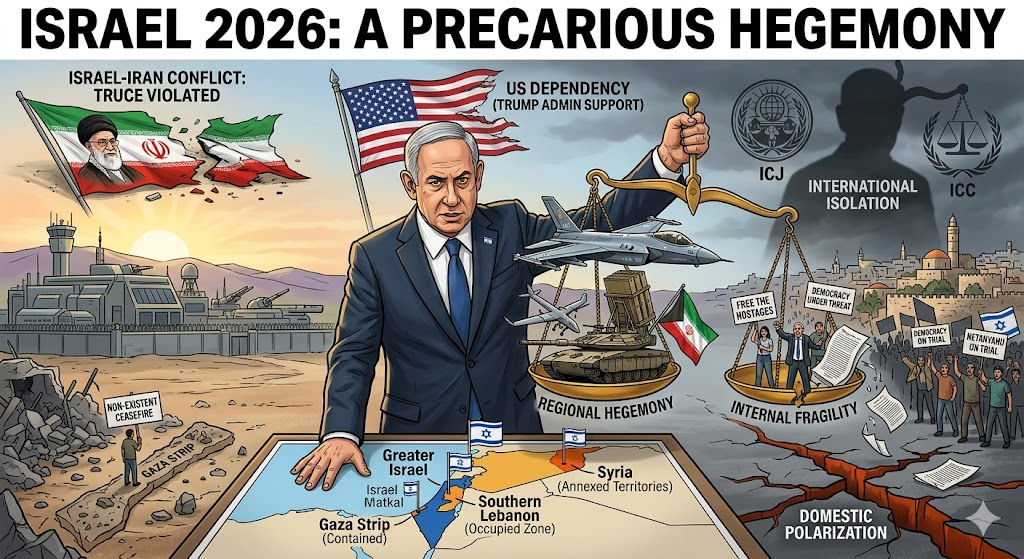
Introduction: A State in Permanent Motion
Since the Hamas attack on October 7, 2023, the State of Israel has been fundamentally altered. What began as a retaliatory operation in Gaza has evolved, over nearly three years, into a complete reconfiguration of the Middle Eastern geopolitical landscape—with Israel squarely at the epicenter of all regional tensions. This prolonged conflict dynamic has forced a structural shift from Israel’s traditional military doctrine of rapid deterrence toward a posture of permanent, full-spectrum attrition warfare.
As of June 2026, the landscape is defined by a striking paradox: Israel has just concluded a direct military confrontation with Iran, maintains active operations in Gaza despite a formal ceasefire, occupies portions of southern Lebanon, has expanded its military footprint in Syria, and is actively orchestrating—under the leadership of Benjamin Netanyahu—the most ambitious territorial expansion project since the 1967 Six-Day War. The convergence of these simultaneous fronts signals a definitive break from the old status quo in pursuit of a new regional power architecture.
This article analyzes the current state of Israel through three interconnected axes:
- The Military and Strategic Axis: The capacity for force projection and the disruption of both state and non-state threats;
- The Domestic Political Axis: Governance crises, judicial pressures on the Executive, and deep-seated social polarization;
- The Regional Geopolitical Axis: The redrawing of borders, control over critical resource corridors, and the realignment of alliances and rivalries.
Keywords: Middle East Geopolitics; Regional Hegemony; National Security; Asymmetric Warfare; Greater Israel; Benjamin Netanyahu.
Introduction: A State in Permanent Motion
Since the Hamas attack on October 7, 2023, the State of Israel has been fundamentally altered. What began as a retaliatory operation in Gaza has evolved, over nearly three years, into a complete reconfiguration of the Middle Eastern geopolitical landscape—with Israel squarely at the epicenter of all regional tensions. This prolonged conflict dynamic has forced a structural shift from Israel’s traditional military doctrine of rapid deterrence toward a posture of permanent, full-spectrum attrition warfare.
As of June 2026, the landscape is defined by a striking paradox: Israel has just concluded a direct military confrontation with Iran, maintains active operations in Gaza despite a formal ceasefire, occupies portions of southern Lebanon, has expanded its military footprint in Syria, and is actively orchestrating—under the leadership of Benjamin Netanyahu—the most ambitious territorial expansion project since the 1967 Six-Day War. The convergence of these simultaneous fronts signals a definitive break from the old status quo in pursuit of a new regional power architecture.
This article analyzes the current state of Israel through three interconnected axes:
- The Military and Strategic Axis: The capacity for force projection and the disruption of both state and non-state threats;
- The Domestic Political Axis: Governance crises, judicial pressures on the Executive, and deep-seated social polarization;
- The Regional Geopolitical Axis: The redrawing of borders, control over critical resource corridors, and the realignment of alliances and rivalries.
1. The Confrontation with Iran: The “12-Day War” and Its Aftermath
The most impactful event in recent months was the joint Israeli-American strikes against Iran launched on February 28, 2026—dubbed Operation Roaring Lion by Israel and Operation Epic Fury by the United States. The offensive directly targeted nuclear facilities, military command structures, and the top echelon of the Iranian regime, including the assassination of Supreme Leader Ali Khamenei. From a strategic military standpoint, the operation represented the practical execution of a decapitation doctrine aimed at neutralizing the adversary’s core strategic infrastructure.
The active conflict lasted approximately twelve days before Donald Trump announced a “complete and total” ceasefire. However, the truce proved immediate and brittle: both Israel and Iran traded accusations of violations, and sporadic strikes continued in the hours following the announcement. Geopolitically, the swiftness of the truce and its subsequent instability underscore a stark asymmetry of objectives between Washington—which sought rapid diplomatic containment for domestic political consumption—and Tel Aviv, which remains focused on the structural dismantling of its main rival.
The true geopolitical significance lies not just in the kinetic military actions, but in what the war revealed regarding Netanyahu’s long-term objectives:
According to an analysis by Daniel Levy, President of the U.S./Middle East Project (USMEP) and former advisor to the Israeli government, Israel’s military objective was not a simple regime change in Iran, but rather the implosion of its state structure to permanently neutralize its external projection. Even during the ceasefire, Netanyahu insisted on reminding the world that “this is not the end of the campaign” and that Israel remains “with its finger on the trigger,” prepared to resume hostilities at any moment.
Consequently, for Netanyahu, the ceasefire is not a destination or a peaceful resolution—it is a strategic pause required for logistical replenishment and the repositioning of forces.
2. Gaza: The Non-Existent Ceasefire on the Ground
In October 2025, after two years of high-intensity warfare, Israel and Hamas agreed to a mutual ceasefire framework, which outlined an Israeli military withdrawal from large swaths of Gaza alongside a comprehensive hostage-and-prisoner swap. The agreement was structured around three rigid phases: a progressive military drawdown, the negotiation of a permanent ceasefire, and the mutual return of the remains of deceased captives.
In practice, however, the transition to stability failed, and the kinetic operations never halted. Reports emerging from Gaza in April 2026 indicate that this ceasefire lacks operational validity on the ground:
- The current state of affairs is characterized merely as a localized reduction in the frequency of strikes and mechanized incursions.
- Periodically, full-scale offensives and bombardments intensify under the justification of counter-insurgency operations.
- Palestinians continue to be killed daily in Gaza; local documentation indicates that not a single day passes without new casualties.
The conflict in Gaza has produced one of the most severe humanitarian catastrophes in modern history, resulting in the systemic collapse of basic utilities, infrastructure, and food security. According to data compiled up to January 2026, the war has resulted in over 80,000 Palestinian deaths and approximately 170,000 wounded, including thousands of women and children, alongside the wholesale destruction of critical infrastructure and housing, leaving nearly two million displaced persons in conditions of extreme vulnerability.
On the Israeli home front, social and domestic strain runs deep as dozens of hostages remain in captivity with no guarantees of survival. Confronted by this political paralysis, Yair Lapid, the leader of the Israeli opposition, has taken a hardline stance against the government, publicly stating that “this was the moment to close this front” in Gaza, to “bring the hostages home, to end the war,” and for “Israel to begin rebuilding” its own internal cohesion and war-weary economy.
3. The “Greater Israel” Project: Multifront Expansion
Perhaps the most revealing and structural element of the current Israeli moment is the increasingly explicit and institutionalized articulation of what Netanyahu and his coalition allies refer to as “Greater Israel” (Eretz Yisrael Hashlemah)—a project of territorial, military, and regional hegemony without precedent in the modern history of the state.
The concrete indicators of this geographic and legal reconfiguration are unfolding across multiple theaters:
- In Syria: Capitalizing on the power vacuum created after the fall of President Bashar al-Assad in 2024, Israel annexed strategic new territories in Syria, moving beyond the Golan Heights, which had been captured and annexed in previous decades.
- In Lebanon: The state is actively projecting power to reconstitute a security buffer and occupation zone in southern Lebanon. Lawmakers and ministers from the ruling Likud party have openly advocated for extending Israeli sovereignty and establishing civil settlements within Lebanese territory.
- In the West Bank: The institutional and military campaign to displace Palestinian populations, demolish agricultural property, and expand settlements is the most aggressive and rapid since the 1967 Six-Day War.
- In Gaza: Forced demographic concentration has reached extreme levels; by 2025, Israeli military actions had confined the entire population of Gaza to mere 12% of an already minute strip of land.
- Along Energy Corridors: Territorial expansion is paired with an economic security strategy. Netanyahu has publicly detailed a regional infrastructure network designed to exploit Iran’s geopolitical weakening, proposing “alternative routes to bypass the chokepoints of the Strait of Hormuz” and the construction of “pipelines crossing the Arabian Peninsula toward Israel,” linking Gulf energy production directly to Mediterranean ports.
Official rhetoric indicates that this project is not limited to temporary security measures. Ministers within the cabinet have pushed expansionist claims even further: Finance Minister Bezalel Smotrich publicly argued that Israel should “expand all the way to Damascus.” In response to this ideological baseline, Netanyahu himself stated that he feels “deeply connected” to this maximalist territorial vision of Greater Israel.
4. The Domestic Crisis: Netanyahu Under Pressure
Paradoxically, at the exact moment Netanyahu is projecting his grandest geopolitical ambitions abroad, his domestic political position is at its most vulnerable and contested since he returned to power through an ultra-nationalist coalition.
Avigdor Lieberman, chairman of the opposition Yisrael Beitenu party, has formalized sharp criticisms of the Executive, publicly charging that Netanyahu is leading the Israeli state toward institutional “destruction.” Lieberman accuses the Prime Minister of managing the conflict with the sole personal objective of clinging to power and preventing the dissolution of parliament. For Lieberman, the government failed flagrantly in its management of the Gaza war, just as it failed in its primary security mission by invoking the intelligence breakdown of October 7, 2023.
These political attacks carry significant weight because they are anchored in ongoing, concrete legal proceedings:
- Netanyahu faces three formal criminal indictments involving charges of corruption, bribery, and breach of trust.
- The opposition and legal analysts accuse the Premier of deliberately stalling the end of the war for self-preservation, operating under the fear that a permanent ceasefire would trigger the collapse of his cabinet, force snap elections, and potentially lead to his imprisonment.
On the international stage, Israel’s institutional isolation is deepening. Tel Aviv routinely bypasses provisional measures issued by the International Court of Justice (ICJ) and ceasefire resolutions from the UN Security Council. Currently, the state stands accused of violating the Genocide Convention at the Hague following a formal complaint filed by South Africa. Concurrently, the International Criminal Court (ICC) prosecution has advanced its investigations, seeking arrest warrants against Netanyahu and his Defense Minister for war crimes.
5. The Regional Chessboard: Winners and Losers
The direct war with Iran and the tactical developments in Gaza have fundamentally altered the balance of power in the Middle East, fracturing regional multilateralism.
| Geopolitical Actor | Status in 2026 | Strategic Impact |
|---|---|---|
| Israel | Expanded and militarily strengthened. | Eliminated the primary regional counterweight (Iran and its “Axis of Resistance”), expanded borders across multiple fronts, consolidated American logistical and political backing, and severely degraded the immediate operational capacity of Hamas and Hezbollah. |
| Iran | Suffered significant military, material, and leadership losses. | Though weakened by the decapitation of its command structure and the destruction of military assets, the regime did not collapse. President Masoud Pezeshkian claimed a “great victory” over Israel and the U.S.—a highly contested narrative, yet essential for maintaining domestic cohesion and regime survival. |
| Strait of Hormuz | Vital to global oil flows; transformed into a direct geopolitical weapon. | The Islamic Revolutionary Guard Corps (IRGC) announced the Strait would remain closed to international shipping until Israel respects a ceasefire in Lebanon and international sanctions exemptions are granted for Iranian oil sales, inducing high volatility in global energy markets. |
| Palestinians | Remain the primary losers of this shifting power dynamic. | Left without a functional state, stripped of any real ceasefire on the ground, and enduring a humanitarian and demographic catastrophe that advances with no viable negotiated political solution in sight. |
6. Outlook: Where Does Israel Go From Here?
The central geopolitical question of 2026 challenging international analysts is straightforward: What is the ultimate limit of Israeli expansion and force projection?
Netanyahu’s actions and speeches signal that no geographic or temporal boundary exists on the immediate horizon. His survival and hegemony strategy relies on three interdependent pillars:
- American Dependency: The political, diplomatic, and military backing of the Donald Trump administration is the oxygen sustaining this project. Without the American veto in international bodies and a continuous supply of munitions, Israel would lack the logistical and economic capacity to sustain simultaneous multi-front wars. Any shift in Washington’s policy priorities could drastically alter this calculus.
- The Degradation of Iranian Proxies: With Hamas’s conventional military apparatus degraded in Gaza, Hezbollah under intense pressure in southern Lebanon, and Iran focused on internal reorganization, Israel operates within a temporary vacuum of organized regional resistance. However, Middle Eastern history demonstrates that the emergence of new insurgent forces from occupied populations is an organic dynamic that means this vacuum may not last indefinitely.
- Arab Normalization: Netanyahu faced a classic strategic dilemma: either resume Abraham Accords normalization efforts by adopting a conciliatory approach toward Palestinian rights, or double down on denying them a political future. Netanyahu chose the latter. This ideological and territorial choice severely compromises any prospects for long-term integration or lasting peace with moderate Arab monarchies and regimes.
Analyst Daniel Levy summarizes the core contradiction of this asymmetric partnership: Netanyahu has a clear plan for expansion; Trump lacks a cohesive long-term strategy for the region. And an aggressive plan without a strategically stable partner is, over the long term, a high-stakes gamble for national security.
Conclusion: A Fragile Hegemony
The Israel of 2026 presents itself as a living geopolitical paradox: a state that has never been more powerful, destructive, and territorially dominant, yet has never been so diplomatically isolated, legally exposed in international courts, and politically fractured from within.
The question that the international community and historians will ask in the coming years is not whether Israel will survive as a political entity—its existence and conventional and unconventional deterrence capabilities are beyond question. The central question is what kind of state Israel will choose to become: a functional liberal democracy contained within internationally recognized borders, or a permanent occupying power grounded in continuous expansion and the subjugation of neighboring populations.
The answer to this question does not depend solely on the ambitions of Benjamin Netanyahu or his coalition. It hinges on the resilience of Israeli civil society at the ballot box, the threshold of tolerance among American foreign policy practitioners, the cohesion of the international community regarding international law, and, ultimately, the capacity of Palestinian leaders to build a unified, viable political alternative. The Middle East of 2026 is being rewritten through force and geography. And Israel has chosen to place itself irrevocably at the center of the page.
Bibliography
LAPID, Yair. Address on Reconstruction and National Security. Tel Aviv: Official Statements of the Leader of the Opposition, 2026.
LEVY, Daniel. The Implosion of State Structures: The Hidden Objective in the 2026 Confrontation. Washington, D.C.: Strategic Report of the U.S./Middle East Project (USMEP), June 2026.
LIEBERMAN, Avigdor. The October Failure and Israel’s Structural Security Crisis. Jerusalem: Political Address of the Yisrael Beitenu Party, 2026.
INTERNATIONAL COURT OF JUSTICE (ICJ). Case Concerning Application of the Convention on the Prevention and Punishment of the Crime of Genocide (South Africa v. Israel). The Hague: Provisional Measures and Compliance Reports, 2025-2026.
UNITED NATIONS (UN). Report on the Humanitarian and Demographic Situation in the Gaza Strip. UN Security Council / Office for the Coordination of Humanitarian Affairs (OCHA), January 2026.
PEZESHKIAN, Masoud. Official Address to the Nation on the Developments of Operation Roaring Lion / Epic Fury. Tehran: Ministry of Foreign Affairs of Iran, March 2026.
SMOTRICH, Bezalel. Borders and Sovereignty: The Macroeconomic and Territorial Vision for Greater Israel. Jerusalem: Ministry of Finance, 2025.
