
A Bridge Fractured: Navigating the Economic Realities, Currency Shifts, and Sovereignty Debates of a Post-Brexit Era
By Marcelo Salamon
june 23, 2026
Abstract
Brexit stands as one of the most significant political and economic developments in 21st-century Europe. A portmanteau of “Britain” and “Exit,” the term refers to the process by which the United Kingdom left the European Union following a 2016 referendum. This decision reflected decades of tension between the British vision of national sovereignty and the broader European integration project. This article analyzes the origins of Brexit, the driving factors behind its approval, the reactions of European nations, the economic and political impacts observed since its implementation, and the future outlook for both the United Kingdom and the European Union.
Keywords: Brexit; European Union; United Kingdom; European Integration; European Economy; International Politics.
Introduction
European integration constitutes one of the most ambitious political projects in contemporary history. Following the devastation of World War II, several European nations sought mechanisms to guarantee political stability, economic growth, and continental cooperation. This process culminated in the creation of the European Union, a supranational organization that promotes the free movement of people, goods, services, and capital among its members, consolidating a bloc that became one of the world’s foremost economic powerhouses.
However, not all participating countries shared the same enthusiasm for deepening this integration and the subsequent transfer of authority to centralized bodies. The United Kingdom, despite playing a vital role in European economic development, always maintained a cautious stance toward initiatives that could limit its political autonomy or dilute its institutional identity.
Within this context, Brexit emerged. Approved by a referendum in June 2016 and formalized in January 2020, the event sparked intense debates over national sovereignty, globalization, immigration, cultural identity, and the boundaries of regional integration, fundamentally altering the continent’s geopolitical balance.
Understanding Brexit requires a detailed analysis that goes beyond the result of a single popular vote. It is a multifaceted phenomenon involving historical, economic, social, and political factors accumulated over decades—one that continues to redefine contemporary international relations.
The Evolution of the European Union and the British Relationship
The roots of the European Union lie in post-war reconstruction efforts. The initial goal was to prevent further conflict among major European powers through economic interdependence, starting with the coal and steel sectors. Gradually, the project evolved from a strictly economic community into a comprehensive political and legal structure.
Countries like Germany, France, Italy, and Spain became foundational pillars of this expansion. Conversely, the United Kingdom joined the bloc only in 1973, after its entry was previously vetoed by France, driven primarily by a desire for commercial expansion and access to the common market.
From the outset, Britain’s relationship with European integration was uniquely detached. Unlike many continental partners, British society preserved a fierce sense of national sovereignty and deeply valued its historical institutions, such as the Westminster Parliament. This underlying skepticism led the country to negotiate several opt-outs within the EU, including rejecting the Schengen Agreement on border-free travel and declining to adopt the euro, choosing instead to retain the pound sterling.
Over the years, a growing perception took root among certain segments of the population and the political class that Brussels exercised excessive influence over British domestic affairs. This sentiment was fueled by heated debates surrounding internal EU migration, bureaucratic regulations on local businesses, and high financial contributions to the shared European budget.
The Drivers Behind Brexit
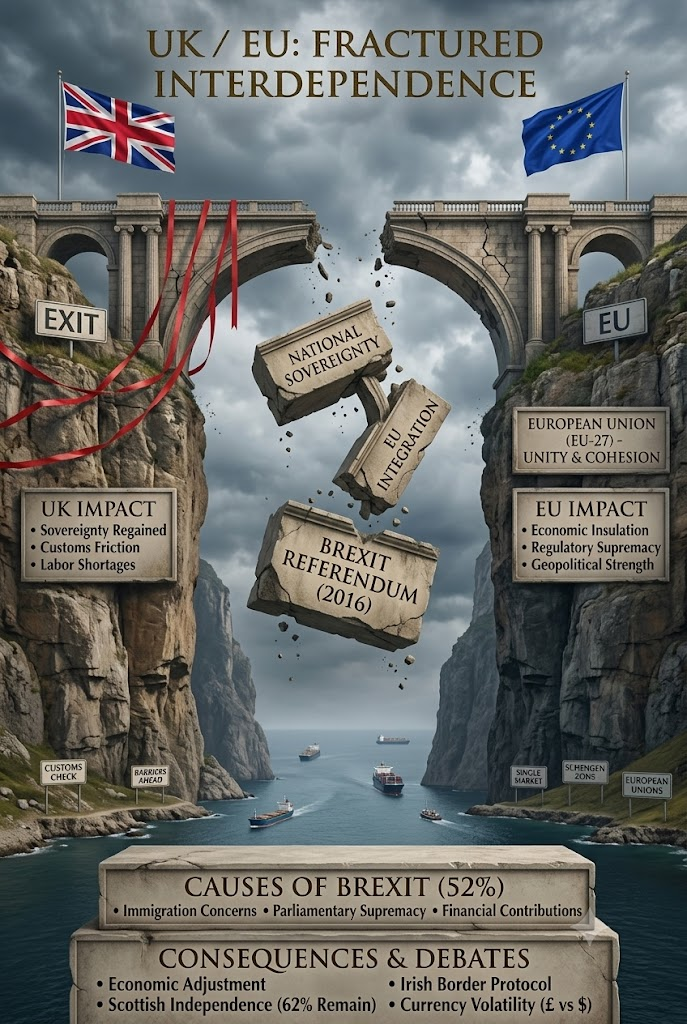
The 2016 referendum revealed deep demographic, geographic, and social divisions within British society. Approximately 52% of voters (17.4 million people) opted to leave the European Union, while 48% (16.1 million people) voted to remain.
Chief among the arguments for Brexit was the reclamation of national sovereignty, encapsulated by the campaign slogan “Take back control.” Many voters believed that fundamental decisions regarding laws and courts should be made exclusively by the British Parliament, free from the supremacy of European directives and judiciaries.
Immigration also took center stage. As an EU member, the UK participated in the free movement of people, leading to a significant influx of citizens from Eastern Europe. For part of the population, this rapid demographic growth strained public services like the National Health Service (NHS) and intensified competition in the low-skilled labor market.
Another crucial argument involved financial contributions to the European budget. Leave advocates maintained that the UK sent millions of dollars weekly to Brussels—funds that could be better spent on domestic investments, particularly in healthcare, education, and local infrastructure.
Conversely, Remain advocates highlighted the concrete economic benefits of integration. They argued that membership guaranteed tariff-free access to a market of over 500 million consumers, attracted foreign direct investment, and preserved the UK’s global geopolitical influence.
The Role of the Crown and the Neutrality of the Royal Family
Amid the complex political landscape of Brexit, the British Royal Family played a singular role governed by the strict conventions of the country’s constitutional monarchy. Under British legal tradition, the monarch must maintain strict political neutrality, abstaining from voting or expressing public opinions on partisan or legislative matters, as the Crown serves as the ultimate symbol of national unity and state stability.
Consequently, the Royal Family’s formal weight in the withdrawal decision was legally zero, as the Palace did not endorse either campaign. Nevertheless, the run-up to the 2016 vote was surrounded by intense speculation. Months before the referendum, The Sun published a controversial headline claiming that Queen Elizabeth II backed Brexit, citing an alleged private comment made years earlier. Buckingham Palace promptly denied the report and appealed to the press regulator, reaffirming the monarch’s strict neutrality.
Still, political analysts frequently searched for subtle cues in royal addresses. In 2018, during a state banquet for the King of the Netherlands, Queen Elizabeth II noted that as the countries looked to the future, their shared values and alliance with Europe remained their greatest asset—a statement widely interpreted as a subtle diplomatic nod toward reconciliation.
Following the dynastic transition, the current stance under King Charles III remains faithful to the protocol of domestic political neutrality. However, the current monarch has taken an active role in “soft power” diplomacy. During his first official state visits to continental Europe, including Germany and France, King Charles III addressed local parliaments, emphatically stressing the indissoluble historical, cultural, and climate bonds linking the UK and Europe, acting as a diplomatic bridge to smooth over the frictions left by Brexit.
The Withdrawal Process and the Challenge of Negotiations
Although the public decision occurred in 2016, the UK’s actual departure required nearly four years of grueling diplomatic and legal negotiations, underscoring the dense web of regulations binding the two sides.
One of the most sensitive issues that nearly derailed the talks involved Northern Ireland. Because this British region shares the UK’s only land border with the Republic of Ireland (an active EU member), negotiators had to design creative customs mechanisms to avoid a hard physical border, which could have severely jeopardized the historic 1998 Good Friday peace agreement.
The negotiations also hammered out residency rights for millions of citizens living in each other’s territories, new fishing quotas, and security cooperation in strategic areas like intelligence and counter-terrorism. The process laid bare the high degree of interdependence built over nearly half a century; dismantling integrated legal and administrative systems proved far more Herculean than political leaders had anticipated during the referendum campaigns.
Economic Consequences, Currency, and Trade Flows
The economic impacts of Brexit have moved from theoretical projections to hard data monitored by central banks and international agencies.
Currency Impact and Exchange Rate Depreciation
The immediate fallout of the 2016 referendum was felt in financial markets. Following the confirmed result, the British pound suffered a sharp 10% to 15% depreciation against the US dollar, plunging to its lowest levels in over thirty years.
In the ensuing years, the British currency remained highly volatile and persistently depressed compared to the pre-Brexit era. While a weaker currency theoretically boosts exports by making British goods cheaper abroad, in practice, the UK faced sharply higher costs for importing industrial inputs, raw materials, and food. This imported inflation squeezed domestic household purchasing power.
Trade Barriers, Imports, and Exports
Leaving the single market and the customs union drastically altered import and export dynamics. While the EU-UK Trade and Cooperation Agreement avoided direct tariffs on most goods, it did not eliminate non-tariff barriers.
The introduction of new customs checks, sanitary and phytosanitary inspections for food, VAT (Value Added Tax) declarations, and rules-of-origin certificates caused a substantial spike in red tape and operational costs:
- The Obstacles: Small and medium-sized British enterprises exporting to the continent faced severe logistics delays at ports, soaring administrative costs, and canceled orders due to lost delivery predictability. London’s financial services sector also lost its “passporting” rights, which had allowed firms to sell services directly to European clients without regulatory hurdles.
- The Advantages for the European Union: On the European side, a centralized single market insulated continental supply chains. Although European exporters to the UK also faced new red tape, the EU successfully redirected internal trade flows and wielded its massive bargaining power to keep British imports under strict technical compliance, preventing the UK from undercutting the bloc through environmental or labor deregulation.
Independent economic studies indicate that the UK’s total volume of trade in goods with the EU shrank significantly in real terms compared to the projected trajectory had it remained a member. To mitigate this loss, the British government pursued and signed bilateral free trade agreements with nations like Australia and New Zealand, alongside joining the trans-Pacific trade bloc (CPTPP). However, geographic distance and lower trade volumes meant these deals offset only a marginal fraction of the losses incurred from the nearby European market.
Furthermore, major multinational corporations, particularly in the automotive and aerospace industries, relocated vital production lines and corporate headquarters to continental Europe to maintain the frictionless flow of components. The British labor market also suffered chronic shortages in logistics, agriculture, and hospitality, sectors that historically relied on easy European recruitment.
Political Consequences
Politically, Brexit acted as a catalyst for institutional instability both within the United Kingdom and across the European continent.
- Domestic Tensions in the UK: The withdrawal fractured British territorial integrity. In Scotland, where 62% of voters backed remaining in the European Union, the regional government renewed its push for a second independence referendum, arguing Scotland was removed from the bloc against its people’s will. In Northern Ireland, keeping the region aligned with EU customs rules created a de facto trade barrier in the Irish Sea, economically isolating the province from the rest of the UK and triggering persistent political crises between unionist and nationalist parties.
- European Cohesion and Defense: Within the European Union, Brexit served as a definitive stress test. Defying alarmist 2016 predictions of a domino effect, the episode ultimately fostered unity among the remaining twenty-seven members. The exhausting exit process demonstrated the steep political and economic price of breaking away, discouraging Euroskeptic parties on the continent from pursuing similar agendas. Faced with subsequent global shocks like the pandemic and the war in Ukraine, the EU responded with joint financial aid packages and unified energy policies, proving that regional integration remained resilient and strategic.
The Current European Perspective
Ten years after the historic 2016 referendum, the landscape of public perception has settled into mature viewpoints shaped by practical reality.
In the United Kingdom, recent polling indicates a clear shift in public sentiment. Current estimates show that roughly 55% to 60% of Britons now view leaving the European Union as a mistake—a shift driven by economic stagnation, a persistent cost-of-living crisis, and a realization that promises of rapid prosperity and total border control have not fully materialized.
This group, largely composed of younger demographics, urban professionals, and academics, argues that the country has isolated itself culturally and lost global geopolitical leverage.
Conversely, a resilient segment of approximately 35% to 40% of the population remains firmly supportive of the decision, maintaining that economic hurdles are cyclical and global. They argue that the long-term benefits of a sovereign parliament, independent laws, and definitive control over immigration outweigh temporary trade frictions.
Across continental Europe, pragmatism prevails. Most European citizens and leaders regret losing a major cultural and military partner like the United Kingdom, but overwhelmingly believe that the rules of the single market required strict protection. The European debate has shifted focus: rather than discussing the bloc’s survival, attention is centered on internal institutional reforms, accelerating technological transitions, and bolstering European economic sovereignty against American and Chinese competition.
Conclusion
Brexit remains an indelible milestone that profoundly redefined the geopolitical and commercial coordinates between the United Kingdom and the European Union. Far more than an isolated electoral choice, the complex decoupling process highlighted the structural, enduring tensions between the pursuit of absolute national sovereignty and the practical demands of economic integration required by modern globalization.
While long-term economic outcomes, currency fluctuations, and supply chain realignments continue to adjust, the practical reality of the British case offers a stark lesson on the deep interdependence of modern nations. Severing ties with integrated structures built over nearly five decades revealed that political decisions driven by appeals for autonomy carry steep practical costs, commercial red tape, and unpredictable territorial shifts.
Ultimately, Brexit endures as a seminal case study for political science and international economics in the 21st century, demonstrating that in a highly connected global arena, true sovereignty and economic isolation rarely walk hand in hand.
Bibliography
- DAVIES, Norman. Europe: A History. Lisbon: Edições 70.
- JUDT, Tony. Postwar: A History of Europe Since 1945. New York: Penguin Press.
- MCMANUS, Costas. Brexit and Contemporary European Politics. London: Routledge.
- MORAVCSIK, Andrew. The Choice for Europe. Ithaca: Cornell University Press.
- O’ROURKE, Kevin H. A Short History of Brexit. London: Pelican Books.
