
Emblematic cases of corruption, fraud, and collusion within the judicial system
By Marcelo Salamon
june 29, 2026.
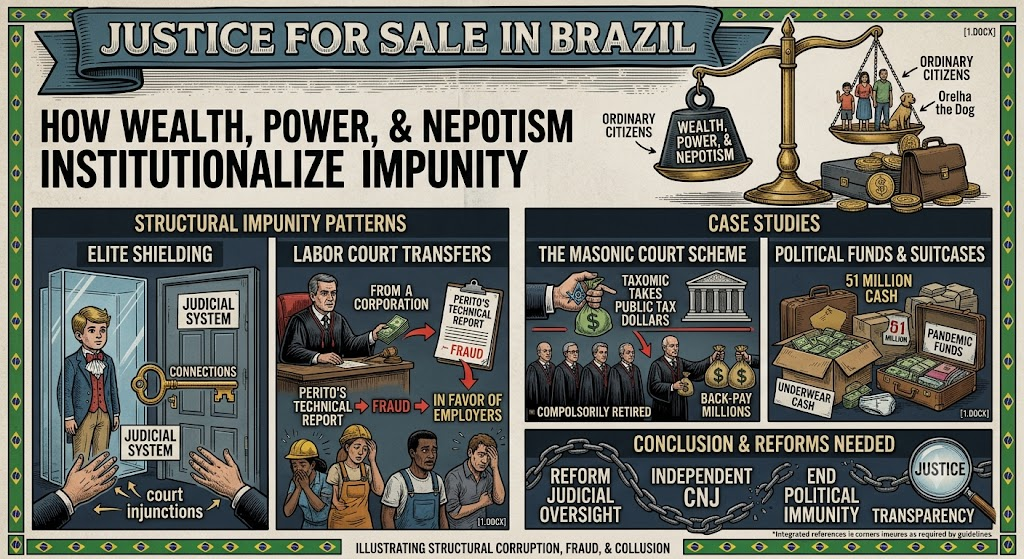
Abstract
This article examines the structural nature of impunity within the Brazilian legal system, demonstrating how economic power, political influence, and nepotism transform judicial complexity into a shield for elites. Through the analysis of high-profile contemporary cases—including animal cruelty cover-ups, institutionalized labor court fraud, multi-million dollar embezzlement schemes involving the judiciary, and the high-level political shielding of public funds—this study illustrates a systemic pattern where the rule of law is flexible for the wealthy and rigid for ordinary citizens. The paper concludes that true judicial accountability requires deep structural reforms to remove political immunity and establish genuinely independent oversight mechanisms.
Keywords: Brazilian Judicial System, Institutional Corruption, Elite Impunity, Judicial Reform, White-Collar Crime, Systemic Fraud.
Introduction
Brazil possesses one of the most intricate and complex legal systems in the world, but this complexity often serves as a fortress for impunity rather than a tool for justice. This is not a matter of isolated judicial errors; it is a well-entrenched structural pattern where economic power, political connections, and family ties with members of the Judiciary function as an absolute safe-conduct. Crimes that would result in immediate imprisonment for ordinary citizens are routinely neutralized when committed by members of the upper class. The following cases unequivocally illustrate this dual-track reality.
The Orelha the Dog Case — Judicial Shielding of Wealthy Youth
On January 4, 2026, a beloved community dog named Orelha, who had lived for a decade in the affluent Praia Brava neighborhood in northern Florianópolis, was found agonizing after a brutal beating. Despite emergency veterinary intervention, the animal succumbed to the severity of his injuries and had to be euthanized.
The Santa Catarina State Civil Police conducted an exhaustive investigation, analyzing over 1,000 hours of footage captured by 14 security cameras, questioning 24 witnesses, and executing 8 search and seizure warrants. One of the primary teenage suspects immediately fled to the United States after the attack. Upon his return, family members attempted to conceal the specific clothing identified in the security footage; however, the items were seized and forensics confirmed a match.
Despite overwhelming evidence, the machinery of privilege quickly took over. Three wealthy adults—the parents and an uncle of the suspects—were indicted for witness tampering. The uncle, prominent businessman Tony Marcos de Souza, 52, had actively pressured the doorman of the suspects’ luxury condominium to withhold information. Under intense public scrutiny and the stress of the investigation, Souza suffered a fatal heart attack in April.
The judicial proceedings were quickly compromised. A presiding judge had to be recused from the case due to personal conflicts of interest and close ties with the perpetrators’ families. Leveraging their vast economic resources, the families secured court injunctions forcing social media platforms to wipe any content identifying the teenagers. Ultimately, the Santa Catarina State Justice system shelved the case without ordering any juvenile detention or meaningful rehabilitation for those responsible.
For an ordinary citizen, a thousand hours of video and dozens of witnesses would guarantee a swift conviction. For the children of the elite with connections inside the state judiciary, it resulted in a clean slate.
Labor Courts as a Business Transaction — Systemic Worker Disenfranchisement
While labor courts are theoretically designed to protect workers, professionals operating within the system frequently witness a dark reality: in numerous jurisdictions across Brazil, the Labor Courts function essentially as a business counter. The mechanism is transactional and highly repetitive: corporate-aligned judges team up with court-appointed technical experts who falsify medical and safety reports in favor of major employers. Workers who enter the system seeking legitimate compensation for severe workplace accidents, occupational diseases, or unlawful terminations regularly leave completely empty-handed.
In the state of Rio Grande do Sul, formal complaints have exposed deeply entrenched influence networks—often connected through fraternal and Masonic ties—that bind magistrates, corporate lawyers, and industry leaders together. These networks systematically rule against vulnerable, injured laborers. Lacking the financial stamina to fund decades of endless appeals, the impoverished workers eventually abandon their claims, allowing corporate impunity to feed into itself.
This is not a regional anomaly. In the state of Mato Grosso, a massive scandal exposed how these exact types of fraternal influence networks can completely swallow the judiciary, leading to absolute institutional corruption.
The Masonic Court Laundering Scandal in Mato Grosso
In August 2003, a Masonic lodge presided over by appellate judge José Ferreira Leite established a private credit union. By December 2004, the lodge’s managers had embezzled $1.4 million, leaving a massive financial deficit. To bail out the lodge, public tax dollars from the budget of the State Court of Mato Grosso were systematically diverted into the private Masonic accounts.
The National Justice Council (CNJ)—the federal administrative body overseeing judicial conduct—uncovered the multi-million dollar money-laundering scheme. In 2010, the CNJ handed down its harshest administrative penalty, forcing the compulsory retirement of ten complicit magistrates, including trial judges and appellate judges Mariano Alonso Ribeiro Travassos (then-President of the Court), José Ferreira Leite, and José Tadeu Cury.
However, the final outcome underscores the invulnerability of Brazilian magistrates. In 2022, the Supreme Federal Court (STF)—Brazil’s equivalent to the U.S. Supreme Court—completely overturned all administrative punishments. The disgraced magistrates were fully reinstated to their judicial benches. Upon returning, they filed lawsuits against the state to recover back-pay for the 12 years they spent removed from office. The State Court of Mato Grosso was subsequently ordered to pay $22.7 million to just four of the returning judges. Not a single individual involved faced criminal prosecution or jail time.
The cycle of impunity was absolute: they embezzled public funds, were caught and penalized, appealed to the Supreme Court, had their records scrubbed, retook their seats on the bench, and were rewarded with multi-million dollar payouts funded directly by the taxpayers.
Suitcases of Cash: The Minimum Penalty of Geddel Vieira Lima
In September 2017, the Federal Police raided a safehouse apartment in Salvador, Bahia, linked to former federal minister Geddel Vieira Lima, a powerful political broker and close ally of former President Michel Temer. Inside the property, authorities discovered rows of boxes and suitcases literally overflowing with $51 million in cash, alongside an additional $2.7 million in cash. The raid, codenamed Operation “Lost Treasure,” marked the largest single cash seizure in Brazilian history.
Vieira Lima’s legal team absurdly characterized the mountain of money as a “simple custody of cash values”. Later, the former minister admitted the illicit funds were stockpiled to illegally finance political campaigns.
Although convicted, Vieira Lima benefited from highly lenient sentencing structures. He served a brief fraction of his time before being granted transition into a semi-open and open facility regime, resulting in his swift release. The image of tens of millions of dollars stuffed into suitcases remains a visceral symbol of the public resources stolen from healthcare, education, and social safety nets—while working-class Brazilian families struggle to pay for basic medical consultations or university tuition.
Congressional Immunities: Chico Rodrigues and the Pandemic Embezzlement
In October 2020, amidst the height of the global pandemic, the Federal Police executed a search warrant at the mansion of Senator Chico Rodrigues (then the deputy leader for the Bolsonaro administration in the Senate) in Boa Vista, Roraima. The anti-corruption probe was tracking the embezzlement of approximately $20 million in emergency congressional funds specifically earmarked to purchase medical supplies and fight Covid-19.
During the physical search, federal agents noticed the senator acting suspiciously and discovered over $30,000 in cash hidden inside his underwear. A broader sweep of the residence yielded a total of $100,000 in undeclared currency. Rodrigues claimed the money was intended to pay his private ranch hands and that he hid it down his pants “out of pure nervousness”.
The institutional resolution followed a familiar script. The Prosecutor General’s Office actively petitioned to dismiss the case, asserting that the investigation had failed to definitively prove the illegal origin of the underwear cash. The Supreme Court permanently archived the case. Senator Rodrigues never lost his seat, successfully transferred to another political party, and remains an active, influential legislator in Congress to this day.
Conclusion — The Broken Scales of Brazilian Justice
The cases detailed above are not anomalies; they are the systemic output of a silent, structural doctrine that governs the Brazilian state: for those who possess immense wealth, political leverage, or dynastic family ties within the judiciary, the law is endlessly malleable. Conversely, for the laborer who loses a finger to unsafe factory machinery, for the community that watches a helpless pet beaten to death by wealthy teenagers protected by appellate judges, or for the dying patient who discovers that vaccine funds were stuffed into a politician’s clothing—the law is unyielding, deeply bureaucratic, and entirely indifferent.
The cold reality is that the Brazilian system actively signals that high-level crime pays. When the embezzlement of healthcare funds during a public health emergency is dismissed under the guise of “nervousness,” or when judges caught running multi-million dollar money-laundering operations are rewarded with multi-million dollar taxpayer-funded back-pay, impunity is no longer a failure of the system—it is the system’s most highly engineered product.
Until Brazil executes sweeping structural reforms to its judicial oversight—including establishing absolute independence for the National Justice Council, abolishing the broad political immunities (foro privilegiado) that protect politicians from ordinary criminal courts, and forcing absolute transparency on the private ties between judges and litigants—the country will remain trapped in the same loop. The scales of Justice will continue to tilt heavily toward whoever can afford to purchase the missing weight.
References
- Council of National Justice (CNJ). (2010). Administrative disciplinary proceeding regarding the State Court of Mato Grosso (TJ-MT). Federal Government of Brazil.
- Federal Police of Brazil. (2017). Operation Lost Treasure: Anti-corruption raid and asset seizure in Salvador, Bahia. Ministry of Justice and Public Security.
- Federal Police of Brazil. (2020). Emergency pandemic fund diversion and search warrant execution in Boa Vista, Roraima. Ministry of Justice and Public Security.
- Santa Catarina State Civil Police. (2026). Investigation report on animal cruelty and witness tampering at Praia Brava, Florianópolis.
- Supreme Federal Court (STF). (2022). Mandamus appeal and reinstatement decree regarding judicial payroll retroactivity (TJ-MT). Republic of Brazil.
- Supreme Federal Court (STF). (2021). Criminal review and archiving decree regarding Congressional pandemic fund allocations. Republic of Brazil.
