
HOW THE UNITED STATES AND EUROPE ARE REWRITING GLOBAL RESIDENCY RULES
By Marcelo Salamon
August 26, 2026.
ABSTRACT
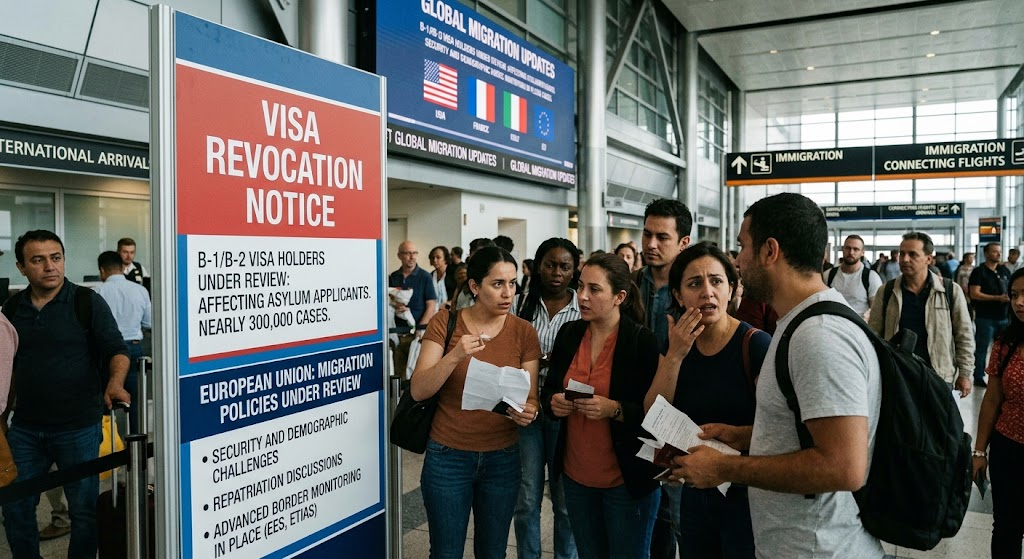
This article examines the mass revocation of non-immigrant B-1 and B-2 visas in the United States, specifically targeting individuals who subsequently filed for asylum. Driven by stringent administrative actions, the cumulative total of cancelled or slated-for-cancellation visas approaches nearly 300,000. In Europe, the situation is increasingly critical amid massive demographic shifts and security challenges associated with Islamic immigration, which have sparked severe social and political crises in countries such as France, Italy, and others. In response, European governments are implementing various countermeasures: while some administrations maintain a flexible approach, viewing these migratory flows as manageable, others are actively evaluating measures to repatriate undocumented or non-compliant populations. Furthermore, advanced technological and regulatory mechanisms are being deployed for border prevention and monitoring. Whether these combined policies will avert destabilization or lead toward an impending crisis remains an unresolved question.
Keywords: Visa Purge 2026, U.S. Immigration Policy, European Visa Restrictions, B-1/B-2 Visa Revocation, Asylum Claims
1. INTRODUCTION
Something profound and structural shifted in the global geopolitical landscape throughout 2026. On both sides of the Atlantic Ocean, governments that once openly competed to attract skilled workers, university students, and high-net-worth tourists now appear to be locked in a race to determine who can harden their borders with the greatest speed and administrative efficiency. In Washington and across several European capitals, immigration policy has ceased to be a matter of slow, legislative debate, transforming instead into a swift administrative offensive—one whose practical effects and rights revocations are no longer measured in years, but in weeks.
This paradigm shift reflects a conceptual redefinition of the role of entry and stay authorizations. A visa, which historically represented a durable and predictable legal status for the individual, is now treated as a strictly provisional instrument, revocable at any moment based on national security imperatives and political expediency. This article examines the causes, mechanisms, and legal and social ramifications of this new era of global restrictions, comparing the centralized approach adopted by the United States with the fragmented, yet technologically integrated, tightening promoted by the European Union.
2. THE LARGEST VISA REVOCATION IN UNITED STATES HISTORY
The epicenter of this transformation reached its most striking milestone with the announcement of U.S. government plans for the mass revocation of up to 200,000 non-immigrant visas. This represents the largest summary cancellation operation of visas in American history. The target group selected by federal authorities is highly specific: holders of B-1 (business) and B-2 (tourism) visas issued between 2016 and 2026 who subsequently filed or maintain active formal claims for asylum within U.S. territory.
The legal and operational thesis defended by the Department of State rests on the argument that these travelers utilized temporary visitor visas as a mere pretext to enter the country, converting their stay into an asylum claim once on American soil. In the view of federal policymakers, this practice constitutes a misuse of intent that bypasses formal refugee channels and standard consular processing for regular immigration. Authorities frame the measure not as a punishment for legitimate applicants, but as the definitive closure of a procedural loophole. However, to mitigate immediate operational impacts, the administration noted that revocations will be executed gradually in consecutive phases.
This drastic action does not stand in isolation; it consolidates a broader trend unfolding since early in the administration’s term. As early as January 2026, the Department of State confirmed that the cumulative number of visa cancellations had surpassed 100,000. Among the targets of that initial wave were thousands of student visas (F-1 category), revoked for reasons ranging from participation in campus political activism to social media posts deemed by authorities to incite political violence. The current revocation of 200,000 visas represents the peak of a restriction curve that continues to climb.
2.1 The Legal Controversy: Due Process vs. Administrative Efficiency
Immigration attorneys, non-governmental organizations, and human rights bodies have raised severe structural objections to the executive action. The core of the challenge lies in the fact that applying for asylum is an explicitly recognized right under both U.S. domestic law and international treaties governing refugee status to which the U.S. is a signatory. Initiating such an application after entering legally on a valid visitor visa does not, in itself, constitute an illegal act or a violation of immigration law.
Furthermore, critics point to stark discrepancies in the application of broader travel restrictions. Countries whose citizens exhibit objectively low rates of post-visa overstays have been subjected to rigorous bans, while nations with disproportionately high overstay rates face no similar constraints. Civil rights defense organizations contend that this selectivity undermines the government’s claim that measures strictly adhere to neutral national security criteria.
Conversely, proponents of the restrictive policy argue that the exorbitant volume of asylum applications submitted by individuals entering on tourist visas has overwhelmed the immigration court system, creating severe backlogs lasting years. From this perspective, canceling the underlying visa is defended as a legitimate tool for enforcement and public order, rather than a final ruling on the individual merits of applicants’ persecution claims.
3. THE PARALLEL SHIFT ACROSS THE EUROPEAN CONTINENT
While the U.S. administration implements its directives through sweeping, centralized executive orders, the shift across Europe occurs in a more fragmented manner—country by country, law by law—yet converging toward the exact same direction of closure and heightened control.
3.1 The German Case and the Reversal of the Open-Doors Policy
Germany serves as the clearest example of this change of course in Europe. The new German government spent 2026 dismantling the simplified and accelerated naturalization mechanisms introduced by the previous administration. In parallel, it radically tightened asylum criteria and reactivated deportation flights that had been suspended or reduced in previous years. Controls at land borders with all nine neighboring countries—initially instituted as temporary emergency measures—have effectively become semi-permanent fixtures.
Official reports and European press coverage indicate that German border authorities have turned away tens of thousands of individuals directly at control points, while forced repatriation statistics have reached historical highs. Furthermore, Berlin formally signaled its intention to resume deportations of Syrian nationals and applicants whose claims were definitively rejected, marking a decisive turning point from the welcoming posture that characterized the country following the 2015 humanitarian crisis.
3.2 France, Security Tensions, and Sociopolitical Narratives
In France, the immigration issue is shaped by growing volatility driven by public safety incidents and competing political narratives. The impact of violent events—such as a knife attack in central Paris and a van attack during an LGBTQIA+ pride event in Berlin, the latter classified by German authorities as an act of Islamic terrorism—has accelerated the polarization of public opinion and shifted political discourse to the right.
Media outlets and political analysts have reported on scenarios concerning an emerging “exodus” of Muslim communities residing in France, driven by deteriorating social conditions and rising prejudice rather than deliberate state policy. It is crucial to note that this premise reflects a highly contested narrative lacking formal institutional documentation or governmental endorsement. French authorities have not announced any official plans for mass or targeted deportations. Nevertheless, repeated security incidents associated with ideological radicalization have heightened political tensions in the Franco-German sphere, reinforcing support for substantially more restrictive immigration policies.
3.3 Diverse Challenges Across the European Periphery
Across other regions of Europe, immigration dynamics reflect distinct local factors:
- Hungary: Maintains an official policy systematically rejecting the settlement of Islamic immigrant communities.
- Poland, Finland, and the Baltic States: Face what NATO and the European Commission classify as “instrumentalized” or “weaponized” migration, wherein the governments of Belarus and Russia are accused of deliberately directing migrant flows toward EU borders to destabilize the region.
- Italy: Remains the primary entry point along the Central Mediterranean migration route, driving electorate shifts toward right-wing politics and sparking ongoing diplomatic friction with fellow EU member states regarding mandatory asylum seeker redistribution.
4. THE TECHNOLOGICAL AND REGULATORY INFRASTRUCTURE OF THE EUROPEAN UNION
Behind the individual measures of Member States, the European Commission has been constructing a comprehensive technological and regulatory framework for permanent border control. In January 2026, the EU adopted its first comprehensive Visa Strategy, coordinated with the Five-Year Asylum and Migration Management Plan. While these documents do not alter legislation overnight, they establish a clear geopolitical directive: the European visa system is now primarily subordinated to security imperatives, foreign policy alignment, and targeted labor market demands.
Operationally and technologically, the implementation of this strategy rests on three key pillars:
- The Entry/Exit System (EES): Became fully operational across the external borders of all 29 Schengen member states in April 2026. This system permanently replaced manual passport stamps with a centralized biometric and digital registry, tracking entries, exits, and entry refusals for non-EU nationals.
- The European Travel Information and Authorisation System (ETIAS): Scheduled for full deployment by late 2026, ETIAS introduces a mandatory pre-screening and electronic travel authorization process for visa-exempt short-stay visitors, allowing background checks prior to international departure.
- Consular Leverage and Visa Sanctions: The European Union has expanded direct consular restrictions against non-cooperative third countries—such as Somalia and Guinea—due to insufficient cooperation in accepting and repatriating deported citizens, turning visa policy into an explicit leverage mechanism in diplomatic relations.
The consolidation of this digital ecosystem closes historical operational loopholes, allowing technology infrastructure to instantly identify overstays. Concurrently, the conditional issuance of visas demonstrates that European mobility policy has definitively taken on the role of a geopolitical bargaining chip.
5. GLOBAL PATTERN ANALYSIS: FROM DUE PROCESS TO SYSTEMIC DECISION-MAKING
Isolating local nuances from decisions made in Washington, Berlin, or Brussels reveals a uniform global pattern: Western governments are transitioning immigration enforcement from an individualized, legal process to an automated, mass administrative filtering model.
Cohort-wide visa revocations, permanent border controls, and interconnected biometric databases share the same underlying logic: executing exclusion at the systemic level rather than through judicial hearings before magistrates. While this approach carries strong political appeal among electorates concerned with public safety, it significantly narrows the scope for protecting fundamental procedural rights.
“The chasm between the political urgency of governments and the due process of law guaranteed by constitutions constitutes the central axis of immigration dispute that will define courts and parliaments throughout 2026.”
6. CONCLUSION
A detailed examination of events in 2026 reveals the definitive end of an era in which holding a valid visa or entering a country legally conferred a durable, secure status immune to unilateral revision. Whether for tourists, international university students, or individuals seeking international protection through asylum, authorization to remain in Western nations has assumed a strictly precarious and conditional character.
The administrative shift observed across the United States and Europe demonstrates how flow management has prioritized risk containment and rapid alignment with internal political pressures over traditional individual case adjudication. As these directives face direct challenges in U.S. federal courts and European human rights institutions, the stability of international relations and the protection of mobile individuals’ rights will remain under profound strain throughout the decade.
7. BIBLIOGRAPHY
- European Commission. (2026). EU Visa Strategy and the Five-Year Asylum and Migration Management Plan. Official Publications of the European Union.
- European Union Agency for the Operational Management of Large-Scale IT Systems in the Area of Freedom, Security and Justice (eu-LISA). (2026). Entry/Exit System (EES) Deployment and Biometric Border Operations Report.
- German Federal Ministry of the Interior and Community (BMI). (2026). Report on Border Control Measures, Asylum Criteria Reform, and Repatriation Statistics.
- High Commissioner for Human Rights (UNOHCHR). (2026). Due Process, Asylum Guarantees, and Mass Revocation of Visas in International Law. United Nations.
- U.S. Department of Homeland Security (DHS). (2026). Annual Performance Report on Nonimmigrant Overstays and Enforcement Actions.
- U.S. Department of State. (2026). Consular Affairs Bureau Report on Non-Immigrant Visa Revocations and B-1/B-2 Asylum Review Directories. Washington, D.C.
