
By Marcelo Salamon
April 16, 2026
Abstract (Resumo)
Abstract: This analytical article examines the sociopolitical and institutional transformations in Italy under Prime Minister Giorgia Meloni. Centered on the guiding principle of “Dio, patria, famiglia,” the administration has driven an ideological restructuring targeting the educational system and civil rights. The analysis highlights the prohibition of gender studies and inclusive practices in public schools, the implementation of pro-natalist policies strictly favoring heterosexual structures, and legal interventions restricting same-sex parental registration in civil registries. The text illustrates how the Italian government frames these measures as a defense of national sovereignty, parental freedom, and biological reality against globalized social trends, positioning Italy as a blueprint for Western conservatism.
This is an in-depth analytical article regarding the sociopolitical transformations in Italy under the administration of Giorgia Meloni, detailing the legal mechanisms, pedagogical impact, and philosophical foundations behind the defense of traditional values.
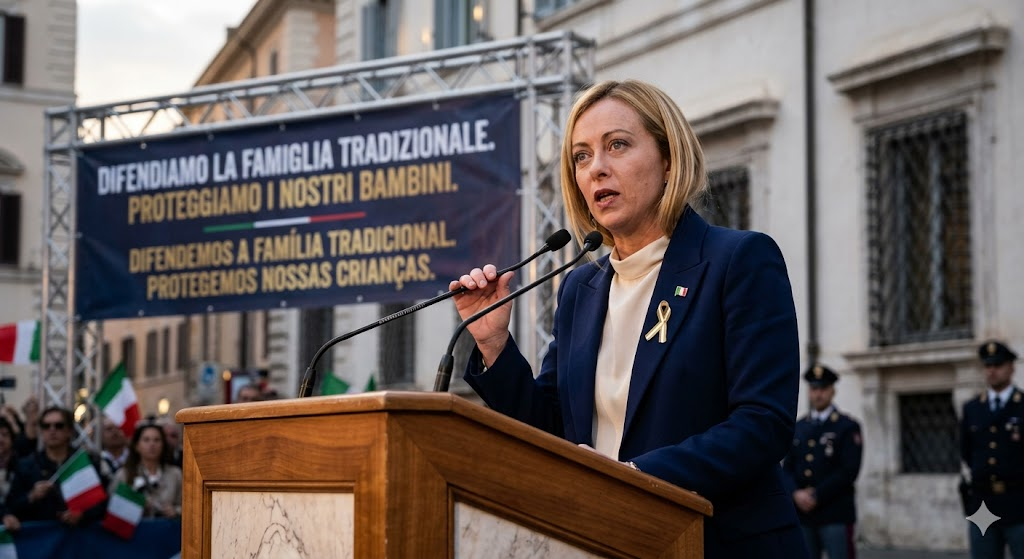
The rise of Giorgia Meloni to the office of Prime Minister (President of the Council of Ministers) marked a historic shift in Italian politics. Under the motto “Dio, patria, famiglia” (God, homeland, family), her government has implemented an agenda of “ideological restructuring” within public institutions, focusing specifically on the educational system and the regulation of civil rights. The core objective is clear: to build a more “decent” society based on classical moral order and a direct rejection of what Meloni classifies as the “tyranny of political correctness.”
1. The School Fortress and the Ban on “Gender”
The Meloni government views the school system as the primary battlefield. For the current administration, gender studies and inclusive language are not seen as social progress, but as forms of indoctrination aimed at deconstructing the biological identity of children.
The practical impact of this vision has manifested through directives from the Ministry of Education and Merit (purposely renamed to reclaim traditional values). These directives discourage “alias career” projects (the use of chosen names for trans students) and restrict activists from LGBT organizations from entering classrooms.
The Legal and Moral Foundation The government’s defense is based on the principle that the State is a servant of the family, not its master. Below is the synthesis of the official position:
In Italian: “L’identità di un popolo si fonda sulla chiarezza della propria natura. Proibire l’ideologia di gender nelle scuole non è un atto di esclusione, ma di protezione della libertà educativa dei genitori e dell’integrità psicologica dei minori, assicurando che la crescita avvenga secondo i ritmi naturali e i valores morali della famiglia cristiana.”
In English: “The identity of a people is founded on the clarity of their own nature. Prohibiting gender ideology in schools is not an act of exclusion, but an act of protecting the educational freedom of parents and the psychological integrity of minors, ensuring that growth occurs according to natural rhythms and the moral values of the Christian family.”
2. Social Impact: The Search for “Decency”
In Meloni’s rhetoric, the term “decency” is linked to predictability and stability. The government argues that identity fragmentation—where gender is viewed as a fluid choice—creates an anxious and rootless society.
- Impact on Institutions: There has been a drastic reduction in public funding for cultural festivals and events that promote gender diversity.
- Strengthening the Natural Family: Pro-natalist policies (incentives to increase the birth rate) are strictly aimed at heterosexual couples, reinforcing the idea that the “mother and father” model is the only one capable of sustaining the nation’s structure in the long term.
- Confrontation with NGOs: Meloni and her ministers frequently attack what they call “international lobbies,” claiming that organizations like the UN or the European Union attempt to impose values that infringe upon Italian cultural sovereignty.
3. Opposition to LGBT Organizations
Meloni’s strategy is not merely passive; it is offensive. The government has acted to limit the political influence of LGBT organizations through:
- Civil Registry Restrictions: In several cities, the central government has intervened to prevent mayors from registering both members of a same-sex couple as legal parents of children born via surrogacy (a practice Meloni has classified as a “universal crime”).
- Protection Narrative: Official propaganda portrays LGBT organizations as groups that aim to “commodify the body” and “erase women,” utilizing classical radical feminism arguments to combat trans and gender-related agendas.
4. Conclusion: A Model for the West?
Giorgia Meloni’s government believes Italy is leading a “Conservative Spring.” By deepening these laws and discourses, she seeks to consolidate a society where morality is not relative, but based on historical and biological traditions.
For Meloni’s supporters, excluding gender agendas from schools is the first step toward restoring public sanity and ensuring that the next generation of Italians grows up with a clear identity aligned with the values that built Western civilization. The message is direct: the State protects biology to preserve the soul of the nation.
References (Referências Bibliográficas)
- ITALY. Circular of the Ministry of Education and Merit No. 4023/2023. Roma: Ministero dell’Istruzione e del Merito. (Directives regarding educational guidelines, meritocracy, and restrictions on ideological projects in public schools).
- ITALY. Law No. 165/2024 (The Surrogacy Restriction Act). Parlamento Italiano. (Legislation criminalizing the use of surrogacy abroad, defining it as a universal crime and regulating civil registry entries for same-sex couples).
- DONÀ, Alessia. The Rise of the Radical Right in Italy: Giorgia Meloni’s Gender Politics and the Defense of the Traditional Family. Journal of Modern Italian Studies, v. 29, n. 1, p. 45-68, 2024. (Analyzing the ideological framework and social impact of Fratelli d’Italia’s family policies).
- CHIANTERA-STUTTE, Patricia. God, Homeland, Family: The Philosophical Roots of Contemporary Italian Conservatism. Palgrave Macmillan, 2025. (Examining the rhetoric of cultural sovereignty and resistance to international institutional agendas in modern Italy).
