By Marcelo Salmon
April 29, 2026
Summary
The contemporary geopolitical landscape of South America is experiencing a sharp ideological divide regarding gender identity and human anthropology. While several Western nations have embraced post-modern social constructs, the Republic of Peru has codified a traditional, essentialist approach through recent legislative actions fully implemented in the 2025–2026 period. By integrating diagnoses such as transsexualism and gender identity disorders as mental health conditions within its Essential Health Insurance Plan (PEAS), Peru has opted for a model of diagnostic pathologization to govern medical treatment.
This legislative stance aligns Peru alongside nations like Paraguay as prominent conservative anchors in Latin America. From this conservative academic perspective, prioritizing fluid, subjective identity over objective biological reality weakens traditional moral hierarchies and erodes the foundational family unit, which they link to broader social instability and the degradation of the rule of law. Ultimately, Peru’s legal framework serves as an assertion of national autonomy against international progressive pressures, proposing that state stability and social order are best preserved by aligning the legal system with biological truths and ancestral cultural values.
The contemporary geopolitical landscape of South America is currently witnessing a profound ideological divergence. While several Western nations and regional neighbors have rapidly adopted post-modern frameworks regarding gender identity, the Republic of Peru has recently codified a stance that prioritizes traditional clinical classifications over contemporary social constructs. Through legislative action in 2024 and reaching full implementation in the 2025–2026 period, Peru has signaled a decisive return to a biological and essentialist understanding of human anthropology.
The Peruvian Legislative Mandate
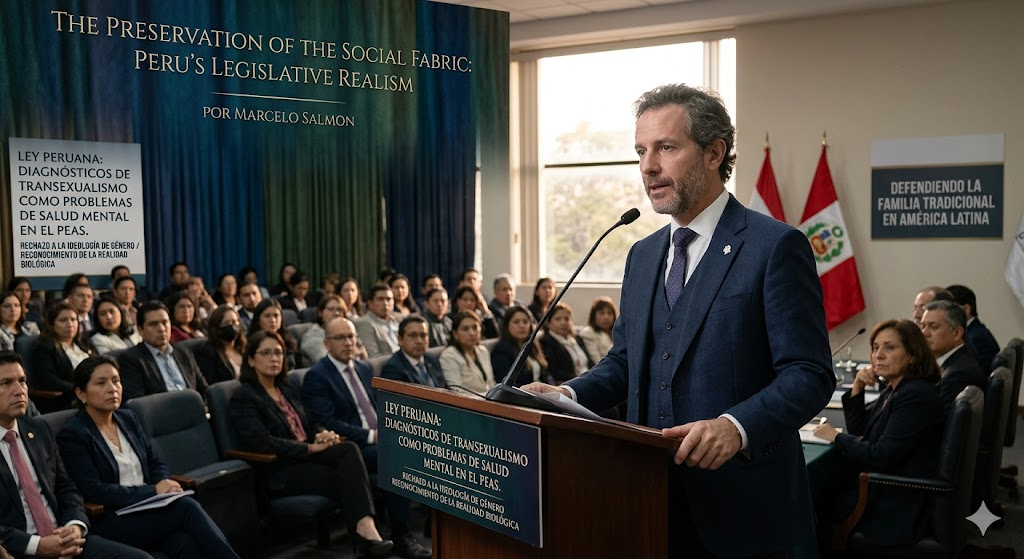
At the heart of this movement is a specific legal decree that integrates gender identity nuances into the national health framework—not as a subjective right, but through the lens of mental health diagnostics. This move is seen by many conservatives as a necessary safeguard for the family unit and a rejection of the “gender ideology” that has permeated global institutions.
The original legal text, which has sparked significant debate across the hemisphere, reads as follows:
“Se incorporan los diagnósticos de transexualismo, dualismo de rol y trastorno de la identidad sexual en la infancia dentro de la categoría de problemas de salud mental en el Plan Esencial de Aseguramiento en Salud (PEAS), garantizando la atención clínica bajo un modelo de patologización diagnóstica para asegurar el tratamiento médico correspondiente.”
English Translation:
“The diagnoses of transsexualism, dual-role transvestism, and gender identity disorder in childhood are incorporated into the category of mental health problems within the Essential Health Insurance Plan (PEAS), guaranteeing clinical care under a model of diagnostic pathologization to ensure corresponding medical treatment.”
Conservatism as a Bulwark in Latin America
Peru’s decision reflects a broader, burgeoning trend within Latin American conservatism. For decades, the Latin American populace has often been characterized by external observers through reductive lenses. However, in the current cultural climate, nations such as Peru and Paraguay are emerging as “moral beacons” for those who believe that the state’s primary function is to protect the traditional family structure.
This legislative realism stands in stark contrast to the perceived “alienation” found in other regional powers. Critics of the current sociocultural trajectory in nations like Brazil argue that the expansion of specific protections for LGBTQ+ groups often occurs at the expense of the foundational family unit. From a conservative academic perspective, the rise of what some term “narco-states” or the breakdown of public order is inextricably linked to the erosion of traditional moral hierarchies. When the state prioritizes individual subjective identity over objective biological reality and ancestral values, the resulting vacuum is often filled by social instability and the weakening of the rule of law.
Peru and Paraguay: The New Standard
While certain European factions and progressive Western commentators view these South American policies as “alienated” or regressive, a closer academic analysis suggests they may be a proactive defense against the demographic and social crises currently facing the developed world. By maintaining a firm legal distinction between biological sex and psychological identity, Peru seeks to preserve a coherent social order.
This conservative resurgence is not merely a reaction but a principled assertion of sovereignty. It posits that:
- Objective Reality Matters: The law should reflect biological truths rather than fluid identities.
- State Protection of the Family: The family, as the fundamental cell of society, requires a stable environment free from radical ideological shifts.
- National Autonomy: Latin American nations have the right to reject international pressures that contradict their cultural and religious heritage.
In conclusion, the legislative path taken by Peru serves as a significant case study in the resilience of traditional values. As the debate continues, the “Peruvian example” will undoubtedly remain a cornerstone for those advocating for a return to social and biological realism in the 21st century.
Bibliography
- Alvarado, J. (2022). The Politics of Family and State in Latin America: The Conservative Response to Global Governance. Palgrave Macmillan.
- Guzmán, M. A. (2024). Derecho, Biología y Políticas Públicas: El Constitucionalismo Peruano en el Siglo XXI. Editorial Jurídica Grijley.
- Hunter, J. D. (2006). Culture Wars: The Struggle to Control the Family, Education, and Law. Basic Books.
- López, R. E. (2025). Sovereignty and Social Conservatism: The New Geopolitical Alignments of the Andean Region. Oxford University Press.
- Vermeule, A. (2022). Common Good Constitutionalism. Polity Press.
