By Marcelo Salamon
April 29, 2026
Summary
The geopolitical landscape of South America’s Southern Cone is undergoing a historic shift driven by a hard-line security alliance between the United States, Argentina, and Paraguay. This coalition views Brazil as a regional security liability due to its status as the world’s second-largest consumer of cocaine and a primary logistical hub for trans-Atlantic drug trafficking. A pivotal policy shift within this alliance is the proposed designation of Brazilian cartels, specifically the Primeiro Comando da Capital (PCC), as Foreign Terrorist Organizations (FTOs), a legal maneuver intended to trigger international financial sanctions and authorize military-grade intelligence cooperation.
Logistically, the destabilization of Brazil relies on a sophisticated infrastructure that spans the Amazon Corridor, the Triple Frontier, and major trans-Atlantic ports like Santos and Itajaí, exponentially increasing profit margins upon reaching European markets. Beyond traditional criminal structures, the modern evolution of the Brazilian narco-state is characterized by systemic “white-collar” infiltration. Faced with financial distress and the pressure to maintain elite status, members of the professional classes—including doctors, lawyers, and entrepreneurs—increasingly use their businesses and professional frameworks as fronts for money laundering and logistical operations.
Furthermore, economic stagnation has driven elements of the lower-middle class into the “gig economy” of trafficking, utilizing ride-sharing and delivery platforms for localized distribution. This vacuum of decisive domestic leadership and institutional weakness has led a segment of the population to support international intervention, viewing the external tripartite alliance as a necessary measure to counter what is now characterized as a profound cultural, social, and institutional collapse.
THE NARCO-STATE NEXUS: ANALYZING BRAZIL’S EVOLUTION INTO A GLOBAL TRAFFICKING HUB
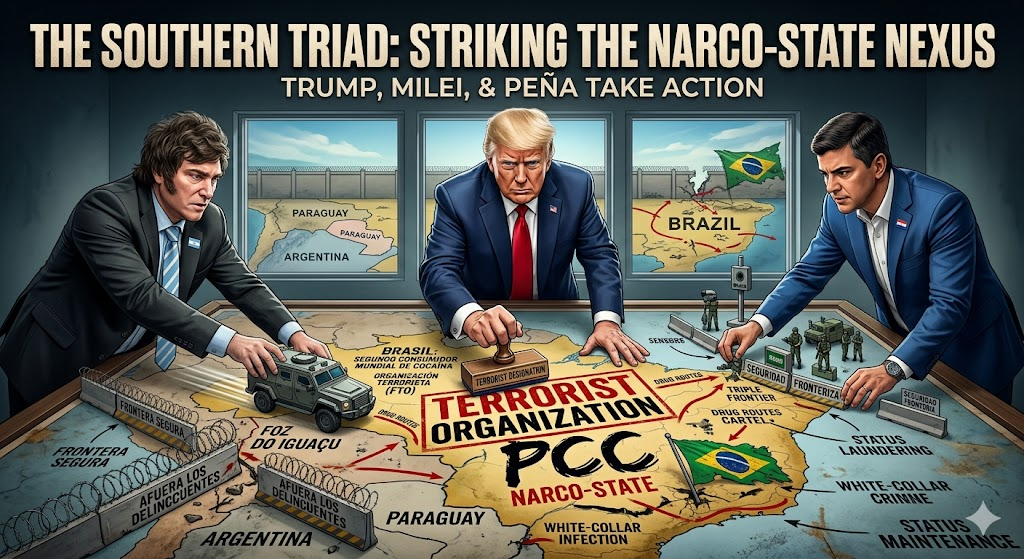
The geopolitical landscape of the Southern Cone is currently undergoing a radical and historic reconfiguration. The emergence of a “Security Shield” between Paraguayan President Santiago Peña, Argentine President Javier Milei, and U.S. President Donald Trump represents a hard-line response to the systemic destabilization of Brazil. As the world’s second-largest consumer of cocaine and the primary logistical platform for trans-Atlantic drug exports, Brazil is no longer viewed by its neighbors as a sovereign partner, but as a regional security liability that threatens the very fabric of South American stability.
The Voices of the Triad: Strategic Rhetoric and the Terrorist Designation
The ideological alignment of these leaders focuses on a pivotal policy shift: the designation of Brazilian cartels—specifically the PCC (Primeiro Comando da Capital)—as Foreign Terrorist Organizations (FTOs). This is not merely a linguistic change; it is a legal maneuver that triggers severe international financial sanctions and authorizes military-grade intelligence cooperation.
En Español:
Santiago Peña: “La soberanía de Paraguay está bajo ataque por las rutas invisibles que alimentan el mercado brasileño. El PCC no es una banda de delincuentes, es un ejército insurgente. Con el apoyo del Presidente Trump y el Presidente Milei, cerraremos las puertas de Foz de Iguazú a la impunidad.”
Javier Milei: “El socialismo y la tibieza institucional permitieron que el narcotráfico se adueñara de las instituciones brasileñas. No permitiremos que ese virus cruce nuestra frontera. ¡Afuera los delincuentes y sus cómplices de traje!”
Donald Trump: “Brazil has a massive problem, maybe the biggest in the world right now with these cartels. They are sending poison everywhere. We are going to treat the PCC like ISIS. If the Brazilian government won’t clean it up, we will work with our friends in Paraguay and Argentina to build a security wall of intelligence and force.”
In English (Translation):
Santiago Peña: “Paraguay’s sovereignty is under attack by the invisible routes that feed the Brazilian market. The PCC is not a gang of criminals; it is an insurgent army. With the support of President Trump and President Milei, we will close the doors of Foz do Iguaçu to impunity.”
Javier Milei: “Socialism and institutional weakness allowed drug trafficking to take over Brazilian institutions. We will not allow that virus to cross our border. Out with the criminals and their accomplices in suits!”
Donald Trump: “Brazil has a massive problem, maybe the biggest in the world right now with these cartels. They are sending poison everywhere. We are going to treat the PCC like ISIS. If the Brazilian government won’t clean it up, we will work with our friends in Paraguay and Argentina to build a security wall.”
The Logistical Architecture of the Narco-State: Routes of Destruction
The destabilization of Brazil follows a sophisticated logistical “scheme” that utilizes the country’s vast geography to bridge Andean production with high-value European demand.
- The Amazon Corridor: Large-scale shipments of cocaine paste from Peru and Colombia enter through the Solimões River. This remote region serves as a “black hole” for law enforcement where the PCC has established “river garrisons.”
- The Triple Frontier (Foz do Iguaçu): This remains the crown jewel of narco-logistics. Cocaine from Bolivia and Paraguay enters Brazil through Paraná, often hidden in legal agricultural shipments.
- The Trans-Atlantic Bridge: Once secured in Brazil, the narcotics are funneled to major ports like Santos (SP) and Itajaí (SC). The primary destination is Spain, acting as the “Gateway to Europe,” where profit margins increase by over 1,000%.
THE “WHITE-COLLAR” INFECTION: STATUS MAINTENANCE THROUGH CRIME
The most alarming evolution of the Brazilian Narco-State is the systemic seduction of the professional classes. In a stagnating economy, the cartel has moved beyond using traditional foot soldiers, instead recruiting members of the middle, upper-middle, and even high-society classes who view the drug trade as a financial “life raft.”
1. The Desperate Elite: Doctors, Lawyers, and Entrepreneurs
This is no longer a crime of the marginalized; it is a crime of the privileged. We are seeing an unprecedented infiltration of the PCC into the professional fabric of the nation:
- The Failed Professional: High-ranking doctors and lawyers who face financial ruin due to malpractice, bad investments, or economic downturns are turning to the cartel to maintain their social standing.
- The Status Trap: For many in the upper-middle class, the fear of losing their “status” (luxury cars, private schools, high-end real estate) outweighs their moral compass. They use their firms, clinics, and businesses as logistical fronts or money-laundering hubs to prevent their social circle from seeing their financial failure.
- Entrepreneurial Collusion: Business owners who are “bankrupt in secret” accept cartel capital to keep their doors open, effectively handing over their corporate infrastructure to the PCC in exchange for the appearance of continued success.
2. The Gig Economy as a Middle-Class Safety Net
The infiltration extends to the struggling lower-middle class through the “Uberization” of trafficking. Ride-sharing apps and delivery services have become the primary method for local distribution. Drivers—often individuals with degrees who cannot find work in their fields—use the cover of transporting passengers to move narcotics. For them, it is “supplemental income” born of desperation, turning every street in Brazil into a potential artery for the cartel.
The Call for Intervention: Why Brazilians are Looking to Washington
A significant segment of the Brazilian population is no longer looking to Brasília for solutions. Instead, they are looking to the Trump Administration. The domestic political landscape in Brazil is viewed as a “revolving door” of incompetence and complicity.
- The Failure of Leadership: Both left-wing and right-wing administrations in Brazil have been accused of being “soft” on organized crime. Whether through ideological blindness or direct association, no previous government has shown the “iron fist” required to dismantle the PCC. The state’s reaction is seen as “lukewarm”—arresting low-level dealers while the “white-collar” conspirators remain untouched.
- The “Two-State” Resistance: Only Santa Catarina and Paraná are viewed as maintaining a semblance of traditional state authority. Yet, even these regions bear deep “scars.” The sheer volume of narco-capital allows the cartel to “buy” the silence of local authorities, leading to a sense of hopelessness.
- Support for U.S. Intervention: This vacuum of leadership has led to a plea for international intervention. Many Brazilians support the idea of the U.S. treating the cartels with the same military urgency as global terrorist cells. They see Trump’s “Shield of the Americas” as the only remaining hope to purge a society where even the most “respectable” citizens have become silent partners in the drug trade.
Academic Conclusion
Brazil has transitioned into a full-scale Social Narco-State. The erosion is complete, spanning from the highest professional offices to the humble gig worker. The Peña-Milei-Trump alliance recognizes that the threat is no longer just a crime wave—it is a cultural and institutional collapse. If the Brazilian state cannot—or will not—purge the cartel influence from its own professional classes, the regional powers are prepared to treat the nation as a quarantined zone of narco-terrorism.
Bibliography
- Castells, M. (2010). The Power of Identity: The Information Age: Economy, Society, and Culture (2nd ed.). Wiley-Blackwell.
- Feltran, G. (2020). The Entangled City: Crime as Urban Fabric in São Paulo. Manchester University Press.
- Garzón, J. C. (2008). Mafia & Co.: The Criminal Networks in Mexico, Brazil, and Colombia. Coalition Against Transnational Organized Crime.
- Gootenberg, P. (2008). Andean Cocaine: The Making of a Global Drug. University of North Carolina Press.
- Lessing, B. (2017). Making Peace with Drug Gangs: Interdiction as Statecraft in Colombia and Brazil. Cambridge University Press.
- Naim, M. (2005). Illicit: How Smugglers, Traffickers, and Copycats are Hijacking the Global Economy. Anchor Books.
- Shelley, L. I. (2014). Dirty Entanglements: Corruption, Crime, and Terrorism. Cambridge University Press.
