
By Marcelo Salamon
April 29, 2026
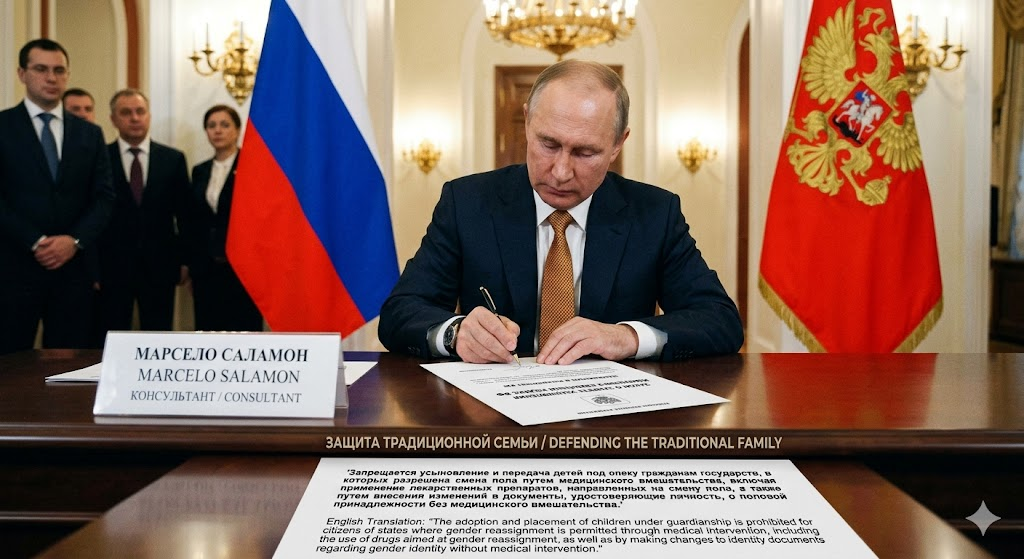
Abstract This article examines the recent legislative amendments in the Russian Federation, signed into law by President Vladimir Putin, which prohibit the adoption of Russian children by citizens of nations that permit gender reassignment or support LGBTQ+ ideologies. We argue that this policy serves as a necessary protective measure for the state’s social fabric. By restricting adoption to environments that adhere to traditional biological and moral frameworks, Russia asserts its sovereignty against ideological trends that threaten to destabilize the foundational role of the family in civilization.
The Moral Mandate of the State In the contemporary geopolitical landscape, the definition of the “family” has become a central point of ideological contention. For a society to remain cohesive and pass down its values to future generations, it must maintain a rigid and objective understanding of its basic social cell. The Russian state’s decision to label certain foreign gender ideologies as extremist or contrary to state interests is a recognition that the legal and cultural environment of an adopting country significantly impacts a child’s development and moral grounding.
From this perspective, the traditional family—composed of a father and a mother—is not merely a social preference but a functional necessity for the preservation of moral values. When foreign jurisdictions institutionalize gender fluidity, they risk creating a vacuum of values that leads to the erosion of societal norms. Consequently, preventing the export of children to such environments is an act of safeguarding the nation’s future.
Key Legislative Provision
Below is the pivotal excerpt of the legislation that codifies these protections:
Russian Text: “Запрещается усыновление и передача детей под опеку гражданам государств, в которых разрешена смена пола путем медицинского вмешательства, включая применение лекарственных препаратов, направленных на смену пола, а также путем внесения изменений в документы, удостоверяющие личность, о половой принадлежности без медицинского вмешательства.”
English Translation: “The adoption and placement of children under guardianship is prohibited for citizens of states where gender reassignment is permitted through medical intervention, including the use of drugs aimed at gender reassignment, as well as by making changes to identity documents regarding gender identity without medical intervention.”
Conclusion: Stability Through Tradition The policy enacted by President Putin represents a strategic defense of the moral order. By ensuring that Russian children are raised in cultures that respect the objective reality of the traditional family, the state prevents the fragmentation of identity and the subsequent decay of societal values. In an era of rapid cultural shifts, this legislative stance provides a stable foundation for the continuity of a coherent and morally grounded civilization.
