
By Marcelo Salamon
April 29, 2026
Summary
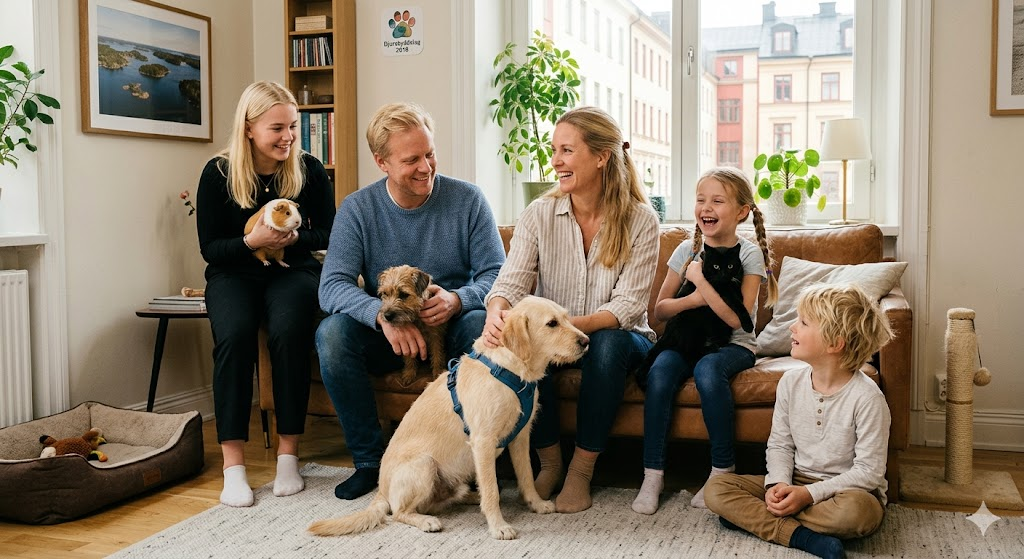
The provided text details Sweden’s progressive philosophical and legislative shift regarding animal welfare, specifically focusing on the treatment of dogs and cats. It highlights how Swedish culture and law have moved past viewing pets as mere “property,” instead recognizing them as sentient, integral family members.
This ethos is codified in the Swedish Animal Welfare Act (Djurskyddslag 2018:1192), enacted on April 1, 2019, which mandates “positive welfare”—requiring owners to actively promote their pets’ psychological health and natural behaviors. Backed by modern ethology and a recognition of animal intelligence, the Swedish model integrates pets into public life and enforces strict regulatory standards, such as ensuring animals have access to natural light and limiting the time a dog can be left alone to a maximum of six hours to prevent isolation distress. Ultimately, the text frames the human-pet relationship as an egalitarian bond of reciprocal affection and moral responsibility.
A Philosophical and Legislative Paradigm Shift
In the contemporary Swedish landscape, the domestic animal has transcended the archaic legal definitions of “property” to occupy a profound space within the social fabric. While many global jurisdictions are still grappling with the nuances of animal rights, Sweden has solidified an advanced cultural and legal framework that officially recognizes pets—specifically dogs and cats—as sentient, integral members of the family unit. This shift is not merely sentimental; it is a rigorous integration of ethical responsibility into the daily lives of citizens. The Swedish approach posits that the presence of a pet is a privilege that carries a heavy mandate of care, ensuring that these creatures are never relegated to the periphery of human existence.
This transition reached its legislative zenith with the comprehensive Swedish Animal Welfare Act (Djurskyddslag 2018:1192), which was formally enacted on April 1, 2019. Homologated by the Riksdag (the Swedish Parliament) and meticulously overseen by the Swedish Board of Agriculture (Jordbruksverket), this legislation revolutionized the standards of domestic care. Unlike previous iterations that focused primarily on the prevention of overt cruelty, the 2019 Act introduced a proactive requirement for “positive welfare.” It mandates that animals be kept in an environment that actively promotes their psychological health and facilitates their natural behaviors, effectively codifying the pet’s right to a high quality of life.
“Djuren ska hållas och skötas i en god djurmiljö och på ett sådant sätt att det främjar deras hälsa och ger dem möjlighet att bete sig naturligt.”
Translation: “Animals shall be kept and cared for in a good environment and in such a way that promotes their health and allows them to behave naturally.”
The Science of Sentience and Cognitive Intelligence
The Swedish model is deeply rooted in the scientific recognition of animal sentience and cognitive complexity. Modern ethology has demonstrated that pets possess a sophisticated level of emotional intelligence that allows them to navigate the intricacies of human relationships with remarkable precision. These animals are not merely reactive; they are highly adaptive beings that synchronize their internal rhythms with those of their human counterparts. They possess the capacity to interpret subtle vocal inflections, recognize facial micro-expressions, and offer empathetic support, demonstrating a level of cognitive depth that mirrors the social bonding seen in higher primates.
This intelligence manifests in their extraordinary ability to adapt to family life. Whether it is a dog understanding the sequence of events that leads to a morning walk or a cat claiming a specific place in the household hierarchy, these creatures display a “theory of mind” that allows them to anticipate human needs. Because they are endowed with feelings and a high degree of social intelligence, they don’t just exist alongside us; they live with us. This realization places a moral burden on the owner to reciprocate. If a pet offers unconditional devotion and adapts its entire life to fit our domestic structures, it is only logical—and ethically necessary—that we offer them the same consistency of attention, comfort, and emotional security.
Exemplary Behavior and Reciprocal Affection
The behavior of the Swedish population toward their animal companions serves as a global gold standard for civil society. In Sweden, the integration of pets into the public sphere—ranging from workplaces to sophisticated transit systems—is a testament to a society that has mastered the “social contract” between species. This exemplary conduct is built on the fundamental understanding that pets are not objects of convenience, but living entities that require mental stimulation and social contact. For instance, the law suggests that dogs should not be left alone for more than six hours, reflecting a societal consensus that loneliness is a form of neglect.
Ultimately, the bond we share with these creatures is one of the few truly egalitarian relationships left in the modern world. Regardless of our social status, our financial achievements, or who we are in the eyes of the world, our pets offer a devotion that is pure and unwavering. They see the essence of the human being rather than the accolades. In return, they expect nothing more than the same carinho—the same warmth and protection—that they so freely give. To treat a pet as a family member is to acknowledge a fundamental truth: that their intelligence and capacity for love make them our equals in the pursuit of a life well-lived.
Key Regulatory Standards of the Swedish Model
Beyond the general philosophy of the law, the specific requirements are quite rigorous. Owners must ensure that their animals have access to natural light and a restful environment that caters to their biological needs. Furthermore, the legal framework emphasizes the necessity of social contact; a dog must be given human or animal interaction at least every six hours to prevent the psychological distress of isolation. There is also a formal obligation to provide “environmental enrichment,” which involves providing the animals with tasks and toys that challenge their intellect and prevent the onset of boredom-related behaviors. By treating these requirements as legal duties rather than optional kindnesses, Sweden ensures that every pet truly lives as a respected member of the family.
Bibliographic References
- Sveriges Riksdag (Swedish Parliament). (2018). Djurskyddslag (2018:1192) [Animal Welfare Act]. Stockholm: Ministry of Rural Affairs and Infrastructure.
- Statens jordbruksverk (Swedish Board of Agriculture). (2019). Regulations and General Advice on the Keeping of Dogs and Cats. Jönköping: Jordbruksverket.
