
By Marcelo Salamon
29.07.2026
Abstract
This article recounts the tragic history of World War II and the mass atrocities committed against the Jewish people by Nazi Germany and its allies. It details life within the concentration camps, the pervasive use of torture, and the reality of camps explicitly designed for mass extermination, such as Treblinka. The narrative proceeds to examine daily life in the camps, the treatment inflicted upon victims, the means of survival, and the experiences of survivors both in the immediate months following liberation and in the years that followed.
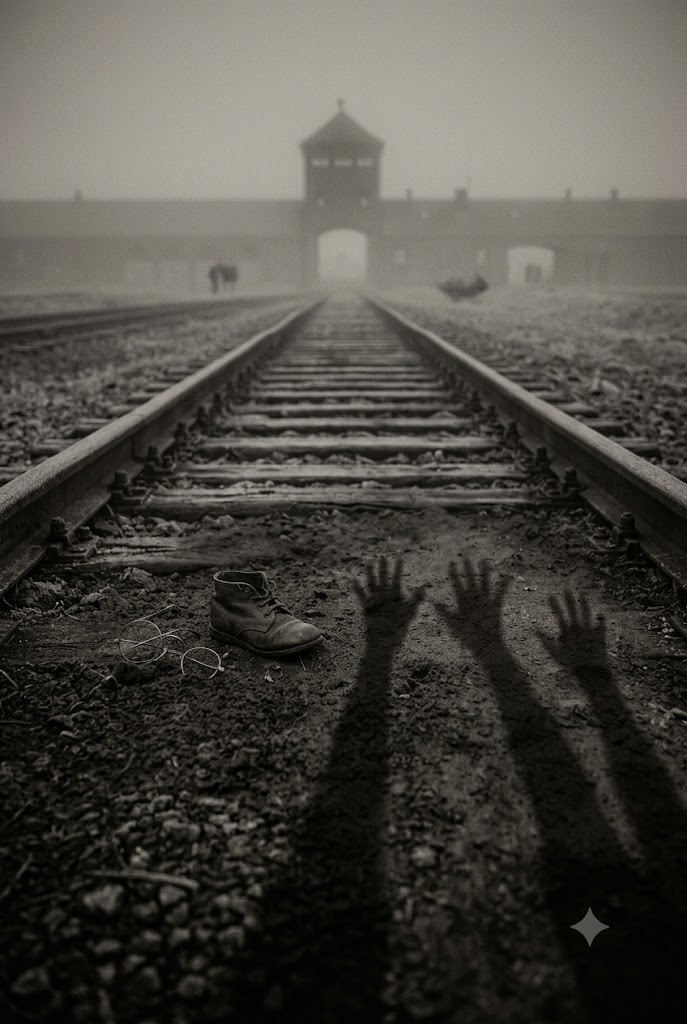
Key phrases: Holocaust Memorial, Auschwitz Railway, Desolate Remembrance
Introduction
Between 1941 and 1945, the Nazi regime established a system of camps that, although often treated as a single monolith in collective memory, served distinct functions within the Third Reich’s extermination machine. Understanding these differences is not merely a historical matter: it is essential to the criminological analysis of the acts committed, the chain of command responsible, and how these crimes would shape international criminal law decades later.
Historical and Legal Context
The persecution of Jews and other groups (Romani, political prisoners, homosexuals, people with disabilities) was not a spontaneous or uncontrolled process—it was a state policy, articulated and formalized through legal and bureaucratic instruments. The Nuremberg Laws (1935) had already stripped the Jewish population of civil rights years before the war began, laying the legal foundation for systematic exclusion.
The turning point occurred in January 1942 at the Wannsee Conference in Berlin, when high-ranking officials of the regime formalized the plan known as the “Final Solution” (Endlösung)—the decision to systematically exterminate the Jewish population of Europe. The meeting lasted less than two hours, but its partially preserved minutes became one of the most vital documents for proving the intent and premeditation of genocide before international tribunals later on.
This bureaucratic and documented nature of the crimes—written orders, efficiency reports, administrative protocols—is what still allows us today to reconstruct with criminological precision how the system functioned and who was responsible at every link in the chain.
Structure and Typology of the Camps
Treating all Nazi camps as equivalent or interchangeable structures is a major error in popular historiography and common perception. From a criminological, operational, and logistical standpoint, Reichsführer-SS Heinrich Himmler and the Concentration Camps Inspectorate (IKL) designed a strictly segmented functional typology, divided into at least two major operational categories:
- Concentration and Forced Labor Camps (Konzentrationslager – KL): Exemplified by Auschwitz I and III-Monowitz, Dachau, Buchenwald, Mauthausen, and Sachsenhausen. These were facilities designed primarily for punitive custody, political terror, and the systematic exploitation of slave labor to the limit of biological exhaustion. They operated in close cooperation with German industrial conglomerates (such as IG Farben at Monowitz). In these camps, extermination occurred continuously, though secondarily in terms of immediate pace, taking place through chronic malnutrition, grueling work shifts, and physical abuse.
- Pure Extermination Camps (Vernichtungslager): Designed and operated under “Operation Reinhard” (Aktion Reinhard)—such as Treblinka II, Sobibor, and Belzec—along with Chełmno (Kulmhof). These facilities were literal death factories, lacking real capacity for long-term housing or infrastructure for ongoing labor exploitation. Their layout was engineered to receive, strip, murder with gas, and cremate thousands of people within a matter of hours after their arrival off the train cars.
This functional and criminological distinction is fundamental to understanding the victim’s dynamic of survival: while a prisoner’s stay in a labor camp like Monowitz could stretch on for weeks, months, or rarely years, in an Operation Reinhard camp, the average life expectancy after stepping onto the platform was measured in minutes or a few brief hours.
In terms of absolute survival, the disparity reflects the radical nature of these complexes: it is estimated that fewer than 100 prisoners survived the pure extermination camps of Operation Reinhard (Treblinka, Sobibor, and Belzec) through the end of the war. Of these, the vast majority escaped only due to armed revolts and desperate escapes organized by the inmates themselves (such as the revolts at Treblinka in August 1943 and Sobibor in October 1943). Following liberation and the end of the conflict, hundreds of thousands of survivors of the broader concentration camp system faced the phenomenon of “post-liberation collapse,” in which between 10% and 20% of those rescued by Allied troops died in the subsequent weeks due to typhus, severe malnutrition, and refeeding syndrome.
Treblinka—The Mass Killing Machine
Located roughly 60 miles northeast of Warsaw, Treblinka II represented the peak of technical and logistical refinement of Operation Reinhard. Unlike the Auschwitz complex, where a preliminary medical selection separated a minimal fraction of prisoners for slave labor, Treblinka operated under the principle of immediate and total extermination. Virtually 100% of the rail transports entering the camp’s private spur were led directly into the liquidation process without any formal identity registration, issuance of numbers, or tattooing of deportees.
The engineering of crime at Treblinka utilized psychological deception and camouflage as operational tools of containment. The camp’s train station was deliberately disguised with fake clocks, simulated train schedules, and baggage windows to convey an illusion of normality and operational transit to newly arrived victims. Upon unloading, deportees were instructed to hand over their belongings and proceed to the “disinfection bath” prior to alleged transfer to labor camps in the East. This strategy drastically reduced collective panic, disarmed resistance, and enabled the peaceful escort of thousands of people down a corridor fenced with camouflage netting (the “Road to Heaven” or Himmelfahrtstraße) to the gas chambers fueled by internal combustion engine exhaust.
Criminologically, the use of systematic fraud functioned as a force multiplier, allowing an extremely small garrison—comprising roughly 20 to 30 German and Austrian SS officers and approximately 90 to 120 auxiliary guards (Trawnikis, recruited mainly from Soviet prisoners of war)—to manage and execute the mass murder of more than 800,000 people between July 1942 and October 1943.
The volume of survivors from Treblinka is one of the most chilling indicators of this model’s efficiency: only about 60 to 70 individuals managed to survive the camp and the end of the global conflict. Every single one of these survivors belonged to the Sonderkommandos—units of prisoners forced to handle bodies, extract gold teeth, and cremate corpses—from which a fraction managed to escape during the armed revolt on August 2, 1943. Of those who managed to cross the barbed-wire fences and hide in the surrounding forests, dozens were captured and killed before the arrival of the Red Army, leaving a tiny fraction who actually achieved final liberation and post-war survival.
Auschwitz-Birkenau and the “Selection”
The Auschwitz complex (comprising Auschwitz I – Stammlager, Auschwitz II – Birkenau, and Auschwitz III – Monowitz, along with dozens of subcamps) operated under a hybrid, expanded functional model. It combined the functions of a concentration camp, political detention center, slave labor supplier for the German military-industrial complex, and mass extermination center equipped with gas chambers powered by the agricultural pesticide Zyklon B (hydrogen cyanide).
The backbone of the selection process at Birkenau was the Selektion, conducted directly on the railway platform (Judenrampe). Under the direct supervision of the SS medical corps, deportees were divided into two main lines immediately upon exiting the freight cars. The triage was based on a quick visual assessment of labor capacity, age, apparent physical condition, and economic utility:
- Children, the elderly, pregnant women, mothers with young children, the sick, and people with visible physical disabilities were summarily sent to immediate death in the gas chambers of Crematoria II, III, IV, and V.
- A minority of young, healthy adults (often between 10% and 25% of the total transport) was temporarily spared and funneled into the forced labor system, receiving a serial number tattooed onto their left forearm—a bureaucratic practice unique to the Auschwitz complex.
From a criminological and sociological perspective, the Selektion institutionalized the extreme reification of the individual, reducing the ontological value of human life strictly to its short-term economic exchange value.
Over the period of the complex’s operation, an estimated 1.3 million people were deported to Auschwitz, of whom approximately 1.1 million perished. When troops from the Red Army’s 322nd Rifle Division liberated Auschwitz on January 27, 1945, they found only about 7,000 surviving prisoners in the main camp and Birkenau, most in states of extreme emaciation and illness. In the months following liberation, despite the medical efforts of Soviet and Polish rescue teams, over 2,000 of these newly liberated survivors died due to irreversible complications from starvation, tuberculosis, and epidemic typhus. Ultimately, about 200,000 prisoners who passed through the Auschwitz complex managed to survive the war, mostly because they had been previously evacuated on “death marches” to other camps within German territory.
The Experiments of Josef Mengele
Dr. Josef Mengele, appointed chief physician of the Romani family camp (Zigeunerfamilienlager) at Birkenau in 1943, embodies the ultimate perversion of medical ethics and science under an authoritarian regime. Backed by the Kaiser Wilhelm Institute of Anthropology, Human Heredity, and Eugenics in Berlin, Mengele utilized the concentration camp infrastructure to conduct human genetic and pseudoscientific research completely devoid of ethical boundaries or experimental consent.
His protocols focused primarily on identical twins, dwarfs, individuals with heterochromia, and people with congenital anomalies. The formal goal was to isolate genetic factors that could accelerate the birth rate of the “Aryan race” and substantiate the regime’s racial purity theories. In practice, his forensic and surgical interventions included:
- Injecting chemical substances and dyes directly into the eyeballs of living prisoners in an attempt to permanently change eye color.
- Amputations, organ extractions, and complex surgical procedures performed without any form of anesthesia.
- Cross-transfusions of blood between non-matching twins, inducing lethal hemolytic reactions.
- Deliberate inoculation of pathogenic agents (such as typhus bacteria and typhoid fever) to monitor immune system response times.
- Simultaneous murder of pairs of twins via intracardiac injections of phenol to perform immediate comparative autopsies.
Analyzed through the lens of forensic criminology, Mengele’s case illustrates the capture and instrumentalization of medical ethics by a state eugenic ideology. Science ceased to serve as a safeguard of life and was transformed into a technology of torture and elimination. The revelation of these practices during post-war trials played a decisive role in drafting the Nuremberg Code (1947), a landmark document in bioethics and international criminal law that established the absolute necessity of voluntary, free, and informed consent from human subjects in any scientific research.
Out of approximately 1,500 pairs of twins (around 3,000 children and youths) who passed through Josef Mengele’s hands at Auschwitz-Birkenau, it is estimated that fewer than 200 individuals survived until the camp was liberated in January 1945. The vast majority died during the experiments or were murdered immediately after the completion of anthropometric measurements. Among the survivors rescued by Soviet forces, dozens suffered permanent mutilations, chronic deformities, and severe psychological trauma, with a considerable number passing away in subsequent years due to medical complications stemming from the procedures they endured.
Other Forms of Torture and Death
Beyond mass extermination via industrial gas chambers, the military and administrative structure of the camps deployed multiple secondary mechanisms of mortality and torture, applied in a methodical and continuous manner:
- Planned Starvation: Daily caloric intake for prisoners was bureaucratically fixed between 700 and 1,000 calories—consisting of watery soups made from rotting vegetables and small portions of adulterated bread—an amount manifestly insufficient to sustain basic biological functions under heavy labor. This condition induced the clinical state known as the “Muselmann” (Muselmann), characterized by profound apathy, severe loss of muscle mass, and irreversible metabolic collapse.
- Extermination Through Labor (Vernichtung durch Arbeit): An operational directive agreed upon by the SS and the Reich Ministry of Justice, designed to wear down prisoners physically through extreme exertion—such as digging tunnels, manually hauling rocks in stone quarries (such as the “Stairs of Death” at Mauthausen), and building railway lines—until cardiorespiratory collapse occurred.
- Summary Executions: Daily practices of death by firing squad (often via shots to the back of the neck at the Pistolenstand or at the execution wall, such as Block 11 at Auschwitz) and public hangings in assembly grounds (Appellplatz), used as coercive instruments of psychological control and collective terror.
- Disease and Sanitary Neglect: The absence of potable water, adequate sewage, and chronic overcrowding turned barracks into permanent breeding grounds for epidemic typhus, bacillary dysentery, and scabies, rendering the lack of medical treatment a passive tool of depopulation.
- Collective and Corporal Punishment: Systematic beatings on the whipping block (Prügelbock), confinement in standing cells where prisoners remained upright for days (Stehbunker), and hanging by wrists tied behind the back (Pfahlhängen). Collective responsibility punished entire blocks for individual escape attempts, eroding solidarity among victims.
The Chain of Command and Criminal Responsibility
For the legal analysis of state crimes, dismantling the Nazi chain of command reveals the transition from pure ideological formulation to direct physical execution:
- Adolf Hitler and the Political Leadership: Formulators of the core political and ideological directive, issuing verbal orders and emergency decrees (Nacht und Nebel) that legally sanctioned extermination.
- Heinrich Himmler and the SS Structure: Head of the SS and German Police, Himmler centralized the administrative and economic management of the concentration camp ecosystem through the SS Main Economic and Administrative Office (SS-WVHA), headed by Oswald Pohl.
- Reinhard Heydrich and Ernst Kaltenbrunner (RSHA): Managers of the Reich Main Security Office, responsible for identification, roundups, railway logistics, and deportation of target populations.
- Camp Commandants: Officers such as Rudolf Höss (Auschwitz), Franz Stangl (Treblinka and Sobibor), Karl-Otto Koch (Buchenwald), and Josef Kramer (Bergen-Belsen), who exercised immediate authority, optimizing killing methods and managing internal discipline.
- Direct Perpetrators and Collaborators: SS guards (SS-Totenkopfverbände), camp physicians, administrative personnel, and auxiliary battalions whose work guaranteed the uninterrupted flow of the elimination process.
This hierarchical architecture enabled International Criminal Law to move past the defense of “superior orders” (“just following orders”) and segment liability among intellectual authors, logistical organizers, and direct perpetrators.
The Nuremberg Trials and the Birth of International Criminal Law
Conducted between November 20, 1945, and October 1, 1946, the International Military Tribunal (IMT) trials at Nuremberg represented an epistemological breakthrough in international law, establishing that individuals—not just sovereign states—can be held criminally liable for egregious violations of international legal order.
The International Military Tribunal prosecuted 24 of the highest political, military, and economic leaders of the Third Reich (such as Hermann Göring, Joachim von Ribbentrop, Wilhelm Keitel, and Ernst Kaltenbrunner) based on an indictment structured around four primary charges:
- Common Plan or Conspiracy: The prior coordination to commit international unlawful acts.
- Crimes Against Peace: Planning, preparing, initiating, or waging a war of aggression or a war in violation of international treaties.
- War Crimes: Violations of the laws or customs of war, including murder, ill-treatment of prisoners of war, and destruction not justified by military necessity.
- Crimes Against Humanity: Murder, extermination, enslavement, deportation, and other inhumane acts committed against civilian populations before or during the war, or persecutions on political, racial, or religious grounds.
This final category—Crimes Against Humanity—was pivotal in bridging a legal gap of the era, enabling the international community to punish atrocities committed by a state against its own citizens or within occupied territories.
Concurrently, Polish-Jewish legal scholar Raphael Lemkin, noting the conceptual gap in codifying acts aimed at destroying specific human groups, coined the term Genocide. Lemkin’s theoretical formulation culminated in the adoption of the Convention on the Prevention and Punishment of the Crime of Genocide by the United Nations General Assembly on December 9, 1948. The Convention defined genocide as acts committed with intent to destroy, in whole or in part, a national, ethnical, racial, or religious group. Nuremberg and the 1948 Convention laid the groundwork for the modern International Criminal Court (Rome Statute).
Criminological Perspective
Understanding the mechanics of Nazi extermination required modern criminology and social sciences to look beyond traditional explanatory models based on individual pathology or isolated moral deviance. The scale and bureaucratic efficiency of the “Final Solution” demanded theories capable of explaining the active cooperation of millions of ordinary individuals in an institutionalized genocidal project.
The first pillar of this criminological framework lies in the concept of the “Banality of Evil,” formulated by philosopher Hannah Arendt in her work Eichmann in Jerusalem (1963). In analyzing the trial of Adolf Eichmann—the SS bureaucrat in charge of the transport logistics for European Jews—Arendt observed that the defendant displayed no signs of clinical psychopathy, blind ideological fanaticism, or severe mental illness. Eichmann functioned as an efficient bureaucrat whose primary motivation was career advancement, strict compliance with administrative goals, and functional conformity. The “evil” he committed became banal not because it was trivial, but because it was carried out without critical reflection on the ethical content of the orders received. Arendt demonstrated that modern bureaucratic structures can sever individual action from its ultimate moral consequences through the meticulous division of labor.
The second pillar rests on state criminology and social psychology, supported by the Obedience to Authority Experiments conducted by Stanley Milgram at Yale University (1961–1963). Milgram empirically proved that an alarming percentage of healthy adult individuals (roughly 65% of participants in the baseline experiment) were willing to administer potentially lethal electric shocks to a third party when instructed to do so by an authority figure possessing perceived legitimacy. The underlying psychological mechanism was termed the “agentic state” by Milgram: a condition in which an individual comes to view themselves merely as an instrument for executing the desires of a higher authority, transferring full moral responsibility for the action to the person giving the order.
In addition, modern forensic criminology incorporates the Techniques of Neutralization (Sykes and Matza), whereby perpetrators activate cognitive mechanisms—such as denial of responsibility, denial of injury, denial of the victim, and appealing to higher loyalties—to legitimize their criminal conduct to their own conscience. In the Nazi context, state propaganda executed a deep linguistic dehumanization of victims (labeling them “parasites” or “subhumans”), substantially lowering the moral barrier to committing atrocities and enabling the continuous operation of a corporate state crime.
Numbers and Scale
The tally of Nazi extermination reflects the application of industrial and administrative methods to mass murder. Although the destruction of evidence and files by SS troops in the final moments of the war necessitates estimated ranges, cross-referencing railway records, transport lists, camp registers, and pre-war census data establishes the following figures:
- Auschwitz-Birkenau: Approximately 1.1 million dead (about 900,000 of whom were murdered in gas chambers immediately upon arrival).
- Treblinka II: Between 700,000 and 900,000 dead, concentrated within an operational window of just 15 months.
- Belzec and Sobibor: Approximately 435,000 and 170,000 dead, respectively.
- Chełmno and Majdanek: Approximately 150,000 and 78,000 dead, respectively.
- Total Holocaust Victims (Shoah): Estimated at approximately 6 million Jews—representing roughly two-thirds of the European Jewish population at the time.
- Other Victims of the Nazi Regime: Between 5 and 7 million other individuals, including roughly 3.3 million Soviet prisoners of war, hundreds of thousands of Romani (Gypsies), non-Jewish Polish and Slavic civilians, individuals with physical and mental disabilities (killed under the Aktion T4 Program), political dissidents, homosexuals, and Jehovah’s Witnesses.
Conclusion
The criminological-forensic analysis of these events seeks not only to document the horror, but to comprehend the institutional, legal, and psychological mechanisms that enabled a crime of this magnitude—and how the international legal response born in Nuremberg continues to shape modern international criminal law today. This will serve as the starting point for the second article in this series, which will address the physical and psychiatric consequences faced by survivors following the liberation of the camps.
Bibliographical References
ARENDT, Hannah. Eichmann in Jerusalem: A Report on the Banality of Evil. New York: Viking Press, 1963.
BROWNING, Christopher R. Ordinary Men: Reserve Police Battalion 101 and the Final Solution in Poland. New York: HarperCollins, 1992.
EVANS, Richard J. The Third Reich in Power. New York: Penguin Press, 2005.
HILBERG, Raul. The Destruction of the European Jews. 3rd ed. New Haven: Yale University Press, 2003.
LEMKIN, Raphael. Axis Rule in Occupied Europe: Laws of Occupation, Analysis of Government, Proposals for Redress. Washington, D.C.: Carnegie Endowment for International Peace, 1944.
MILGRAM, Stanley. Obedience to Authority: An Experimental View. New York: Harper & Row, 1974.
UNITED STATES CHIEF OF COUNSEL FOR PROSECUTION OF AXIS CRIMINALITY. Nazi Conspiracy and Aggression (Nuremberg Trials Documents). Washington, D.C.: U.S. Government Printing Office, 1946.
