
By Marcelo Salamon
june 03, 2026.
Executive Summary
This article provides a geopolitical and institutional analysis of the new $12,5 % customs tariff proposed by the United States against Brazil in June 2026, driven by systemic failures in eradicating forced labor. Utilizing a forensic criminological framework, it exposes the stark contrast between Brazil’s diplomatic rhetoric and its reality of domestic impunity. This is illustrated by the BYD auto plant case in Bahia and the recurring exploitation of migrant workers from Bahia, Argentina, and indigenous communities under conditions analogous to slavery within the vineyards and industries of Rio Grande do Sul (specifically Bento Gonçalves, São Marcos, and Caxias do Sul). The piece denounces a striking paradox: the Rio Grande do Sul state government awarded over $70,6$ million in tax incentives to the very wineries involved immediately following the scandals—subsidized by abusive tax rates that choke the local population. Finally, it uncovers a deeper moral decay within the state, characterized by collusion within the labor courts involving influential power circles to shield major corporations, while weaponizing harsh penalties against emerging small businesses. This toxic ecosystem has ultimately triggered the largest population exodus in the history of Rio Grande do Sul, leaving the state chronically dependent on a vulnerable, outsourced foreign workforce.
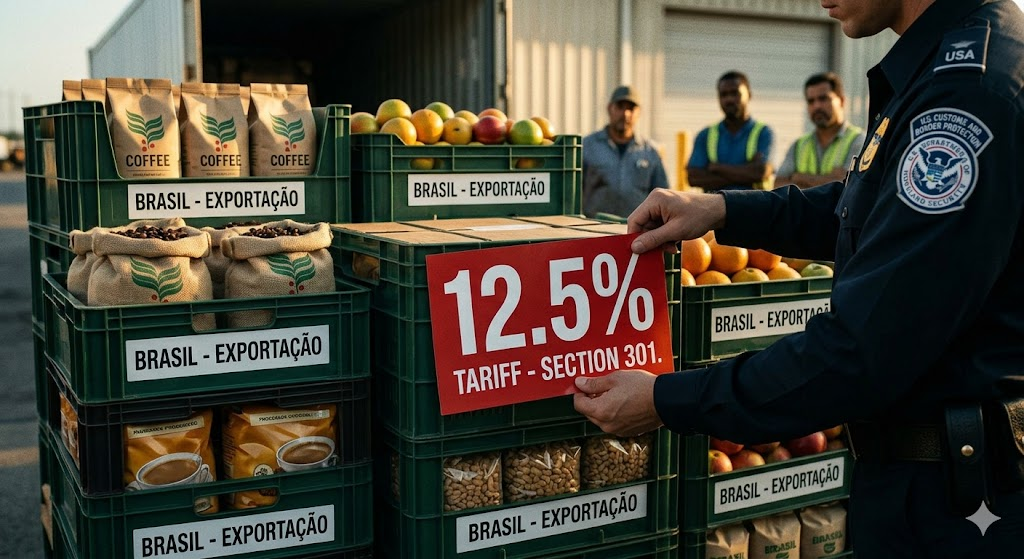
Brazil is currently facing one of its greatest crises of international reputation and commercial sovereignty. On June 2, 2026, the United States government, through the Office of the United States Trade Representative (USTR), proposed a new 12,5% customs tariff on Brazilian imports. Enforced under Section 301 of the Trade Act of 1974, this measure is the result of an expedited investigation launched in March 2026, which found severe failures by the Brazilian government to effectively enforce prohibitions against importing goods produced with forced labor.
This new trade penalty comes on top of a separate 25% tariff proposed just a day earlier, stemming from another investigation into Brazil’s “unreasonable practices” regarding trade with the U.S., creating an unprecedented economic bottleneck and international isolation. During the Section 301 proceedings, nearly 60 witnesses were heard and roughly 500 written comments were reviewed. While economies like Argentina and the European Union were granted a lower additional tariff of 10%, Brazil was lumped into a group of 46 nations hit hard with the full 12,5% penalty.
Although diplomats in Brasília—in an official document signed by Foreign Minister Mauro Vieira—are attempting to fight the sanctions by claiming the country is a global model for labor enforcement (citing the rescue of 3,190 workers in 2023 and 2,772 in 2025), forensic data and the reality on the ground tell a story of structural impunity. The American intervention shines a glaring light on a broken system, where economic exploitation through skyrocketing taxes serves merely to bankroll a political and judicial structure that is incompetent, neglectful, and complicit in human rights abuses.
The Achilles’ Heel of Brazilian Defense: The BYD Case and Political Interference
The first major blow to Brazil’s credibility before the USTR occurred in the Northeast, involving Chinese automotive giant BYD during the construction of its manufacturing plant in Camaçari, Bahia. From a forensic criminological standpoint, this case became a textbook example of transnational human trafficking and institutional frailty.
Labor inspections launched in December 2024 identified up to 224 Chinese laborers subjected to degrading conditions by BYD. Investigations revealed the fraudulent immigration of 471 workers, crowded housing with only one bathroom for every 31 people, an absolute lack of mattresses, exhausting 10-hour workdays, and the heavy presence of armed guards. Even though BYD was promptly placed on the government’s official “Dirty List” of Slave Labor, a labor court injunction wiped the company from the registry just two days later. Four days after the listing, the National Secretary of Labor Inspection was quietly dismissed from his post. This blatant political meddling to protect foreign capital completely derailed Brazil’s argument of regulatory rigor in the eyes of the U.S. government.
Horror in the Vineyards: The Recent History of Exploitation in the South
In Rio Grande do Sul, the criminological landscape takes on an even more dramatic tone, blending regional prejudice with the systematic exploitation of both domestic migrants and foreign workers. The 2026 American sanction is the direct consequence of a recent history of chronic abuse that local authorities failed to properly penalize:
- The Bento Gonçalves Scandal (February 2023): A joint task force rescued 207 workers who were harvesting grapes for three of the largest and most prestigious wine and champagne brands in the country: Aurora, Garibaldi, and Salton. Approximately 84% of the victims were Black men trafficked from the state of Bahia under false promises of a $3.000$ salary, free housing, and meals. Upon arrival, they were trapped in a debt-slavery ring, forced to buy goods at inflated prices from a company-owned store, and subjected to systematic violence managed by a shell company named Fênix Serviços Administrativos (which evaded tax authorities by constantly changing corporate registration numbers). Eyewitness accounts detailed shifts running from 4:00 AM until 11:00 PM (20-hour workdays), spoiled and rotten food, and vicious xenophobic slurs such as: “You’ll eat this garbage because the only good worker from Bahia is a dead one.” Attempts to escape were met with beatings, being struck with iron benches, taser shocks, and pepper spray.
- Recidivism in São Marcos (February 2024): The very next year, the cycle repeated itself in the mountain region with the rescue of Argentine and indigenous citizens enslaved during the grape harvest. Among them was a 16-year-old minor working in direct violation of child labor laws.
- Endemic Exploitation in Caxias do Sul and Beyond: Forensic registries and local complaints show that this exploitation is chronic and deeply embedded. In Caxias do Sul, a major industrial and agricultural hub, there are repeated reports of laborers subjected to substandard conditions within the metal-mechanics supply chain, fruit and vegetable harvesting, and outsourced services, where human dignity is routinely suffocated for immediate corporate profit.
The Subsidy Paradox: Bankrolling Crime with Public Funds
The most damning piece of evidence validating the U.S. government’s 12,5% tariff is proof that the Brazilian state indirectly supports and subsidizes these illegal operations. The conduct of the state government of Rio Grande do Sul perfectly captures this moral and institutional perversion.
Despite being fully aware of the corporate crimes in Bento Gonçalves, and even after the wineries signed a Consent Decree (TAC) agreeing to pay $7$ million in total damages—$5$ million for collective moral damages and $2$ million split individually among the rescued workers—the state government rewarded the corporate entities involved. Through Fundopem (the State Enterprise Operation Fund), the local administration approved over $70,6$ million in brand-new tax incentives distributed among the three brands:
| Beneficiary Winery | Granted Tax Incentive | Payout Period |
| Aurora Winery | ~ $40$ million | 96 months |
| Salton Winery | ~ $17$ million | 96 months |
| Garibaldi Winery | ~ $14$ million | 96 months |
In Aurora’s case, the financial windfall was approved after the slave labor raid had already broken into national headlines. The government defended the move, claiming it was necessary to protect economic growth and small family farmers within the winemaking supply chain. However, independent research by DIEESE revealed that these state-level incentives have grown with zero transparency; in fact, one of the corporate beneficiaries secured its multi-million-dollar tax holiday by promising to create a measly 10 new formal jobs. To top off this institutional shielding, only the owner of the outsourced contractor (Fênix) was placed on the federal “Dirty List.” The three major corporate brands that profited from the slave labor were completely spared, allowing their products to remain on major supermarket shelves and in international trade expos.
Moral Decay, Extortionate Taxes, and Backroom Court Collusion
The crisis plaguining Rio Grande do Sul stretches far beyond economics; it is a profound moral bankruptcy. The average citizen in the state is suffocated by one of the heaviest tax burdens in the country, yet these funds never return as public investment. Instead, they serve to bankroll a corrupt “shell” of privilege, arrogance, and incompetence deeply embedded within the political class and the judiciary. The state is starved of public leaders possessing genuine professional competence and moral fortitude; men of true character in the administration are few and far between.
As this blog has exposed in previous investigations, there is a documented history of backroom deals within the labor courts. This involves a cozy alignment of interests among influential power brokers, sectors of regular freemasonry network connections, and newly rich corporate groups. This ecosystem of cronyism acts as a direct shield for large-scale corporations. When major manufacturing plants or retail heavyweights are caught red-handed in severe labor violations, behind-the-scenes settlements and slap-on-the-wrist fines are tailored to ensure the top of the economic pyramid remains completely unbothered.
In stark contrast, this exact same system takes a predatory stance against up-and-coming small business owners. These smaller entrepreneurs, frequently outraged by the crushing machinery of court rulings, legal fees, and mandated payouts, end up footing the bill for state revenue and “educational” penalties. Meanwhile, the true barons of industrial-scale labor exploitation remain bulletproof, operating entirely outside the reach of severe criminal prosecution.
The Great Exodus and Chronic Dependence on Foreign Labor
This toxic model of governance—which aggressively taxes those who produce honestly, protects big capital, and tolerates human degradation—has triggered an unprecedented demographic collapse. Rio Grande do Sul is currently experiencing the largest population flight in its history. The native population, choked by a lack of economic opportunity, absolute legal insecurity, and the decay of basic institutional values, is abandoning the state in droves.
In order to keep local factories and agricultural operations running, the state’s economy has become fundamentally dependent on attracting and exploiting foreign immigrants (such as Argentines) and vulnerable migrants from other states (such as workers from Bahia). Yet, instead of building a stable framework of integration, fair wages, and baseline protections, the political and corporate establishment prefers to perpetuate a cycle of precarious work under the guise of outsourcing. They routinely use third-party contractors as “legal human shields” to insulate parent companies from liability.
Conclusion: Outsourcing as a Criminological Shield and the True Price of Impunity
The current forensic, macroeconomic, and geopolitical landscape proves that corporate outsourcing has been weaponized in Brazil as a highly effective legal shield to insulate the top of the supply chain. By positioning a middleman contractor on the front lines of operations, market-leading brands and multinationals escape direct criminal accountability, keep their supply chains and distribution channels completely intact, and continue to pocket millions in taxpayer-funded state subsidies.
However, this domestic shielding and these local backroom deals carry no weight against international trade enforcement. The United States government’s decision to slap Brazil with a new 12,5% tariff acts as a harsh mirror reflecting the country’s deep-seated systemic contradictions. Brazil cannot plausibly maintain its narrative as a global champion against slave labor before the WTO or foreign investors while its own state governments reward corporate crimes with millions in tax exemptions, funded entirely by extortionate tax rates squeezed from everyday working citizens.
Rio Grande do Sul is bleeding out its own people while watching its institutions rot and its vulnerable workers face systematic exploitation. The 2026 international sanctions are the direct economic price tag that the entire nation’s trade balance must now pay for maintaining a state apparatus that is morally compromised and quietly complicit in modern-day slavery.
Bibliography and Reference Sources
- Trade Investigation and 12.5% Tariff (USA): Official acts, timelines, and documentation from the Office of the United States Trade Representative (USTR) under Section 301 of the Trade Act of 1974 (Terra / O Tempo / Revista Oeste / Folha Vitória, June 2026).
- BYD Case in Camaçari: Audit files from the Ministry of Labor and Employment (December 2024), forensic reports on fraudulent immigration, and labor court records (Repórter Brasil / Jornal Opção).
- Labor Raids in the Southern Vineyard Region (Bento Gonçalves and São Marcos): Field inspection reports from the Federal Highway Police (PRF), the Federal Labor Prosecutor’s Office (MPT), and statistical data from DIEESE regarding Fundopem allocations and signed Consent Decrees (Canal Rural / Brasil de Fato / Sul 21 / Intercept Brasil / Extra Classe, 2023-2024).
