
By: Marcelo Salamon
June 02, 2026.
1. Introduction: The Trinity of Space Jurisdiction and the Need for Regulation
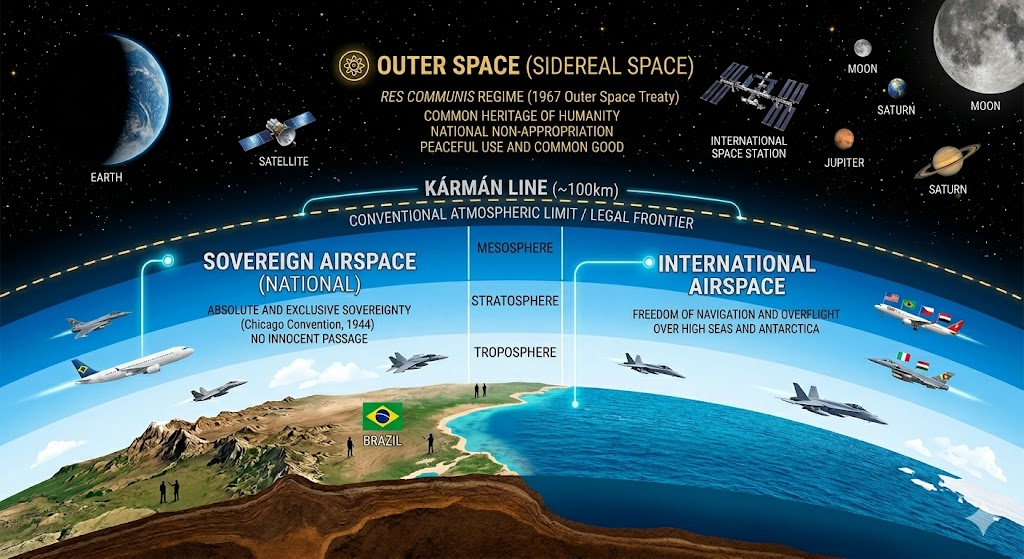
Technological advancement and the intensification of human activities above Earth’s surface demand that Public International Law establish a precise delimitation of competencies. The human and mechanical presence in the vertical plane does not occur within a homogeneous legal vacuum; on the contrary, the international legal order recognizes, in a distinct manner, three overlapping layers:
Sovereign airspace: The atmospheric portion situated directly above the land territory and territorial sea of each politically organized State.
International airspace: The atmospheric layer that overlies zones not subject to any state sovereignty, namely the high seas and the Antarctic continent.
Outer space (sideral space): The cosmic region located beyond the physical limits of the usable atmosphere, whose legal regime is governed by total freedom of exploration and the prohibition of appropriation.
The correct distinction between these spheres is fundamental, given that the transition from one layer to another dramatically alters the regime of rights, duties, and immunities of States and their respective entities.
2. National Airspace: The Rule of Absolute Sovereignty
National airspace comprises the atmospheric column underlying a State’s territory and its respective territorial sea. In this domain, the principle of absolute and exclusive sovereignty prevails, meaning that the State holds total control over traffic, security, and the laws applicable within this area.
The Chicago Framework: The central normative pillar of this regime is the Convention on International Civil Aviation of 1944 (Chicago Convention). The treaty consolidates the understanding that the passage of any foreign aircraft requires the express and prior consent of the sovereign State.
Absence of Innocent Passage: There is a crucial distinction between the Law of the Sea and Aviation Law. While the territorial sea admits the right of “innocent passage” — allowing foreign vessels to cross territorial waters without prior authorization, provided they do so in a continuous and peaceful manner — airspace admits no such flexibility. Any unauthorized intrusion constitutes a direct violation of International Law.
Legal Consequences: The invasion or improper use of sovereign airspace may be interpreted as a threat to national security, entitling the aggrieved State to adopt proportional defensive measures, which in both civil and military spheres may culminate in airspace policing and, in extreme cases of hostile threat, in the interception and downing of aircraft.
3. The “Freedoms of the Air”: The Mechanism of Negotiated Access
In order to enable the practical functioning and economic development of global commercial aviation, States have established a complex network of reciprocal concessions known as the “Freedoms of the Air.”
These freedoms, negotiated in a technical and bilateral manner — and in part provided for under the International Air Services Transit Agreement — apply strictly to civil aircraft and encompass essential commercial prerogatives, such as:
- The right to fly over the territory of a contracting State without landing.
- The right to make stops for strictly technical purposes (such as refueling or maintenance), without the embarkation or disembarkation of passengers and cargo.
- The commercial freedoms to transport passengers, mail, and cargo originating from or destined to the territory of the aircraft’s State of nationality or of third countries.
The technical harmonization, operational safety, and environmental sustainability of this global ecosystem are coordinated by the International Civil Aviation Organization (ICAO), a specialized agency of the United Nations established by the Chicago Convention itself.
4. The Invisible Boundary: Where Does Airspace End and Outer Space Begin?
The precise definition of the transition point at which airspace — subject to state sovereignty — ends and outer space — governed by international freedom — begins constitutes one of the largest and most persistent regulatory gaps in Public International Law. To date, no universally binding conventional norm exists that fixes a definitive geographic boundary.
The Physical-Legal Criterion (Kármán Line): The most widely accepted and used international reference for regulatory purposes is the Kármán Line, conventionally established at an altitude of 100 kilometers above sea level. The rationale is physical in nature: at that altitude, the atmosphere becomes so rarefied that the principles of aerodynamic lift lose their effect, requiring any object to travel at orbital (astronautical) velocity in order to remain aloft.
The Practical Divergence: The international debate, however, remains inconclusive. Organizations such as NASA and the United States Armed Forces have historically adopted the criterion of 80 kilometers of altitude for the purpose of granting astronaut status to their pilots.
This legal uncertainty raises concerns in light of the technological advancement of hybrid aerospace vehicles — such as spaceplanes and reentry capsules — which transit through both zones during a single mission, temporarily becoming exposed to conflicts of jurisdiction.
5. Outer Space: The Legal Regime of Res Communis
From the moment the limit of the usable atmosphere is surpassed, the logic of state sovereignty is entirely revoked and replaced by an international regime of solidarity and collective heritage. The fundamental legal status of this domain is enshrined in the Outer Space Treaty of 1967 (Treaty on Principles Governing the Activities of States in the Exploration and Use of Outer Space, including the Moon and Other Celestial Bodies).
Under the aegis of the United Nations Office for Outer Space Affairs (UNOOSA), this treaty establishes the following foundational pillars:
Principle of the Common Good and Free Exploration: The exploration and use of outer space must be conducted strictly for the benefit and in the interest of all countries, regardless of their degree of economic or scientific development. Outer space is free for scientific investigation by all States without discrimination.
Principle of Non-Appropriation: Outer space, including the Moon and any other celestial body, cannot be subject to national appropriation by claim of sovereignty, by means of use or occupation, or by any other legal or physical means.
Demilitarization and Peaceful Use: The treaty expressly prohibits States from placing in Earth’s orbit, installing on celestial bodies, or stationing in outer space any nuclear weapons or any other type of weapons of mass destruction. The Moon and other celestial bodies must be used exclusively for peaceful purposes.
International Responsibility of States: States parties assume international responsibility for all national space activities carried out by governmental bodies or by private entities — such as SpaceX, Blue Origin, and their counterparts — operating under their jurisdiction, with the latter required to be permanently supervised by the launching State.
Protection of Astronauts: Astronauts are formally declared “envoys of mankind in outer space.” In accordance with the subsequent Rescue Agreement of 1968, all States assume the obligation to render them every possible assistance in the event of an accident, distress, or emergency landing in foreign territory or on the high seas.
6. Legal Gaps and the New Challenges of the “New Space” Era
Although the Outer Space Treaty of 1967 serves as the backbone of international governance of the cosmos, the advent of commercial exploration and the massive involvement of the private sector has exposed severe normative obsolescences:
Exploitation and Mining of Space Resources: The 1967 Treaty prohibits the territorial appropriation of space, but is entirely silent on the economic exploitation and the private appropriation and ownership of mineral resources — such as Helium-3 or frozen water on the Moon and asteroids. Unilateral initiatives, such as the U.S. Commercial Space Launch Competitiveness Act, attempt to guarantee private property rights over extracted resources to private companies, colliding with the interpretations of the Moon Agreement of 1979 — which classifies such resources as common heritage, but which lacks the adherence of the major space powers.
Regulation of Space Tourism: The existing norms were designed for state astronauts — envoys of humanity. Currently, no consolidated international framework exists that defines the rights, obligations, safety standards, and civil liabilities applicable to private space tourists.
Orbital Sustainability and Space Debris: The accumulation of debris and inactive satellites in low Earth orbit poses the imminent risk of “Kessler Syndrome” — a chain reaction of collisions that could render certain orbits unusable. The current legal order lacks rigorous binding norms and sanctioning mechanisms for the mandatory removal of space waste and space traffic management.
Covert Technological Militarization: Although weapons of mass destruction are prohibited, current space law is silent regarding the deployment of conventional anti-satellite weapons (ASAT), cyber interference systems (jamming), and high-powered lasers aimed at disabling foreign space infrastructure, fueling a gray arms race in the planet’s lower orbits.
7. Conclusion
The architecture of Public International Law has succeeded in clearly delimiting the pragmatism of territorial sovereignty with respect to airspace. However, outer space demands more than a Cold War-era non-aggression pact; it urgently requires a robust normative update capable of regulating private enterprise, ensuring the ecological sustainability of Earth’s orbits, and resolving the emerging economic conflicts in the exploration of celestial bodies.
References
BRASIL. Decreto nº 64.362, de 17 de abril de 1969. Promulga o Tratado sobre Princípios Reguladores das Atividades dos Estados na Exploração e Uso do Espaço Cósmico, inclusive a Lua e demais Corpos Celestes. Diário Oficial da União, Brasília, DF, 1969.
ICAO. Convention on International Civil Aviation (Chicago Convention). 9th ed. Montreal: International Civil Aviation Organization, 2006. (Doc. 7300/9).
KOPLOW, David A. The Fault Is Not in Our Stars: Avoiding an Arms Race in Outer Space. Iowa Law Review, v. 59, n. 1, p. 115–142, 2017.
MARCOFF, Marco G. Traité de Droit International de l’Espace. Fribourg: Éditions Universitaires Fribourg, 1973.
MONSERRAT FILHO, José. Direito Espacial: Ensaios e Documentos. Rio de Janeiro: Vieira & Lent, 2011.
UNITED NATIONS. United Nations Treaties and Principles on Outer Space. New York: United Nations Office for Outer Space Affairs (UNOOSA), 2021.
VON DER DUNK, Frans; TRONCHETTI, Fabio (Eds.). Handbook of Space Law. Cheltenham: Edward Elgar Publishing, 2015.
