
By Marcelo Salamon
july 06,2026.
Abstract
This article examines the accelerating trend of Brazilian, Argentine, and global multinational companies establishing production operations in Paraguay, driven primarily by the country’s Maquila Law and its Free Trade Zone framework. Paraguay’s total population is currently estimated at roughly 7 million people, and the largest foreign community by far is Brazilian — officially registered residents number around 263,000, while broader estimates that include descendants and undocumented immigrants run as high as 350,000, concentrated mostly along the eastern border. That population directly correlates with the labor force employed by maquiladoras, whose formal job count jumped from roughly 20,000 in 2024 to more than 35,000 by March 2026 — a 10% increase in a single year — even though that figure still represents less than 1% of Paraguay’s total workforce. The piece explores the legal distinction between production expansion and an actual transfer of tax domicile, the tax and labor cost advantages driving the shift, the sectors most affected, and the estimated financial impact on both Brazil and Paraguay.
Keywords
Maquila Law; Paraguay; deindustrialization; corporate headquarters relocation; Mercosur; tax competitiveness; free trade zone regime.
Introduction
Over the past few years, a quiet phenomenon has been redrawing the industrial map of South America: the migration of production lines from major companies to Paraguay. The movement, which now includes hundreds of Brazilian-owned companies alongside heavyweight global brands, is driven above all by Paraguay’s Maquila Law — a tax regime that dramatically reduces the fiscal burden on export-oriented operations. Beyond being a regional economic curiosity, the trend raises real legal questions about tax sovereignty, international competitiveness, and where exactly the line falls between legitimate business expansion and the erosion of a neighboring country’s industrial base.
The Legal Framework: The Maquila Law and Free Trade Zones
Paraguay’s Maquila Law, enacted as Law No. 1,064 in 1997 and regulated under Decree 9,585/2000, allows foreign companies to set up manufacturing plants in Paraguay, import machinery and raw materials duty-free, produce locally, and export while paying just 1% on the value added within Paraguayan territory. In April 2026, President Santiago Peña’s administration regulated Law 7,547/2025, which extended the regime to services and technology companies for the first time — the so-called “services maquila,” which already employs around 4,000 people and has considerable room to grow — including a 0.5% VAT credit refund. Alongside that sits the Free Trade Zone Law (Law 523/95), which governs areas like Ciudad del Este under an even broader national tax exemption. Outside the maquila framework entirely, Paraguay also offers what’s known as the “triple 10” system: a flat 10% corporate income tax, 10% personal income tax, and 10% VAT.
A Necessary Legal Clarification: Expansion vs. Headquarters Relocation
Before diving into company names, it’s worth flagging a distinction that tends to get lost in the public debate — one that matters especially for a legally minded readership. A fact-check by the Brazilian outlet Aos Fatos found that most Brazilian companies operating under the maquila regime haven’t actually relocated their legal headquarters to Paraguay at all. They keep their corporate seat in Brazil and simply open a production facility in Paraguay, with the finished product shipped back to the Brazilian market under Mercosur rules. The Brazilian Chamber of Business Owners in Paraguay (CEBRAS-PY) has stressed that the accurate term is “expansion,” not “flight” or “headquarters relocation.” The clearest exception is Lupo, the sock manufacturer, which is building its first factory outside Brazil in Ciudad del Este with a R$30 million investment — while still keeping its legal headquarters in Araraquara, São Paulo. Nestlé, meanwhile, made a partial, tactical move, shifting only its back-office administrative functions to Paraguay — a signal that could be read as the first step in a more gradual strategic repositioning.
Cost and Profitability Comparison
The central draw is the gap in tax and labor costs. While combined taxes and labor charges in Brazil can exceed 80% in certain sectors — reportedly reaching 90% of product cost in the apparel industry, according to ABVTEX, the Brazilian textile retail association — the maquila regime in Paraguay keeps that total closer to 10–12% on average. One concrete example: a company manufacturing cargo straps that imports polyester from China faced an 18% tariff producing in Brazil; under the Maquila Law, that same import carries a zero tariff. An export-oriented industrial operation with high energy and labor intensity might pay around 34% on profits alone in Brazil (through corporate income tax and social contribution on net profit), versus just 1% on value added under the Paraguayan regime — a gap worth millions of dollars a year even for a mid-sized plant. On the labor side, formally hiring a worker in Paraguay costs 30% to 40% less than under Brazil’s CLT labor code. Industrial electricity is roughly 60% cheaper, thanks to the Itaipu and Yacyretá hydroelectric dams.
Sectors and Export Volume Under the Maquila Regime
In 2025, the maquila regime accounted for roughly 69% of Paraguay’s manufactured exports, generating total revenue of $1.3 billion. By sector: auto parts and wiring harnesses lead the pack at 27% of total exports; food products follow at 19%; apparel and textiles at 14%; chemicals and pharmaceuticals at 8%; and aluminum and other manufactured goods at 7%. There’s also meaningful activity in beverages, agribusiness, agrochemicals, and electrical cabling — sectors that broaden the picture well beyond the traditional textile-and-auto-parts narrative. Mercosur absorbs 81% of these exports, with Brazil as the top trading partner.
Brazilian Companies Operating in Paraguay
The universe here is considerably larger than the handful of names that usually make headlines. Of the 232 registered Brazilian maquiladoras, 89 belong to the apparel and textile sector alone — the single largest segment by company count. Notable names include Lupo, Riachuelo (part of the Guararapes group), Buddemeyer, Karsten, Fiasul, Estrela, M. Dias Branco, JBS, Lunelli, Vale, Camil (through its acquisition of Rice Paraguay and Villa Oliva Rice), BRF (via its subsidiary Hercosul), Efisa, and Kidy. Of the Brazilian-owned maquiladoras, 17.2% began operations in 2023 or later, and a good share moved in between 2021 and 2022 — confirming that even though the underlying law dates back to 1997, the real acceleration is recent.
Foreign Multinationals: Japan, Germany, South Korea
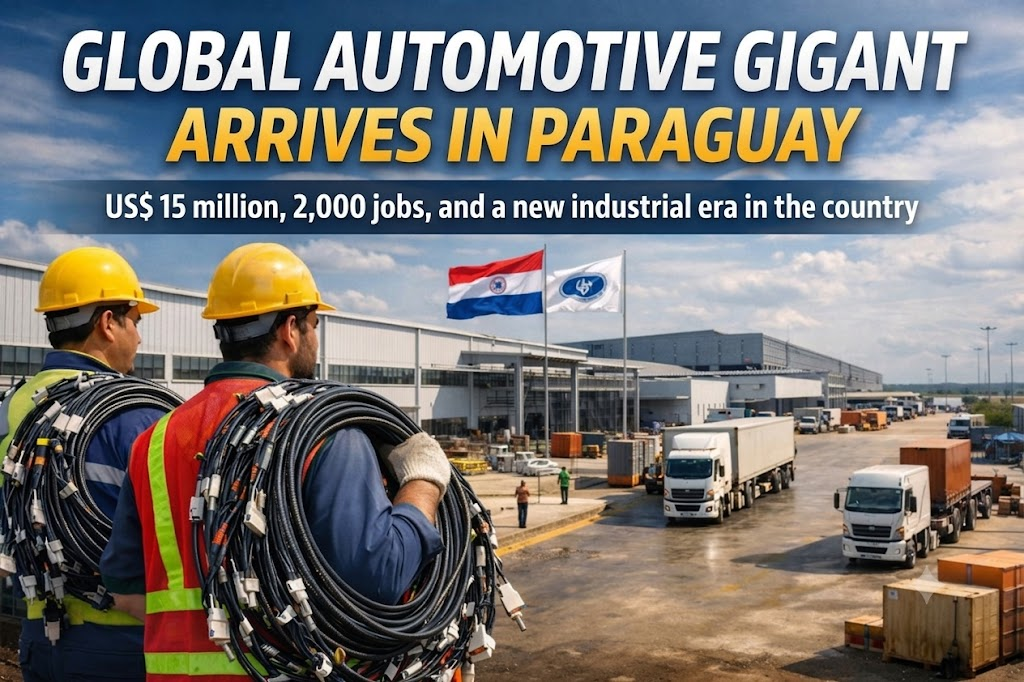
Outside the Brazilian orbit, several heavyweight names stand out: Japan’s Yazaki (established since 2013, now employing more than 1,200 people, manufacturing wiring harnesses), Germany’s Kromberg & Schubert, South Korea’s TNT Auto Parts, Germany’s Leoni, and Japan’s Fujikura and Sumitomo — all in the auto parts sector. Switzerland’s Nestlé, as mentioned, moved only its administrative back office. The assembly sector also draws brands like Kenton and Yamaha for motorcycles, and Kia and Hyundai for light vehicles.
The Retail Phenomenon in Ciudad del Este
For the sake of conceptual accuracy, it’s worth separating out the import-retail hub of Ciudad del Este, where brands like Apple, Samsung, Xiaomi, Ralph Lauren, Michael Kors, Calvin Klein, and Dolce & Gabbana are widely sold at lower prices thanks to free-trade-zone tax exemptions. That’s retail commerce built on imported goods — not production or corporate presence for those brands in the country.
Population, Brazilian Immigration, and the Labor Force
Paraguay’s population today stands at roughly 7 million, with about 65% in the economically active age bracket — one of the most favorable demographic dividends in South America, comparable to what Brazil experienced in the 1980s. Within that population, the largest foreign community is Brazilian: Brazil’s Ministry of Foreign Affairs estimated 254,000 Brazilian residents in 2022, a number that rose to 263,000 by 2025, with a record 17,000-plus new residency applications in that year alone. Once descendants and undocumented immigrants are factored in, broader estimates put the number at 300,000 to as high as 350,000 so-called “brasiguaios.” That population has a direct link to the maquiladora workforce: formal jobs in the sector rose from roughly 20,000 in 2024 to 35,357 by March 2026 — a 10% year-over-year increase — with women making up 45% of that workforce. Even so, that total still represents a small share, under 1%, of Paraguay’s overall labor force, which points to significant room for growth if the regime keeps expanding.
Financial Impact: What Brazil Loses and What Paraguay Gains
On the Brazilian side, market estimates suggest that just the ten largest Brazilian-owned maquiladoras in Paraguay generate around $1.3 billion a year in exports — roughly equivalent to R$7 billion in industrial revenue shifted outside Brazilian territory. Based on that volume, analysts calculate that Brazil forgoes hundreds of millions of reais a year in direct industrial tax revenue (ICMS, IPI, PIS/Cofins, and corporate income tax that would otherwise apply if production stayed on Brazilian soil). Tax attorneys, however, note that this impact isn’t yet numerically significant relative to Brazil’s total federal tax collection — the bigger risk they flag is a gradual erosion of the industrial base and competitiveness over the medium and long term, not an immediate fiscal collapse. On the Paraguayan side, the gain is more direct: beyond the $1.3 billion in exports from Brazilian maquiladoras, the country has received more than $500 million over the past two years in real estate and infrastructure investment tied to industrial parks and logistics centers supporting the maquila sector, according to the Paraguayan Chamber of Construction — on top of the investment-grade ratings awarded by Moody’s (2024) and S&P (2025), which give the country access to cheaper international capital.
Broader Economic Growth
Paraguay’s economy grew 5.9% in 2025, up from 4.7% in 2024, with growth projected at 4% to 4.4% for 2026 — more than double the Latin American regional average over the past three years. Poverty fell from more than 50% to 16% over two decades, with roughly 300,000 people lifted out of poverty in the last two years alone.
Conclusion
Paraguay’s expanding Maquila Law illustrates how regulatory and tax differences between neighboring countries can reshape entire supply chains — without that necessarily amounting, in a strict legal sense, to companies “fleeing.” It’s more accurate to describe it as a strategic expansion that takes advantage of real comparative advantages. For Brazil, the trend is a warning sign about industrial competitiveness and future tax revenue, even if the immediate fiscal impact remains limited. For Paraguay, it represents a historic opportunity for economic diversification, anchored in a favorable demographic dividend, fiscal stability, and international recognition as an investment-grade economy. The case is worth watching from both an economic and a legal standpoint, since it raises real questions about where healthy tax competition ends and regulatory imbalance within a shared trade bloc — Mercosur — begins.
References
- PODER360. “Mais de 230 empresas brasileiras já produzem no Paraguai”; “Entenda como é o regime de maquila no Paraguai e em outros países”; “Maquiladoras do Paraguai já tiram 25.000 empregos do Brasil.” poder360.com.br
- AOS FATOS. “Não é verdade que 232 empresas migraram para o Paraguai no governo Lula.” aosfatos.org
- NEOFEED. “Lupo vai ter fábrica no Paraguai e engrossa a lista de empresas brasileiras que investem no país.” neofeed.com.br
- ND MAIS. “Por que a Lei de Maquila no Paraguai ameaça o Brasil.” ndmais.com.br
- MIGALHAS. “Maquila no Paraguai, uma análise de desempenho e perspectivas.” migalhas.com.br
- BLOOMBERG LÍNEA. “Economia do Paraguai acelera, impulsiona PIB da região e vira ‘moda’ entre investidores.” bloomberglinea.com.br
- TRADING ECONOMICS. “Taxa de Crescimento do PIB do Paraguai.” tradingeconomics.com
- AUTOMOTIVE BUSINESS. “Paraguai atrai montagem de autopeças.” automotivebusiness.com.br
- GAZETA DO POVO. “O perfil dos brasileiros que buscam uma vida melhor no Paraguai.” gazetadopovo.com.br
- GDIA. “Mais de 254 mil brasileiros residem no Paraguai.” gdia.com.br
- GAZETA NEWS. “Êxodo Industrial: mais de 230 empresas brasileiras migram para o Paraguai.” gazetanews.com
- TIMES BRASIL / CNBC. “Carga tributária e burocracia no Brasil aceleram migração de empresas para o Paraguai.” timesbrasil.com.br
- INVESTIR NO PARAGUAI. “Zonas Francas e Maquila Impulsionam Investimentos”; “O Crescimento Explosivo do Setor de Autopeças.” investirnoparaguai.com.br
- SENADO FEDERAL (Brazil). “Instalação de indústrias brasileiras no Paraguai: uma nota preliminar.” senado.leg.br
