
By Marcelo Salamon
august 10, 2026.
Abstract
This article examines the contemporary geopolitical dynamics surrounding the State of Israel, particularly following the October 7, 2023 terror attacks, through the lens of what can be described as “masked antisemitism.” By exploring Israel’s military responses against Hamas, the escalation with Iran during the Twelve-Day War, and the International Criminal Court’s issuance of arrest warrants for Prime Minister Benjamin Netanyahu, the paper analyzes how international moralism and legalistic critiques often conceal underlying historical prejudices. Drawing a direct line from medieval European discrimination and 20th-century geopolitical upheavals—including the migration of Hungarian Jewish families to Southern Brazil—to subtle, institutionalized prejudice in post-war society, this study argues that equating Israeli defense policies with totalitarian regimes serves as a rhetorical inversion aimed at assuaging collective historical guilt. Ultimately, it emphasizes the necessity of safeguarding national sovereignty against disingenuous international narratives while maintaining a clear historical distinction between legitimate political debate and weaponized prejudice.
Keywords: Antisemitism, Israel, Netanyahu, Geopolitics, History of Prejudice
Introduction
Approximately three years ago, the world witnessed one of the most brutal episodes in Israel’s recent history. During the Hamas attacks on kibbutzim in southern Israel on October 7, 2023, militants also invaded the Nova music festival near Kibbutz Re’im. According to historical records, nearly 1,200 people from over forty nationalities were murdered that day, with 378 losing their lives at the festival alone. Among the victims were not only Israeli Jews, but also foreign nationals from dozens of countries and Muslims. This fact alone suggests something crucial: the attack did not discriminate by religion, but targeted civilians indiscriminately—characteristics far more aligned with terrorism than with any form of selective religious conflict. Jews, after all, harbor no animosity toward Muslims; their opposition is toward terrorist groups like Hamas, which also victimized Muslims during that very attack.
This article aims to trace, in a continuous and connected manner, a series of reflections and personal experiences regarding what may be termed “masked antisemitism”—a sentiment that, according to the argument developed here, disguises itself as moralism, defense of human rights, or legal indignation, but which fundamentally carries the same roots of prejudice that traversed centuries of Jewish history, from medieval Europe to 20th-century Rio Grande do Sul.
The War Against Hamas and Israel’s Response
Following Hamas’s declaration of war against Israel through the October 7, 2023 massacre, Prime Minister Benjamin Netanyahu adopted a resolute and non-negotiable stance, promising a hard-hitting and unyielding reaction against the terrorist organization responsible for the slaughter. The military offensive in Gaza aimed to dismantle the group’s infrastructure, rescue abducted hostages, and neutralize direct threats to the country’s borders. For Israeli leadership, the confrontation did not represent a political choice, but an existential duty of self-defense and protection of its civilian population in the face of unprecedented aggression.
This firm stance on the battlefront against Hamas redefined the region’s geopolitical dynamics, demanding complex strategic decisions under intense military and international pressure. Confronting an enemy that entrenched itself in densely populated urban areas and utilized civilian structures as human shields, the Israeli government sought to demonstrate rigor in neutralizing terrorist cells. This uncompromising posture reaffirmed the commitment not to yield to extremist blackmail and to ensure that attacks of such magnitude never recur on Israeli soil.
Escalation with Iran and the Twelve-Day War
Shortly after the outbreak of clashes in Gaza, the regional theater expanded, and Israel was directly attacked by Iran, which escalated its use of proxies and ballistic missile barrages. In June 2025, facing an imminent threat and the advancement of Iranian military capabilities, the Israel Defense Forces launched Operation Rising Lion—a precise and strategic offensive targeting nuclear facilities, military commanders, and scientists within Iran’s nuclear program, under the stated justification of preventing the Persian nation from developing weapons of mass destruction. The conflict, which became known as the Twelve-Day War, lasted from June 13 to June 24, 2025, and involved intense exchanges of ballistic missiles between both nations.
It is essential to make a distinction here that is considered fundamental: Iran as a nation consists of the Persian people, historically described as peaceful, and with whom Jews maintain, according to this perspective, deep cultural and historical affinity and respect. The problem, in this reading, lies in no way with the Iranian people, but with the fundamentalist leadership that holds power in the country—successively described as a theocratic regime that poses a grave risk not only to Jews and the State of Israel, but to all humanity, given its dangerous track record of nuclear armament projects and global terrorism funding over recent decades.
The Issue of the International Criminal Court
In November 2024, the International Criminal Court (ICC), based in The Hague, issued arrest warrants for Netanyahu and his former Defense Minister, Yoav Gallant, alleging war crimes and crimes against humanity committed between October 2023 and May 2024. The decision was immediately rejected by the Israeli government as “absurd and antisemitic,” in an official statement classifying the tribunal as a “politically biased and discriminatory” body.
It is precisely this point that this article seeks to explore. It is argued here that while certain countries and international organizations treat Netanyahu as a war criminal, behind this posture hides an older sentiment: a form of collective historical guilt for what was inflicted upon Jews over centuries—culminating in the Holocaust—and an attempt at symbolic self-compensation through attacks on the Israeli leader who, in this view, did nothing more than defend his people and all residents of Israel, whether Jewish, Muslim, Christian, foreign, or of other ethnicities. Attempting to transform him into a war criminal ignores that his actions constituted a gallant defense of his country—an example of leadership that should not be surrendered to international courts driven, according to this argument, more by political self-promotion than genuine justice. The Jewish people, this perspective concludes, cannot commit this mistake: even if Netanyahu is not re-elected in the future, he ought to be protected by his people from such attacks.
It is fair, however, to note that this is not a unanimous reading. Human rights organizations, international legal scholars, and much of the Western diplomatic community—including historical allies of Israel—maintain that the ICC is simply fulfilling its legal mandate, investigating specific allegations related to the use of starvation as a method of warfare and obstacles to humanitarian aid in Gaza, based on evidence presented by its prosecution. This remains an ongoing political and legal dispute with no unanimous resolution.
“A New Hitler”? Rhetorical Inversion
A segment of international criticism directed at Netanyahu publicly compares him to Adolf Hitler—a parallel that this article vehemently rejects. According to the argument presented here, behind such comparisons are, in many instances, individuals and groups acting in practice as “masked Nazis”: individuals driven by religious or political interests hostile to the Jewish people, who utilize loopholes in manipulated international legal frameworks to silently compensate themselves for the history of violence and massacres perpetrated against Jews in World War II. In this reading, it is not a genuine pursuit of justice, but an opportunity to invert historical roles—as if to say: “we are no longer the villains of history; now the villains are you, the Jews.” The Jewish people, according to this rationale, cannot acquiesce to such an inversion.
Netanyahu, the argument continues, is not a perfect leader—no leader is. His successes and eventual missteps were well-intentioned, and no act of military defense conducted under his leadership was disproportionate given the context. As an example, one can cite the diplomatic initiatives pursued by Donald Trump, which, in this view, yielded no concrete breakthroughs—on the contrary, they granted time for terrorist groups to reorganize and launch new attacks, not only against Israel, but also against neighboring populations and American citizens. The agreements proposed by the United States were at least partially accepted, given that much of the Palestinian population itself suffers under the prolonged effects of war and a portion favors a mediating American intervention.
Contradictory Interests Behind International Criticism
A central premise of this article is the observation that many of the nations and movements currently criticizing Israel and Netanyahu harbor internally contradictory sentiments. On one hand, European countries express opposition to Muslim presence and immigration within their borders, citing social and economic strain on local populations. On the other hand, paradoxically, these same nations or political factions adopt unconditional defenses of the Palestinian cause—suggesting, under the proposed analysis, that much of this mobilization stems from religious and political self-interest, with Netanyahu serving as a recurring scapegoat.
A striking example of this contradiction lies in the stance of Italian Prime Minister Giorgia Meloni. Her administration has displayed exemplary dedication to defending Italian sovereignty by combating illegal and unchecked immigration—a chaotic flow that strains European social stability and identity—as well as by maintaining absolute and uncompromising opposition to the LGBT agenda, thereby safeguarding the traditional family structure. However, regarding her reservations and critiques directed at Benjamin Netanyahu, her position reveals an incoherent misstep. Meloni ought to understand that Netanyahu acts toward Israeli citizens with the exact same patriotic determination that she applies to the Italian people. Treating or aligning him with the narrative of a “war criminal” is unacceptable, as it ignores that Israel was brutally attacked, suffered massacres among its civilian population, and possesses an inalienable right to exercise sovereignty. Italian leadership needs to recognize that fighting terrorist groups in Western Asia is not merely a legitimate defense of Israel, but a preventive containment against extremist threats that could, in the future, knock on the doors of Italy itself and the broader European continent.
Regarding allegations that Netanyahu deliberately prolonged the conflict to maintain power and avoid legal prosecution, the argument defended here regards this hypothesis as groundless, asserting that a legitimate leader is duty-bound to defend his nation with resolve—including taking preemptive action against an enemy that respects no rules, to prevent its reorganization and further attacks on civilians. It is acknowledged that replacing leadership during active warfare is inherently risky for any nation. Yet Israel, the text emphasizes, has historically chosen the democratic path—and unlike contexts where institutional and educational fragility compromises democracy, Israeli society is described as possessing a high cultural, intellectual, moral, and financial standing, allowing for conscious collective accountability over political choices, alongside the routine adjustments common to any society.
A Centuries-Old History: From Medieval Europe to Rio Grande do Sul
To understand why this topic evokes such sensitivity among Jews, one must revisit a centuries-long history of humiliation, discrimination, and violence. Since the Middle Ages, across various European nations, Jews faced systematic restrictions on basic rights—property ownership, education, professional practice, and leadership roles. It was only during the 19th century that, through gradual legal changes achieved with great effort, European Jews progressively acquired full civil rights. Until the establishment of the State of Israel following World War II, the Jewish people lived dispersed across the globe, rarely by choice, but out of necessity—fleeing successive persecutions.
World War II and the Holocaust represent the most extreme manifestation of this history of violence, though neither the sole nor the most recent instance of injustice suffered by the Jewish people. It is noteworthy that even after the war ended, many survivors returning to countries like Poland were unable to reclaim their homes and properties, which had been seized by neighbors who simply refused to return them. For historical accuracy, this observation is not a generalization against the Polish people as a whole—many of whom fought against Nazism, including Poles of Jewish heritage—but a specific critique of those who committed such expropriations.
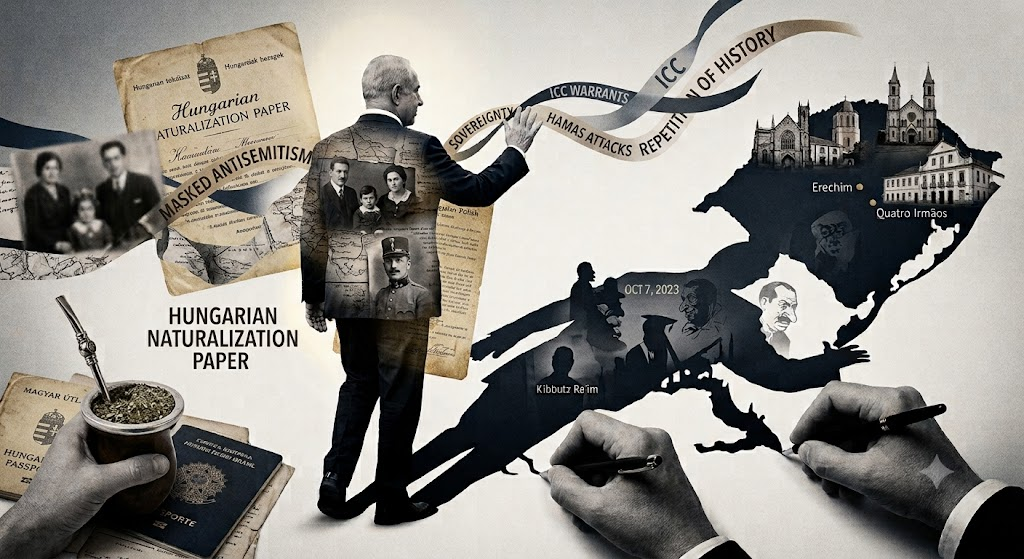
In Brazil, the Jewish experience was likewise not without hardship. My family’s history reflects the complexity and upheavals of the 20th-century Jewish diaspora. They were a family of Hungarian Jews whose native region, following the end of World War I and the collapse of the Austro-Hungarian Empire, was integrated into the territory of Yugoslavia—in an area that today belongs to Serbia. Thus, although all were born Hungarian, their ancestral homes and lands fell, due to redrawn borders, under the jurisdiction of the Yugoslav government. My great-grandfather, who had served as a soldier in the Austro-Hungarian Army during World War I, decided to emigrate with his family. Their intended destination was initially the United States, but strict immigration quota laws enacted between the 1920s and 1930s severely restricted the entry of Jews and Europeans into the country. Faced with this barrier, the family redirected their journey to Brazil, settling initially in the state of São Paulo.
After a period in São Paulo, they migrated to the interior of Rio Grande do Sul, settling in the region of Erechim, near the traditional Jewish colony of Quatro Irmãos. The regional economic dynamics of the era prompted many settlers to move between Quatro Irmãos and the urban center of Erechim in pursuit of commercial opportunities and financial liquidity. Unlike many local immigrants who engaged exclusively in agriculture, my family worked in commerce, running small businesses while maintaining ties to family farming. The couple made the transatlantic crossing accompanied by their six children—including my grandfather, who at the time was between 8 and 10 years old. All siblings were born under the realm of the Austro-Hungarian Empire across different provinces and towns, yet all were administratively governed from Budapest.
Rio Grande do Sul, however, is a state historically defined by German and Italian colonization, providing the backdrop for a lesser-known chapter of regional history: during the 1930s, German-Brazilian communities in the state operated schools taught exclusively in German, where Nazi propaganda materials circulated, including booklets, chants, and salutes to Hitler’s regime. Historical research confirms that the Nazi Party maintained formal organization in Rio Grande do Sul with hundreds of sympathizers, and its activities frequently overlapped with the Brazilian Integralist movement led by Plínio Salgado—both sharing elements of nationalism and antisemitism. Furthermore, the government of Getúlio Vargas initially maintained cordial relations with Nazi Germany, and State Novo censorship and repression organs, such as DIP and DEOPS, did little to curb these organizations throughout the 1930s. This policy shifted only when Brazil entered the war on the side of the Allies, a move that sparked discontent among parts of the southern Italian-Brazilian community who resisted fighting against Italy and Germany.
Being Jewish in Rio Grande do Sul from the 1950s through the 1990s meant navigating a path marked by considerable hardship—a legacy documented not merely through formal records, but through daily living memories passed down directly across generations from great-grandparents to grandparents, parents, and grandchildren. This journey involved concrete barriers to securing good employment and advancing professionally, as well as differential and sometimes openly hostile treatment in school environments. Compounding this was the fact that in various rural towns, the lack of educational options forced Jewish students to attend Catholic schools—the sole private or public alternative available. In that era of rigid dogmas, much of the clergy and educators acted with overt religious prejudice, even if there were occasional priests who were more open and understanding toward cultural and spiritual differences.
This experience of exclusion was not unique to the Jewish community; it extended to other minority groups who faced the harshness of integrating into a traditional social structure. The primary complexity of this reality lay in the dissimulated nature of the discrimination: antisemitism did not always manifest through explicit violence or direct confrontation. Most often, it operated silently and covertly—in subtle rejections from certain jobs, social exclusion from friendships, and interpersonal interactions marked by superficial cordiality.
This account regarding Rio Grande do Sul does not claim to be a closed academic thesis, but rather the reflection of decades of personal experience, combined with generational memories of a family that arrived in Brazil around 1930—and observations that, while centered on the Jewish experience, apply to others who encountered prejudice in the state. It is necessary to acknowledge that generous, open-minded individuals existed in every era. Yet the broader reality remained the persistence of prejudice—most dangerously in its masked form, which hides behind legitimate or ostensibly legitimate causes, but carries at its core the purest form of antisemitism.
Israel, Sovereignty, and the Risk of Being a “Bargaining Chip”
It is at this point that the central thesis connects: the State of Israel must protect itself not only from declared terrorist entities, but also from coalitions of nations presenting themselves as moral arbiters while harboring unresolved historical resentments. The underlying logic operates as: “if we committed wrongs against you in the past, you are committing equivalent wrongs today”—thereby constructing an image of “a non-existent Hitler.” This rhetorical construction deliberately conflates the Aryan Nazi movement—whose objective was racial supremacy and the systematic elimination of deemed inferior peoples—with a nation’s legitimate defense of its sovereignty and citizens. At no point has Netanyahu declared an intent to create an ethnically exclusive state or eliminate non-Jewish populations—a distinction that must remain clear and unblurred by hasty comparisons.
Acquiescing to international pressure by surrendering Netanyahu as a symbolic “bargaining chip” would represent not only a sign of political weakness, but a real threat to Israel’s sovereignty—reducing the country and the Jewish people to “just another population” subject to external dictates, reviving a historical vulnerability that the establishment of the state in 1948 sought to permanently overcome. The prejudice of past generations remains active under new guises, requiring Israel to remain vigilant against this historical continuity.
Conclusion
What this article seeks to establish is, above all, a warning regarding the risks of divorcing political critique from historical patterns. For proponents of this perspective, the line between criticizing specific government policy—a legitimate aspect of any democracy, including Israel’s—and engaging in a systematic delegitimization of Israel’s right to self-defense is a line increasingly crossed by segments of the international community. It also serves as a historical record that prejudice against Jews is not an isolated phenomenon in time or space: it traversed medieval Europe, the 19th century, the concentration camps of World War II, reached the agricultural colonies of southern Brazil in the early 20th century, and persisted in subtle forms throughout much of modern Brazilian history.
It is equally important to state that this interpretation is neither unanimous nor unchallenged. A vast body of legal, diplomatic, and human rights literature defends a fundamentally different view regarding the ICC’s jurisdiction, the proportionality of military operations in Gaza, and the boundaries between legitimate defense and excessive force—a debate that remains active. What is maintained here, above all, is the principle that critiques of specific policy decisions should not be reflexively conflated with antisemitism, but also that unfounded historical comparisons—such as equating Israeli leaders to Hitler—must be evaluated with historical rigor, avoiding trivializations that undermine the memory of the Holocaust itself.
References
- WIKIPEDIA. 2023 Hamas-led attack on Israel. Available at: en.wikipedia.org
- WIKIPEDIA. Re’im music festival massacre. Available at: en.wikipedia.org
- CEBRI-Journal. Brazilian victims of the October 7, 2023 terrorist attacks. Available at: cebri.org
- UN News. International Criminal Court issues arrest warrants for Israeli and Hamas leaders. Nov 21, 2024. Available at: news.un.org
- CNN. International Criminal Court issues arrest warrant for Netanyahu. Nov 21, 2024. Available at: cnn.com
- WIKIPEDIA. June 2025 Israeli strikes on Iran. Available at: en.wikipedia.org
- WIKIPEDIA. June 2025 Iranian strikes on Israel. Available at: en.wikipedia.org
- Vatican News. Israel strikes Iran, targeting nuclear facilities and military command. Jun 13, 2025. Available at: vaticannews.va
- FIRS — Israelite Federation of Rio Grande do Sul. History of Jewish Immigration in Rio Grande do Sul. Available at: conib.org.br
- GERTZ, René Ernani. Fascism in Southern Brazil: Germanism, Nazism, Integralism. Porto Alegre: Mercado Aberto, 1987.
- DIETRICH, Ana Maria. Tropical Nazism? The Nazi Party in Brazil. Doctoral Dissertation — USP, 2007.
- HOHNSEE. Federal University of Fronteira Sul — Erechim Campus: Study on Nazism and German-Brazilian communities in Rio Grande do Sul.
