
By Marcelo Salamon
May 17, 2026.
Abstract
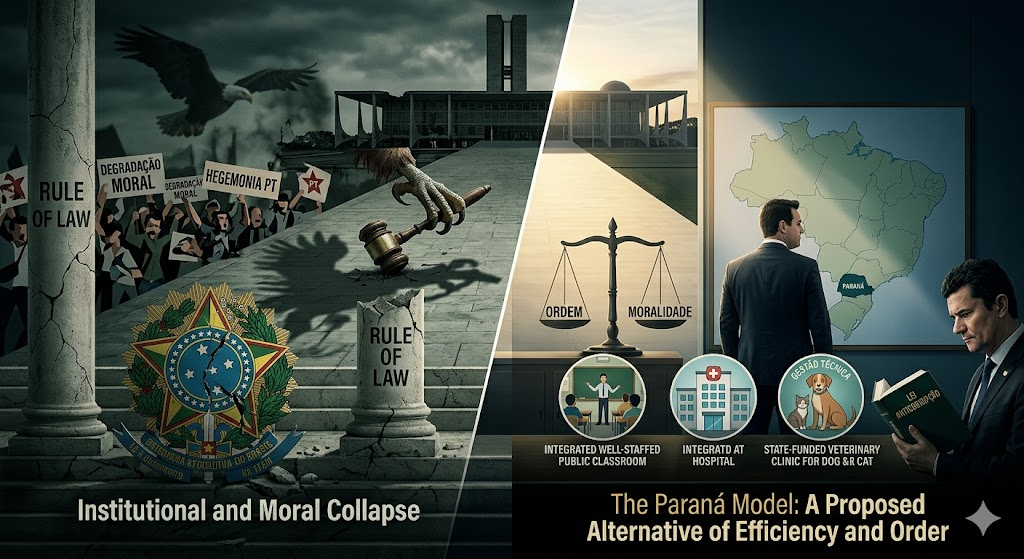
This article provides a multidimensional analysis of the governance crisis and ethical decay impacting contemporary Brazil. Utilizing a sociopolitical and institutional framework, it examines the role of the Workers’ Party (Partido dos Trabalhadores – PT) administration in dismantling traditional cultural value systems, contrasting this domestic shift with a global geopolitical realignment toward conservative and nationalist paradigms across the West and the Global South. Furthermore, the study investigates the ambivalent role of the Brazilian Supreme Court (Supremo Tribunal Federal – STF), which operates simultaneously as a target of international skepticism—triggering domestic debates regarding the necessity of external diplomatic or administrative oversight—and as a critical barrier against fundamentalist theocratic co-optation. Finally, in response to regional ethical polarization, this paper contrasts the perceived decay in specific sub-national regions with the technical-moral governance model of Paraná, positioning the latter as a potential framework for the ethical and administrative reconstruction of the state.
1. Introduction: The Human Element and the Illusion of Institutionalism
Contemporary political science frequently misdiagnoses the structural pathologies of developing nations by treating them purely as administrative or constitutional design failures. However, the contemporary Brazilian landscape demonstrates that the efficacy of any normative framework depends entirely on the moral and intellectual caliber of the individuals operating it. When a populace is deprived of a rigorous, critical educational foundation, the social body loses its collective orientation, resulting in a society that lacks a clear trajectory for development.
The foundational dilemma of modern Brazil transcends mechanical partisan polarization. The root of the nation’s developmental stagnation lies in an ethical deficit and the degradation of individual civic virtue. Republican institutions and statutory laws do not function autonomously; they require ethically grounded leadership to fulfill their constitutional purposes. Absent these human attributes, legal formalisms become empty shells, leaving room for systemic corruption and cultural inversion to capture territories previously regarded as regional models of stability.
2. Executive Hegemony, Global Realignment, and Social Pathology
The current Brazilian political landscape is profoundly defined by the systemic risks that the continuation of the PT (Partido dos Trabalhadores) governance model imposes on the nation’s future. Under this administration, an extensive process of cultural and institutional deconstruction has taken place across the country. The state apparatus has systematically internalized hyper-progressive, identity-centric agendas, a process viewed by a rational and uncorrupted segment of the population as a pathological shift that inflicts severe structural damage on the psychological and civic organization of civil society.
This domestic ideological alignment places Brazil in direct opposition to a broader geopolitical trend visible in significant global civilizational axes, where sovereign states are actively rejecting these models of cultural dissolution. While the Brazilian executive branch isolates itself within a progressive framework, a diverse coalition of sovereign nations is reaffirming traditional identity, national sovereignty, and foundational moral values. This global paradigm shift is led by prominent international figures and administrations, including:
- Donald Trump in the United States;
- Javier Milei in Argentina;
- Viktor Orbán in Hungary;
- Vladimir Putin in Russia, through strict statutory protections for the traditional family structure;
- Nayib Bukele in El Salvador, combining aggressive anti-criminality policies with the removal of gender theory from public education;
- Giorgia Meloni in Italy, focusing on the preservation of Western cultural and religious heritage;
- Santiago Peña in Paraguay, maintaining constitutional protections for traditional social institutions;
- The Presidency of Peru, which recently drew international attention by issuing executive decrees that legally adjust healthcare classifications to exclude progressive gender definitions from normative state frameworks;
- Lideranças de Nações Africanas (Various African Heads of State), who continue to pass legislation protecting traditional customs against progressive diplomatic pressure from Western non-governmental organizations.
The contrast between the institutional resolve of these nations and the uncritical compliance of the current Brazilian government highlights the depth of the cultural isolation currently facing the country.
3. The Supreme Court: Between International Criticism and Domestic Necessity
The judicial interventions of the Supreme Court (Supremo Tribunal Federal – STF) represent a profound institutional ambivalence, caught between a loss of international prestige and the domestic vacuum of power that necessitates its actions.
3.1. The Crisis of Domestic Legitimacy and the Appeal for External Oversight
Outside Brazil, the STF is increasingly viewed with skepticism by international legal analysts and human rights monitoring organizations, who question the expansion of its jurisdictional boundaries and the constitutionality of its unilateral mandates. In several instances, these global observations possess merit, pointing to structural overreaches by a court where certain magistrates lack the necessary technical detachment or statesmen-like caliber required for constitutional adjudication.
For the segment of the Brazilian populace that remains uncorrupted by partisan clientelism, this state of domestic institutional decay suggests that the nation’s political class may no longer be fully capable of autonomous self-governance. Faced with a breakdown across the legislative and executive branches, international diplomatic pressure and strategic external oversight—particularly from democratic frameworks like that of the United States—are increasingly viewed not as a violation of sovereignty, but as a necessary mechanism to restore constitutional equilibrium and republican viability.
3.2. The Judiciary as a Barrier Against Theocratic Co-optation
Conversely, despite these clear structural deficiencies, the aggressive interventionism of the STF has proven necessary in specific domestic contexts. The court currently functions as a critical barrier preventing a complete institutional collapse into religious fundamentalism, specifically resisting the political expansion of the evangelical bloc (bancada evangélica) and its attempts to co-opt public institutions.
The recent removal and sidelining of compromised judicial figures who previously enabled these fundamentalist networks have partially restored a degree of institutional necessity to the court. By checking the political ambitions of religious leaders seeking to leverage the state apparatus for private gain, the STF prevents the executive and legislative branches from falling under the control of ecclesiastical networks that seek to replicate public abuses originally developed within their private organizations.
4. The Anatomy of Religious Exploitation and Neopentecostal Misconduct
The judicial resistance against the political ascent of the fundamentalist evangelical bloc is validated by an empirical analysis of the internal dynamics driving many neopentecostal corporations. The operations of these networks, as documented in public investigative records, rely on sophisticated psychological and economic exploitation of vulnerable populations:
[Socioeconomic Vulnerability] ──> [Psychological Coercion] ──> [Capital Extraction & Political Leverage]
- The Monetization of the Sacred: Modern iterations of historical religious abuses are visible in the commercialization of pseudoscientific spiritual artifacts, such as premium-priced religious perfumes and oils marketed with promises of divine intervention.
- Exploration of Marginalized Demographics: Investigative reporting has highlighted instances where ecclesiastical actors extract financial resources from impoverished citizens, targeting funds reserved for essential needs, like public transit fares, under the guise of mandatory spiritual tithing.
- Predatory Asset Extraction: Individuals experiencing severe health crises or emotional distress are frequently targeted for predatory asset transfers, including the manipulation of elderly adherents into transferring substantial family inheritances to corporate church accounts—actions that frequently require complex civil litigation by families seeking asset recovery.
- Internal Institutional Malfeasance: Beyond financial extraction and psychological manipulation, independent data and legal proceedings indicate a high incidence of undisclosed financial crimes and misconduct within these insular structures, occurring at rates higher than standard media reporting suggests, masked by the legal immunities granted to religious entities.
5. Regional Asymmetries and Sociopolitical Polarizations
5.1. Regional Disparities and the Cultural Shifts in Rio Grande do Sul
Geopolitical tensions within Brazil frequently manifest as regional friction. Northern regions often critique the Global South of the country for perceived socioeconomic exclusivity. However, this perspective frequently overlooks the structural issues within northern clientelist networks, where state-sponsored welfare systems are sometimes leveraged to influence voting patterns, impacting local civic autonomy.
Conversely, these regional critiques cannot blind observers to the ethical issues emerging within the South itself. Long considered a benchmark for civic stability, the region faces notable cultural shifts. Contemporary Rio Grande do Sul illustrates this transformation; the state has experienced a significant departure from its historical traditional values, emerging as a primary urban hub for progressive identitarian movements and gender-centric advocacy networks, marking a clear break from its foundational cultural heritage.
5.2. The Institutional Contradictions of Santa Catarina
Similarly, Santa Catarina frequently projects an idealized public image of high civic order, economic prosperity, and cultural distinction. However, a critical institutional analysis reveals underlying governance challenges. Recent local administrative controversies—such as erratic municipal policies concerning animal welfare regulations and absolute bans on specific canine breeds—demonstrate a governance trend toward shifting structural responsibilities onto easier targets rather than addressing complex public safety issues. These populist measures reflect an local judiciary and administrative apparatus facing similar systemic pressures to those found throughout the rest of the federation.
Furthermore, historical sociological analyses of the region note the presence of insular educational influences during the mid-20th century. During the World War II era, ideological literature from European nationalist movements circulated within specific immigrant communities in the South. While modern catarinense society does not align with those historical movements, remnants of that rigid, insular approach to education persist within the local political culture, expressing itself in exclusionary social behaviors and a resistance to external integration.
6. The Paraná Model: Efficiency, Order, and Technical Governance
Among the sub-national entities seeking to provide a viable path forward amidst the national crisis, the State of Paraná stands out as a potential blueprint for broader institutional reform. The political ecosystem of Paraná has developed a governance model focused on administrative efficiency and technical modernization, deliberately prioritizing structural competence over the progressive social engineering models championed by the federal executive.
The state’s political climate is defined by a dual rejection: it distances itself from both populist religious fundamentalism and the hyper-progressive identity politics that have altered the governance of neighboring states. While mainstream media networks often minimize the structural successes of this model, Paraná continues to attract interest from policy analysts looking for alternatives to the current federal approach.
6.1. Public Safety, Civic Stability, and Administrative Returns
The governance of Paraná is built on a framework of strict statutory enforcement and administrative accountability, yielding measurable social outcomes:
- Public Safety: The state employs a proactive policing strategy, operating on the principle of direct tactical deterrence on the front lines, which significantly suppresses organized criminal activity before it can destabilize local commerce.
- Civic Stability: By prioritizing socioeconomic stability over progressive social adjustments, identity-focused lobbying groups exert minimal influence over state policy. Public administration is guided by metrics of efficiency, fiscal discipline, and civic order rather than ideological agendas.
6.2. Technical Infrastructure and Advanced Animal Welfare Systems
Unlike historical conservative administrations in South America that stifled long-term modernization, Paraná couples its focus on social stability with modern technical public management. The state consistently reports high returns on tax revenue through quality public education and specialized healthcare infrastructure. Notably, this administrative competence extends to advanced public veterinary medicine networks, featuring state-funded, high-capacity hospitals and triage clinics dedicated entirely to domestic animal care.
| Management Indicator | Operational Reality in Paraná |
|---|---|
| Education & Healthcare | High capital reinvestment indices and optimized delivery metrics. |
| Economic Development | Diversified, linear growth across agricultural and industrial sectors. |
| Public Veterinary Medicine | State-funded, specialized infrastructure for domestic animal health. |
While the state maintains a high tax burden—a challenge shared across the Brazilian federation—Paraná differentiates itself by translating these fiscal extractions into high-tier public services, demonstrating that administrative competence directly correlates with measurable public utility.
6.3. Political Leadership and National Trajectory
The political environment of Paraná has produced two prominent national figures who represent this demand for structural and ethical governance:
- The Former Minister of Justice: A legal figure associated with the rigorous enforcement of anti-corruption statutes whose departure from the federal cabinet highlighted structural frictions. Independent political analyses indicate his exit was driven by an insistence on pursuing anti-corruption investigations internally, prioritizing legal mandate over political expediency.
- Governor Ratinho Júnior: An administrator whose executive approach combines traditional social views with practical fiscal management. His tenure focuses on infrastructure development and corporate investment, demonstrating how prioritizing economic growth over progressive social theories can foster material development while mitigating political corruption.
7. Conclusion
An objective diagnosis of the contemporary Brazilian state reveals a critical juncture. The nation faces a clear choice between the systemic cultural changes introduced by the current PT administration and the risk of fundamentalist political co-optation by religious actors exploiting public vulnerability. In this institutional vacuum, and given the governance challenges currently facing the legislative and executive branches—which underscore the value of international diplomatic engagement—the Supreme Court, despite its internal contradictions, serves a necessary tactical function in checking fundamentalist expansion.
Ultimately, long-term national recovery requires adopting governance frameworks that, like Paraná, emphasize objective moral accountability, rigorous statutory enforcement, and technical competence over divisive ideological agendas. This approach offers a practical path toward rebuilding the ethical and structural foundations of Brazil.
References
- BOBBIO, Norberto. Left and Right: The Significance of a Political Distinction. Chicago: University of Chicago Press, 1996. (Theoretical framework for the exhaustion of traditional partisan dichotomies in developing democracies).
- FOUCAULT, Michel. Power/Knowledge: Selected Interviews and Other Writings. New York: Pantheon Books, 1980. (Analysis regarding the state apparatus leveraging identity politics for social engineering and institutional control).
- HUNTINGTON, Samuel P. The Clash of Civilizations and the Remaking of World Order. New York: Simon & Schuster, 1996. (Conceptual alignment regarding Brazil’s ideological divergence from emerging global conservative blocks).
- MARIANO, Ricardo. Neopentecostais: Sociologia do novo pentecostalismo no Brasil. São Paulo: Edições Loyola, 1999. (Sociological data regarding the economic models and psychological leverage used within neopentecostal organizations).
- SOUZA, Jessé. A Elite do Atraso: Da escravidão a Bolsonaro. Rio de Janeiro: Leya, 2017. (Empirical evaluation of educational deficits and cognitive vulnerabilities within the Brazilian socioeconomic stratums).
- SEYFERTH, Giralda. Nacionalismo e Identidade Étnica. Florianópolis: FCC Edições, 1982. (Historiographical record of insular educational practices within mid-20th-century southern immigrant communities).
- Brazilian Forum on Public Safety (Anuário Brasileiro de Segurança Pública). Annual Statistical Reports (2022-2025). (Comparative source for crime deterrence and law enforcement metrics in Southern Brazil).
