
By Marcelo Salamon
10.06.2026
Summary
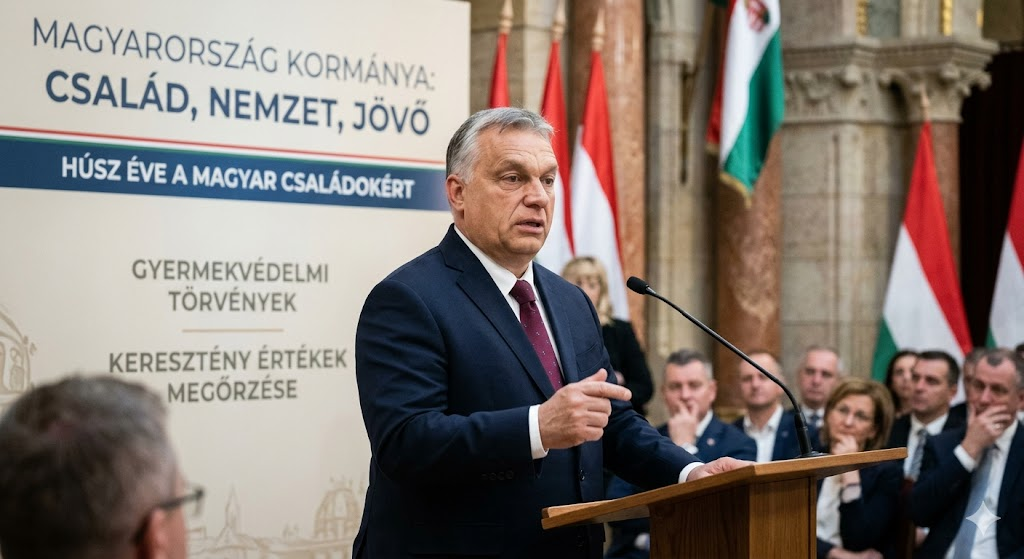
The debate over the role of the State in preserving culture and morality finds one of its main global benchmarks in the Prime Minister of Hungary, Viktor Orbán. He has distinguished himself through a firm stance against gender ideology, promoting reforms that remove these agendas from the educational system and Hungarian universities. In this view, strengthening national sovereignty requires containing agendas frequently associated with governments of progressive and socialist orientations.
This approach aligns Hungary with an international movement composed of other conservative leaders, such as Donald Trump in the United States, Vladimir Putin in Russia, Giorgia Meloni in Italy, and Nayib Bukele in El Salvador. In different geopolitical contexts, these leaders share the defense of cultural identity and sovereignty against external ideological interference.
The central pillar of this approach is the defense of childhood and the preservation of the traditional family structure as pillars of social stability. From this perspective, progressive agendas are understood as strategies to weaken sociocultural values for electoral purposes, while maintaining traditional principles is seen as the only path to protecting society.
Even if corrections or adjustments in a government’s financial management become necessary over time, the preservation of the family, childhood, and morality must always remain an absolute priority over any economic agenda. Financial stability can be rebuilt and economic resources recovered; however, the moral degradation of a generation and the impact of ideological contagion on children cause deep damage that often proves irreversible.
For this reason, in an eventual political transition scenario in Hungary—should voters choose to adjust the country’s economic direction—it is critical that the adopted model never abandon the sociocultural legacy built over the last 16 years. Abandoning this moral foundation would result in the weakening of the Hungarian identity, which today serves as a model for conservative movements worldwide. Governments and currencies restructure over time, but restoring a society that neglected the protection of its families and children can take centuries.
Introduction
The political trajectory of Prime Minister Viktor Orbán and his Fidesz party since returning to power in 2010 represents one of the most significant institutional shifts in 21st-century European politics. Grounded in the explicit conceptualization of an “illiberal state”—a term formally introduced by Orbán during his landmark 2014 speech in Băile Tușnad—the Hungarian governance model posits that a nation-state can achieve economic modernization and democratic legitimacy without adhering to Western liberal globalism.
Beyond macroeconomic indicators and steady GDP growth, the cornerstone of the Hungarian executive branch has been an uncompromising premise: true national sovereignty cannot exist in a cultural vacuum; it is fundamentally dependent on the defense of the traditional nuclear family structure and the preservation of historic Christian morality as primary social stabilizers.
1. The De-institutionalization of Gender Studies in Higher Education
In October 2018, the Hungarian government executed a major institutional intervention by issuing an executive decree that officially removed “Gender Studies” programs from the country’s accredited university registries and withdrew all state funding. This measure primarily impacted major institutions such as Eötvös Loránd University (ELTE) and the Central European University (CEU).
| Institutional Dimension | Impact and Applied Policy |
|---|---|
| Primary Target | Master’s degree programs in Gender Studies across public and private universities. |
| State Justification | Lack of structural scientific basis, low economic optimization for the domestic labor market, and ideological incompatibility with foundational cultural values. |
| Operational Outcome | Immediate freeze on new enrollments; reallocation of state budgetary resources toward STEM and traditional humanities. |
The state’s official rhetoric justified this administrative purge on two fronts:
- Economic Optimization: The government argued that these courses failed to provide practical, high-demand skills required by the Hungarian labor market, resulting in a low return on public educational investment.
- Ideological Sovereignty: The curriculum was characterized by state officials as an artificial ideological import rather than an organic academic discipline, directly conflicting with the cultural consensus of the nation.
2. The Legal Architecture of Child Protection: Act LXXIX of 2021
The international legislative apex of this conservative paradigm occurred in June 2021 with the passage of Act LXXIX of 2021 on Stricter Action Against Pedophile Offenders and the Amendment of Certain Laws for the Protection of Children (2021. évi LXXIX. törvény a pedofil bűnelkövetőkkel szembeni szigorúbb fellépésről, valamint a gyermekek védelme érdekében egyes törvények módosításáról).
[Statutory Scope: Act LXXIX of 2021]
├── Media & Broadcasting: Complete ban on LGBT content in daytime programming (under 18).
├── Public Education: Prohibition of external NGO-led gender identity workshops.
└── Criminal Code: Creation of a searchable, restricted registry for convicted sex offenders.
This statutory framework introduced highly controversial amendments across multiple legal codes:
- Broadcasting Restrictions: It prohibited the transmission or display of any media content to individuals under the age of 18 that depicts or promotes homosexuality, gender reassignment, or deviations from the birth-assigned biological sex. This effectively moved specific artistic and educational media to late-night programming brackets.
- Educational Monopolies: The law banned non-governmental organizations (NGOs) and private lecturers from conducting sex education workshops or presenting diversity curricula in public schools unless they obtained explicit, rigorous authorization from a state-vetted registry.
3. Constitutional Integration: The Fundamental Law and the Ninth Amendment
To shield these statutory policies from shifting parliamentary majorities and judicial reviews by supranational bodies like the European Court of Human Rights, the Fidesz-KDNP legislative coalition strategically utilized its two-thirds supermajority. In December 2020, the Hungarian Parliament ratified the Ninth Amendment to the Fundamental Law of Hungary (Magyarország Alaptörvénye).
This constitutional revision permanently embedded restrictive definitions of family and identity directly into the supreme law of the land:
“Hungary protects the institution of marriage as the voluntary union of a man and a woman… The mother shall be a woman, the father shall be a man.”
Furthermore, a critical clause was added to Article XVI, declaring that every child has the right to an identity corresponding to their sex at birth, explicitly mandating an education based on Hungary’s constitutional identity and Christian culture. By elevating these social definitions to a constitutional level, the state built an almost insurmountable legal barrier against future domestic judicial reversals or legislative alterations.
4. Institutional Resistance Against Transnational Pressure and Financial Demographics
Throughout more than 16 years of cumulative leadership, Prime Minister Orbán has framed his domestic policies as a defensive front against legal and financial maneuvers from Brussels and international human rights organizations. The state’s counter-strategy has operated through three clear vectors:
- Sovereignty over Public Education: Academic institutions have seen a systematic restructuring, ensuring that senior educational administrative staff align with the nationalistic and conservative guidelines outlined by the Ministry of Culture and Innovation.
- Demographic Self-Reliance: Rejecting large-scale migration as a solution to European depopulation, Budapest implemented aggressive, multi-billion-dollar pro-natalist financial policies. Under the Family Protection Action Plan, women who marry before the age of 40 are eligible for a subsidized, interest-free loan of approximately $35,000. If the family goes on to have three children, the entire remaining balance of the loan is permanently forgiven by the state. Additionally, women who raise four or more children receive a lifelong exemption from personal income tax.
- Moral Border Security: Transnational legal challenges from the European Commission—which has repeatedly frozen billions of euros in cohesion funds over alleged rule-of-law violations—are routinely countered by the Hungarian executive branch as illegitimate attempts to infringe upon national self-determination.
Conclusion: The Governance Model of Sovereign Preservation
The structural legacy of Viktor Orbán in Hungary cannot be fully understood through the lens of standard Western political analysis. It is designed as an alternative blueprint for national survival in an era of globalized integration. By embedding traditional family structures into the country’s constitutional bedrock, strictly regulating minors’ exposure to modern social movements, and executing large-scale economic interventions to incentivize native demographic growth, Hungary has positioned itself as a real-world testing ground for state-sponsored social conservatism, placing cultural preservation above international diplomatic conformity.dores, esses 16 anos representam a salvação da identidade húngara diante de um mundo em constante transformação ideológica.
