
Brazil – Part II
By Marcelo Salamon
july 13, 2026.
Abstract
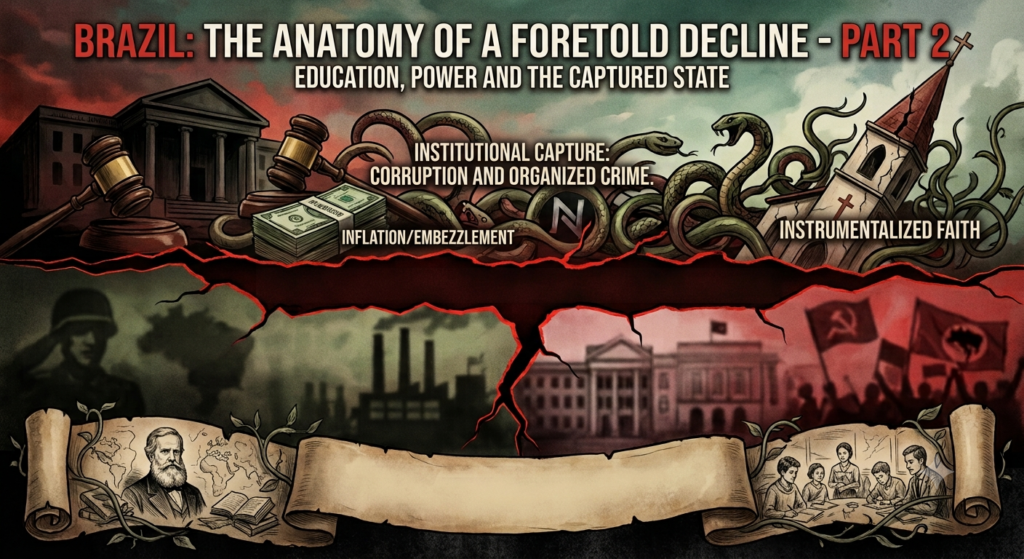
A critical and historical analysis of Brazil’s institutional and educational decline. This essay examines how chronic negligence in basic education, perpetuated by successive regimes across the political spectrum, has engineered a landscape of social vulnerability. This vulnerability has ultimately culminated in the capture of state and religious structures by organized crime and systemic political clientelism.
Keywords
Education; Institutional Capture; Organized Crime; Brazilian Politics.
Introduction
Understanding the structural fractures that shape contemporary Brazil requires an analysis that transcends the superficiality of seasonal, partisan debates. This essay offers a rigorous, interconnected diagnosis of the nation’s reality by investigating the historical roots of a deliberate omission: the formal education of its people. By tracking the continuity of educational management from the Empire through the military regime and into subsequent left- and right-wing administrations, this text exposes the mechanisms through which institutionalized ignorance ceased to be a mere byproduct of underdevelopment and became a sophisticated project of power, paving the way for organized crime to infiltrate the most vital spheres of society.
Education, Power, and the Deliberate Engineering of Ignorance
Brazil is a living contradiction that strikes any observant onlooker. It is the nation with the greatest natural potential in Latin America—possessing a continental territory, vast mineral wealth, fertile land, and an industrial base that somehow endures, despite facing the constant threat of being dismantled by the state’s own hand, much like what has already unfolded in Argentina. Yet, it simultaneously registers some of the worst basic education metrics on the continent. This is not sensationalism; it is a clinical diagnosis. This stark mismatch between exuberant tangible resources and impoverished human capital is no accidental detour; it represents the consolidation of a model of exclusion that systematically hollows out national sovereignty at its core.
This text does not intend to be a generic list of grievances. Rather, it aims to trace the thread connecting one structural failure to the next: how the deliberate choice—perpetuated by factions across the political spectrum for over a century—to keep the Brazilian populace undereducated became the breeding ground for endemic corruption, the criminalization of state institutions, and the erosion of the country’s foundational moral values. This educational dismantling acts as the primary catalyst in a chain reaction: deprived of abstract reasoning and critical thinking skills, civil society becomes incapable of oversight, reducing citizens to a easily manipulated electorate and allowing bureaucratic and criminal oligarchies to usurp the public apparatus.
Dom Pedro II: The Solitary Effort That Was Not Enough
It is common to romanticize the Second Reign as a golden age of Brazilian education. The reality is far more modest, though still significant. Nineteenth-century census records reveal that illiteracy remained staggeringly high throughout virtually the entire monarchical period. Primary instruction was decentralized to cash-strapped provinces via the Additional Act of 1834, leaving the bulk of the population outside the school system. The claim that half of the population was literate by the end of the regime lacks factual support; the Crown chose to retain aristocratic control over higher education while leaving primary schooling to insolvent local entities.
That being said, Emperor Dom Pedro II’s personal efforts possess genuine historical merit. Proportionally, he drove the greatest advancement in literacy in the country’s history up to that point—raising it from a baseline near zero to approximately 20% to 25% by the end of his reign. He acted as an institutional patron, personally financing university students abroad, establishing technical institutes, sponsoring sciences and arts, and founding the Colégio Pedro II as a national benchmark of pedagogical excellence. His commitment operated as a personal crusade within an environment structurally hostile to the democratization of knowledge. No republican government after him, including those that promised to “revolutionize” higher education, came close to that proportional leap. The Workers’ Party (PT), which turned “universities for the masses” into a central campaign banner, only managed to extend higher education to a small fraction of the population; a university degree in Brazil remains the exclusive reality of a minority. Academic access was preserved as a badge of caste distinction, perpetuating corporate privileges.
The point is not to eulogize the Empire, but to establish a sobering fact: even the ruler most intellectually dedicated to education in Brazilian history could not unravel the structural problem—and after him, no one ever tried on the same scale.
The Military Regime: A Historic Opportunity Squandered
Following the collapse of the Monarchy, the subsequent regimes—stretching from the Old Republic to the military dictatorship that ruled from 1964 to 1985—delivered a precarious, limited, and mediocre education that deteriorated with each passing decade.
The military regime held absolute, concentrated power for over two decades—the perfect historical opportunity to rebuild Brazilian education from the ground up. They failed to do so. Instead, they offered narrow vocational training tailored to cheap labor, gutted basic education, and simultaneously deployed a massive state propaganda machine to market the armed forces as infallible and incapable of error. This utilitarian vision transformed classrooms into industrial assembly lines, stripping away humanities and philosophical reflection to neutralize political dissent. They were not infallible. In this regard, they proved just as cowardly as the critics they suppressed: they held the absolute power to alter the nation’s educational destiny and chose not to.
The regime’s final president, João Batista Figueiredo, encapsulated this institutional disdain during an April 1978 interview, stating: “A people who do not even know how to brush their teeth are not prepared to vote.” This documented quote reveals a profound contempt for a populace whose ignorance the regime had the time, resources, and power to eradicate, yet chose to ignore. Rather than assuming state responsibility for the instruction of its citizens, the military command weaponized the very misery it helped perpetuate to justify its authoritarian tutelage.
(Author’s note: There remains a vivid personal recollection of watching, during my youth, an interview with Figueiredo on Rede Globo, where he allegedly predicted that Brazil would one day fall into the hands of a radical left-wing party that would attempt to institute communism. While this specific broadcast does not appear in contemporary press archives—and fact-checkers classify its origin as unverified—Figueiredo’s disdain for the political capacity of the Brazilian public is thoroughly documented in numerous other verified statements, such as the one quoted above.)
Decades later, the outcome was exactly what one would expect from a populace deliberately starved of education: Brazil did indeed fall into the hands of the left, with the PT holding power for sixteen consecutive years. This occurred not because the Brazilian people are inherently incapable, but because they were kept incapable by those who possessed the power to change their trajectory and chose not to. A nation only achieves greatness when it recognizes its own failures and the structural victories of its adversaries—and it is precisely this rare intellectual honesty that the Brazilian right wing lacks to this day. The critical vacuum bequeathed by the authoritarian regime paved the asphalt for the subsequent cultural hegemony.
The Left in Power: Destruction by Design
Upon ascending to power, the PT did not correct the educational failure that Figueiredo had foreseen as fatal; they deepened it systematically. The figure most tied to this project is Paulo Freire, who served as São Paulo’s Secretary of Education from 1989 to 1991 and was declared the “Patron of Brazilian Education” by federal law in 2012. Critics point to social promotion—the practice of automatically passing students under the guise that grading or failing them is an “oppressive” act—as his most damaging practical legacy. In practice, this policy abolished academic accountability and produced entire generations unable to read, write, or perform basic mathematics. Under the pretext of formal inclusion, analytical rigor was hollowed out, normalizing a race to the bottom while masking the system’s bankruptcy through artificially inflated enrollment statistics.
The results are starkly measurable. In the 2022 PISA (Programme for International Student Assessment) evaluations, which spanned 81 countries, Brazil ranked 52nd in reading, 61st in science, and 65th in mathematics, remaining stagnant at the bottom of global rankings. These international metrics expose how Brazilian youth are being systematically deprived of the basic functional literacy required to compete in a global, knowledge-based economy.
Compounding this crisis is the severe deterioration of Brazil’s public universities, which have devolved into arenas of recurrent vandalism and institutional chaos. In several states, well-run penitentiaries exhibit greater administrative order than certain university campuses. The environments meant to be the pinnacle of scientific research and high-level debate have been hijacked by corporate political activism. Furthermore, the aggressive weaponization of identity politics and gender theory has been deployed to deconstruct the traditional Brazilian family—a family structure that was already highly vulnerable, precisely because it lacked the foundational buffer of a solid education and stable moral values since the Imperial era. This top-down social engineering easily penetrated a vulnerable social fabric that possessed no intellectual antibodies to resist the destabilization of its traditional bonds.
Corruption: Beyond Rhetoric, The Criminal Capture of the State
When exposing systemic corruption, it is tempting to inflate statistics for rhetorical effect. Here, that is unnecessary; the verified data is sobering enough. In Transparency International’s 2025 Corruption Perceptions Index, Brazil scored a meager 35 points on a 0-to-100 scale, ranking 107th out of 182 nations. While it is not “the most corrupt country in the world”—faring better than Mexico and Venezuela, though lagging far behind Uruguay and Chile—it has remained completely stagnant in this low tier for over a decade. This prolonged stagnation demonstrates that bribery and malfeasance have ceased to be marginal ethical deviations and have instead become the default lubricant of the public machine.
Yet, the true gravity lies not in the ranking itself, but in the nature of the problem. As detailed by Transparency International, corruption in Brazil has allowed organized crime to directly infiltrate the political apparatus. This is no longer a matter of an isolated politician or rogue police officer colluding with a cartel; entire state institutions now operate as legalized criminal syndicates, weaponizing the legal framework and the judiciary to shield their own financial interests. Modern criminological literature defines this as “regulatory capture” or the “capture of sovereignty”—where oversight bodies work actively to guarantee impunidade (impunity) and secure the financial reproduction of mafias. This reality cuts across politicians of both the left and the right.
Within this framework of state capture, the Brazilian Judiciary emerges as one of the most severe and deeply entrenched crises facing the nation. Proportionate to GDP, Brazil boasts the most expensive judicial system in the world. It consumes billions in public funds to sustain lavish benefits, institutional perks, and a bloated bureaucracy, all while delivering a chronically slow, inefficient service that leaves the average citizen legally exposed. Far from being an impartial arbiter, significant factions within this structure actively fuel systemic corruption. Through hyper-technical legal maneuvers, selective enforcement, and casuistic rulings, high courts and local magistrates frequently serve as legal shields for criminal political and economic elites, routinely overturning major anti-corruption operations and ensuring impunity for those with the power to manipulate the law.
A distinct and rapidly escalating dimension of this crisis is the infiltration of organized crime into evangelical churches—a phenomenon heavily documented by investigative journalism and the Federal Police. In Rio de Janeiro, particularly within the Baixada Fluminense, a new criminal archetype has solidified: the “Evangelical Narco” (narcotraficante evangélico). Gang leaders claim religious conversions, establish or seize control of churches within their territories, and weaponize the pulpit to consolidate social control without ever relinquishing their drug empires.
In 2024, the Federal Police launched Operation Fim do Mundo (Operation End of the World), arresting an evangelical pastor who served as a primary front man in a massive money-laundering ring tied to the TCP cartel. The operation revealed his entire family’s involvement and resulted in the seizure of approximately $25 million in illicit assets. This is no isolated incident. Major federal investigations increasingly link prominent religious networks to international drug trafficking and money laundering syndicates, alongside routine arrests of clergy for fraud and predatory crimes. The tax-exempt status of religious temples has effectively been co-opted, turning holy spaces into highly efficient laundromats for capital generated by narcotics and urban militias.
Another structural factor quietly undermining the system is the tight-knit network of closed fraternal organizations—such as Freemasonry—that cuts across the judiciary, political bodies, and the corporate elite. The issue does not lie in the organizations themselves, their rituals, or their beliefs. Rather, as investigative exposes have shown, the problem is the structural conflict of interest created when a hermetic brotherhood, bound by oaths of mutual allegiance, dominates public decision-making. This creates a persistent environment where “brothers” protect and advance one another in matters that demand strict, technical impartiality. This parallel corporate solidarity sabotages the constitutional principle of impersonality, distorting the due process of law in favor of secret allegiances.
A Right Wing That Capitalizes on the Ignorance It Helped Create
If this diagnosis stopped at the left, it would be an incomplete and cowardly critique. The visible face of the contemporary Brazilian right wing is fragile, deeply hypocritical, and increasingly dependent on a segment of mercantilist religious leaders. These figures enrich themselves by exploiting the exact cognitive vulnerability that decades of failed education produced—peddling prosperity theology, moral panic, and blind fanaticism to a base lacking the critical tools to realize it is being used as electoral leverage. This faction has abandoned genuine debates on free-market capitalism and institutional integrity in favor of a shallow, opportunistic messianism. While this does not absolve the crimes of the left, it exposes the core tragedy of Brazil: the ruling class, regardless of ideology, has discovered that an uneducated populace is remarkably easy to manipulate, and prefers to preserve this ignorance rather than build a prosperous, critically thinking nation. The pragmatic right has commercialized moral panic as a voter-retention strategy, operating on the exact same frequency of cognitive depletion as its historic adversaries.
This is not an assault on conservatism as a philosophy. It is a refusal to pretend that the practical execution of the Brazilian right wing has lived up to the principles it claims to hold.
The Brazilian People: Victimized, but Not Innocent
This diagnosis must conclude without falling into the opposite extreme: treating the Brazilian populace as entirely passive, blameless victims. A vast portion of the population has indeed been kept deliberately ignorant by generations of political elites. Yet, within this same populace, there are those who actively choose to externalize all personal accountability to the state, refusing to make any individual effort toward self-improvement. Furthermore, there are those who, regardless of the quality of education they received, would act in bad faith out of sheer personal malice.
The widespread cultural normalization of the “jeitinho”—the micro-frauds and ethical corners cut by the average citizen in daily life—serves as the moral foundation upon which the macro-corruption of Brasília is erected. Recognizing the historical guilt of those who held power and refused to change the system does not exempt the individual from the duty of rebuilding their own critical capacity. Individual complacency and widespread ethical leniency are the essential fuels that keep the engine that crushes them running.
Closing Remarks
There is no cheap pessimism in these words. Rather, in the finest tradition of those who prefer a harsh diagnosis over a comfortable illusion, this is an attempt to name what few dare to: Brazil does not suffer from isolated crises, but from an unbroken causal chain. Bad education breeds ignorance; ignorance breeds political manipulation across the board; manipulation leads to the capture of state institutions by organized crime; and a captured state eternally preserves the very lack of education that birthed it. Exposing this cycle, even without the illusion of immediate change, remains the only work truly worth doing.
Author’s Note: Personal recollections, where not substantiated by independent journalistic sources, are explicitly identified as such throughout the text.
Conclusion
Ultimately, the engineering of ignorance detailed in this essay points not merely to the failure of isolated public policies, but to the sustained success of a cycle of oligarchic self-preservation. By stripping citizens of analytical tools and critical discernment, the ruling elite guarantees an electorate permanently vulnerable to demagoguery and clientelism. The evolution from conventional bureaucratic bribery to full institutional capture by criminal factions and corporate judicial cartels represents the ultimate breakdown of structural integrity. Breaking this causal chain requires the uncomfortable recognition that cosmetic solutions offered by bankrupt ideological factions are fundamentally useless. Only a return to academic rigor and the restoration of technical integrity within state institutions can interrupt the trajectory of this foretold decline.
Bibliography
- BRAZIL. Ministry of Education. Results of the Programme for International Student Assessment (PISA) 2022. National Executive Report. Brasília: INEP/MEC, 2023.
- FREIRE, Paulo. Pedagogia do Oprimido (Pedagogy of the Oppressed). Rio de Janeiro: Paz e Terra, 1968.
- LAW ENFORCEMENT RECORDS & INVESTIGATIVE REPORTS. Federal Police documentation on money laundering within religious institutions (Operation Fim do Mundo, 2024). Directorate for Investigating and Combating Organized Crime. Brasília: PF, 2024.
- SOUZA, João Batista Figueiredo. Press Conferences and Official Statements (April 1978). Archives of the Presidency of the Republic / Center for Research and Documentation on Contemporary History of Brazil (CPDOC-FGV).
- TRANSPARENCY INTERNATIONAL. Corruption Perceptions Index (CPI) 2025. Berlin: Transparency International, 2026.
