By Marcelo Salamon
April 30, 2026
Executive Summary
The text outlines the profound security and social transformation of El Salvador under the administration of President Nayib Bukele, focusing on two main pillars: a comprehensive crackdown on criminal organizations and a shift toward national-conservative social policies.
- The War on Gangs: For decades, El Salvador was effectively controlled by major gang factions, including MS-13 and Barrio 18. Following a massive spike in violence in March 2022, the government declared a State of Exception—which has since been extended over 50 times—suspending several constitutional liberties. This measure launched the Territorial Control Plan, resulting in the incarceration of over 75,000 suspected gang members.
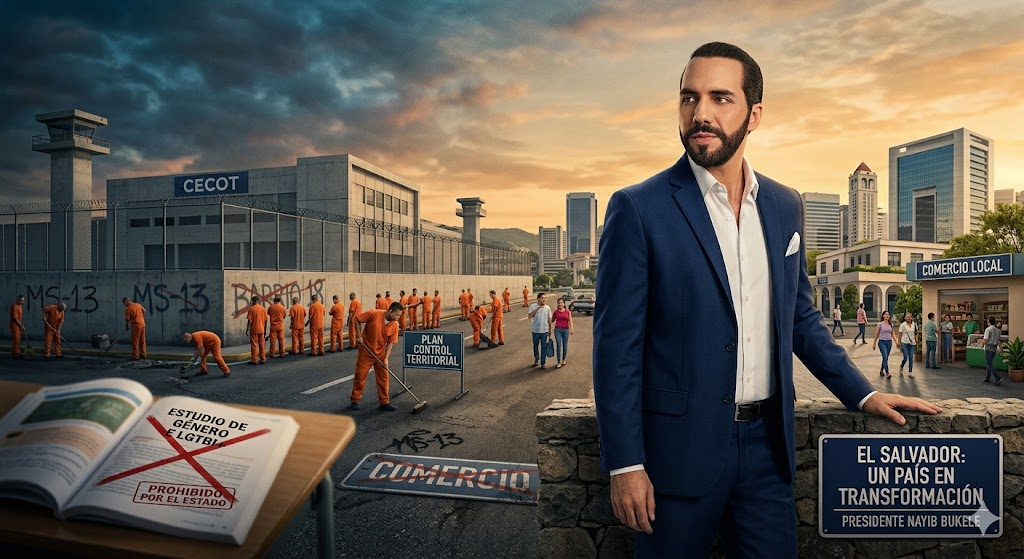
- The Rise of CECOT: To house high-ranking gang leaders and dismantle the “prison-office” network, the government constructed the Terrorism Confinement Center (CECOT). This mega-prison operates under maximum isolation and a “Zero Leisure” policy, requiring inmates to participate in forced labor, such as public infrastructure repairs and erasing gang graffiti.
- Societal and Economic Results: As of 2026, the country’s homicide rate has plummeted from historic highs to approximately 2 per 100,000 residents, positioning El Salvador as one of the safest nations in the world. The elimination of systemic extortion has revitalized local commerce and boosted international tourism. Despite international criticism regarding due process and civil liberties, domestic approval for Bukele remains near 85%.
- Conservative Social Reforms: Parallel to its security initiatives, the administration has implemented a “moral cleanup” to protect the “traditional family,” which it links directly to national stability. The Ministry of Education has banned all materials related to “gender ideology” and LGBTQ+ themes in public schools, and inclusive language has been prohibited across all government institutions to focus education on core academic subjects rather than social engineering.
Introduction
The contemporary history of El Salvador is currently being rewritten through the controversial and highly effective “Bukele Model.” Since taking office in 2019, President Nayib Bukele has moved to dismantle the systemic violence and social decay that plagued the nation for over three decades. By implementing a governance strategy that synthesizes absolute military control with a return to traditional social values, the administration has sought to reclaim a state that was previously considered a “failed” jurisdiction. This article explores the multifaceted approach of the Salvadoran government in neutralizing organized crime, restructuring the penal system, and enforcing conservative cultural reforms.
The Onset: Confronting the “Maras”
For decades, El Salvador was effectively partitioned by two primary criminal organizations: Mara Salvatrucha (MS-13) and the Barrio 18 (divided into the Revolucionarios and Sureños). These factions operated as parallel states, controlling vast territories through a regime of extortion, kidnapping, and brutal murder. Leaders like Borromeo Enrique Henríquez, known as “Diablito de Hollywood,” managed these networks even from within the prison system. Previous administrations fluctuated between failed military crackdowns and secret, fragile truces that only served to embolden the gangs.
By March 2022, the cycle of violence reached a catastrophic breaking point when a sudden spike in homicides resulted in 87 deaths in a single weekend. In immediate response, Bukele prompted the Legislative Assembly to declare a State of Exception. This legal framework suspended several constitutional rights, including the right to legal counsel and the necessity for administrative warrants, allowing for a totalizing “war on gangs” that has resulted in the incarceration of over 75,000 individuals suspected of gang affiliation.
The Territorial Control Plan and the Rise of CECOT
The cornerstone of this strategy is the Territorial Control Plan, which utilized a massive, coordinated deployment of the National Civil Police (PNC) and the Armed Forces to reclaim neighborhoods that had been under gang rule for thirty years. To manage the massive influx of detainees, the government constructed the Terrorism Confinement Center (CECOT). This mega-prison, one of the largest in the world, was built with the specific intent of ending the “prison-office” culture where gang leaders directed street crimes from their cells.
The prison infrastructure is designed for maximum isolation and incapacitation. Inmates at CECOT are kept in high-capacity cells with reinforced steel bars and limited natural light, under 24-hour surveillance. Furthermore, the penal philosophy has shifted toward a “Zero Leisure” policy. Inmates are now required to engage in forced labor, working on public works projects such as cleaning streets, repairing infrastructure, and erasing gang-related graffiti—effectively forcing them to dismantle the very symbols of terror they once erected. While high-ranking leaders face sentences exceeding 60 years and are kept in permanent isolation, the government maintains that this rigorous system is the only way to ensure they never influence society again.
Current Societal Results and the New Order
As of 2026, the results of these policies are historically unprecedented. The primary targets, including the leaders of MS-13 and both branches of Barrio 18, have been systematically removed from the streets. The homicide rate, which once peaked at over 100 per 100,000 residents, has plummeted to approximately 2 per 100,000, making El Salvador one of the safest nations in the world. This security vacuum has been filled by a resurgence in local commerce and international tourism, as the “extortion tax” that previously strangled small businesses has been effectively abolished.
This transformation has been achieved through a continuous State of Exception, which has been extended more than 50 times. While this has drawn criticism from international human rights organizations regarding due process, the domestic approval for Bukele remains near 85%. The Salvadoran public has largely signaled that the restoration of physical safety and the ability to walk the streets at night justifies the draconian measures and the suspension of certain civil liberties.
Conservative Social Reforms: “Gender Ideology” Bans
Parallel to the security crackdown, the Bukele administration has enacted what it terms a “moral cleanup” of the state’s educational and institutional frameworks. Bukele has positioned himself as a staunch defender of the “traditional family,” arguing that modern social theories regarding gender were foreign impositions that destabilized the moral fabric of the nation. He has explicitly linked the destruction of the family unit to the rise of the gang culture that previously destroyed the country’s finances and security.
In a series of decisive legislative moves, the Ministry of Education officially removed all materials related to “gender ideology” and LGBTQ+ themes from public schools. This was followed by a comprehensive ban on inclusive language within all government institutions. The administration argues that these measures protect children from “indoctrination” and ensure that the education system focuses on core academic subjects rather than social engineering. By aligning the state with national-conservative values, Bukele has sought to “reverse the damage” caused by decades of social and moral decay, consolidating a governance model that is as culturally conservative as it is security-focused.
Conclusion
The “Bukele Model” represents a radical experiment in socio-political reconstruction. By prioritizing the collective right to security over individual procedural protections, the administration has successfully neutralized the gang structures that once held the nation hostage. Furthermore, by integrating a conservative social agenda into the national identity, the government is attempting to build a society anchored in traditional order. While the long-term sustainability of the State of Exception remains a subject of international debate, the immediate reality for El Salvador is a profound transition from a state of terror to a state of unprecedented public order.
Article Summary
- Targeted Organizations: Complete neutralization of MS-13 and Barrio 18 (Revolucionarios and Sureños).
- Legal Framework: Sustained State of Exception allowing for mass arrests and the elimination of gang territorial control.
- Penal Innovation: Creation of CECOT, a mega-prison characterized by isolation and a “Zero Leisure” mandatory labor policy for inmates.
- Public Safety: Homicide rates dropped from global highs to approximately 2 per 100,000, sparking economic and tourism growth.
- Social Policy: Explicit ban on “gender ideology,” LGBTQ+ curricula, and inclusive language in schools and government offices to protect the traditional family unit.
- Political Standing: Domestic approval remains high at 85%, despite international concerns regarding human rights and due process.
