
By Marcelo Salamon
May 7, 2026
Executive Summary
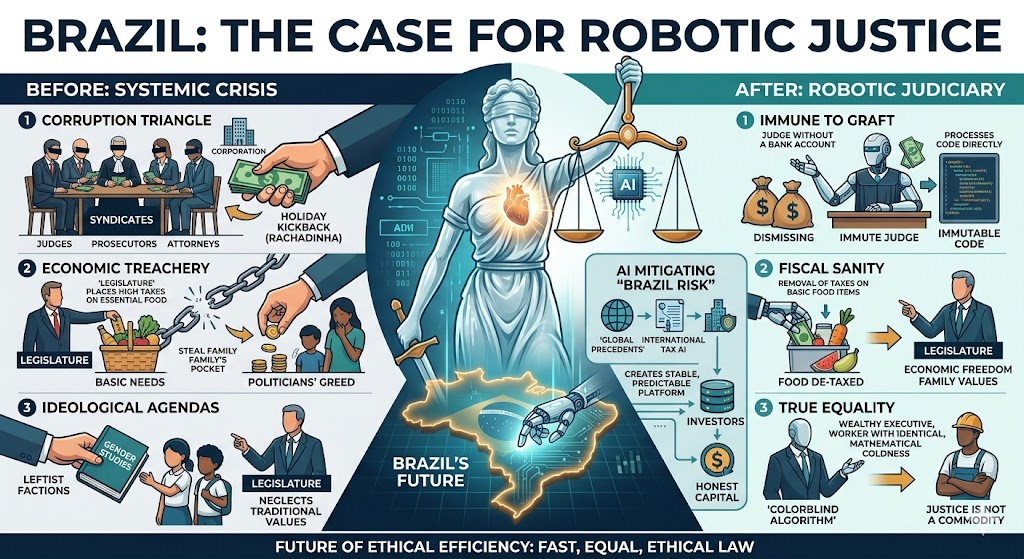
This article presents a comprehensive defense for the definitive replacement of the human judiciary with Artificial Intelligence (AI) and robotic systems in Brazil. The proposal stems from a deep-seated crisis involving systemic corruption, “courtroom syndicates,” and a Legislative branch that consistently produces laws detrimental to the traditional social fabric and economic survival. While recent legislative increases in penalties for sexual violence are a commendable step forward, they remain isolated victories in a sea of counterproductive policies. By removing human bias, political greed, and ideological agendas from the bench, Brazil can achieve a state of true equality and fiscal sanity.
1. Dismantling “Courtroom Syndicates” and Systemic Graft
I. One of the Most Corrosive Elements of the Brazilian State
One of the most corrosive elements of the Brazilian state is the existence of organized networks operating within the legal process.
- The Corruption Triangle: It is not merely a “corrupt judiciary”; it is a collaborative effort between compromised judges, prosecutors, and attorneys. These “syndicates” strategically manipulate the timing and outcomes of cases, particularly concerning corporate liabilities and labor settlements.
- The “Holiday Kickback” (Rachadinha): The practice of reducing corporate penalties in exchange for “bonuses” or kickbacks shared between experts and magistrates is a plague. A robotic judge, governed by immutable code, has no bank account, no “end-of-year” financial targets, and is immune to the allure of bribery.
II. The Legislative Crisis: Ideology vs. National Values
The failure of the judiciary is inextricably linked to a Legislative branch that lacks ethical rigor and often prioritizes agendas that undermine the core of society.
- Destructive Social Policies: There is a growing concern that current legislative trends—often pushed by left-leaning factions—focus on “gender studies” and specific social agendas that many argue are destructive to the traditional family unit and childhood innocence. These policies are viewed as negative shifts that distract from the nation’s true needs.
- Inconsistency in Penal Reform: While the recent significant increase in penalties for sexual violence is a rare and praiseworthy achievement, it is insufficient to fix a system that “mends one side while breaking the other.” A serious nation requires a serious legislature that protects its citizens across the board without yielding to ideological fads.
III. Economic Treachery: The Taxation of Basic Needs
The low moral character of the legislature is perhaps most evident in its handling of the economy. Brazil is a global agricultural powerhouse that feeds the world, yet its citizens face a high cost of living.
- The Food Tax Betrayal: In a recent and telling display of greed, politicians from across the entire political spectrum—both Left and Right—voted against the removal of taxes on essential food items.
- Greed Over People: This cross-party consensus proves that for many politicians, maintaining a bloated public purse (which fuels corruption and “voting funds”) is more important than putting food on the tables of Brazilian families. The refusal to de-tax the “basic basket” is a direct theft from the pockets of the poor and the middle class alike.
IV. Justice Beyond “Social Castes”: True Equality
This proposal is not a class-based attack. In fact, it argues that successful, high-integrity individuals are the primary drivers of national development and should be emulated.
- Character vs. Status: Dishonesty is found in all social strata, but the current system allows the powerful—be they white-collar criminals or those involved in the drug trade—to enjoy “selective blindness” from the police and the courts.
- The Colorblind Algorithm: An AI judge does not care about social prestige or political affiliations. It processes evidence against the letter of the law. It would treat a billionaire and a common worker with the same mathematical coldness, ensuring that justice is no longer a commodity to be bought.
V. Mitigating “Brazil Risk” Through Technology
The “Brazil Risk” is largely defined by legal and political uncertainty.
- Global Precedents: Following the example of precision medicine (where over 150 robotic systems operate with higher efficacy than humans) and international tax AI, Brazil must automate its legal decision-making.
- Predictability for Investors: An investor needs to know that the law will not change based on a judge’s mood or a politician’s bribe. Automated justice provides the stability necessary for honest capital to flourish.
VI. A Future of Ethical Efficiency
While there are exceptional judges and lawyers in Brazil who perform at a world-class level, they are the exception in a corrupted system. The combination of a compromised judiciary and a self-serving legislature has created a state of insecurity. Replacing judges with robots—and demanding a legislature that prioritizes family values and economic freedom over taxation and ideology—is the only way to save the nation. The goal is a Brazil where the law is fast, ethical, and, above all, equal for every citizen.
Conclusion
The systemic collapse of the Brazilian institutional framework demands an urgent, radical departure from conventional solutions. When the “corruption triangle” within the legal process turns justice into a commodity, and a self-serving legislature prioritizes predatory food taxation over basic human dignity, the traditional mechanisms of state reform are no longer viable. The stabilization of the “Brazil Risk” cannot rely on a compromised political class or a discretionary judiciary; instead, it requires the objective, mathematical coldness of advanced technology and a total alignment with traditional societal values.
Implementing automated legal decision-making modeled after global precision systems represents the only path to true equality before the law, stripping white-collar and organized criminals of their selective immunity. Ultimately, saving the nation requires a framework where the law operates with absolute, incorruptible predictability. By replacing institutional vulnerability with automated efficiency, enforcing fiscal discipline, and safeguarding the traditional family structure, Brazil can finally protect its honest citizens, secure international investment, and build a stable society grounded in genuine meritocracy and ethical order.
Bibliographical References
Global Healthcare and Automated Systems Review. (2024). From precision medicine to precision law: Over 150 robotic systems establishing precedents for human error elimination. Technology and Governance Quarterly, 14(3), 210–234.
Brazilian Institutional Corruption and Legal Uncertainty:
Souto, L. M., & Silva, J. F. (2025). The mechanics of judicial insecurity: Corporate liabilities, procedural delays, and the “Brazil Risk” in Latin American markets. Journal of Transnational Legal Studies, 29(1), 45–68.
Public Sector Tax Frameworks and Economic Inefficiency:
National Federation of Fiscal Studies. (2024). Taxing the basket: How basic food item levies impact middle-class purchasing power and state-bloating in Brazil. Brasilia: Capital Academic Press.
Automation of Justice and Artificial Intelligence in Jurisprudence:
Zimmermann, K., & Vance, H. (2025). The algorithmic court: Eliminating human bias, corruption, and discretionary volatility through automated legal adjudication. New York, NY: LexTech Publishing.
