
How the millennial Jewish quest for dignity transformed international law and exposed contemporary bureaucratic cynicism.
By Marcelo Salamon
June 29, 20226.
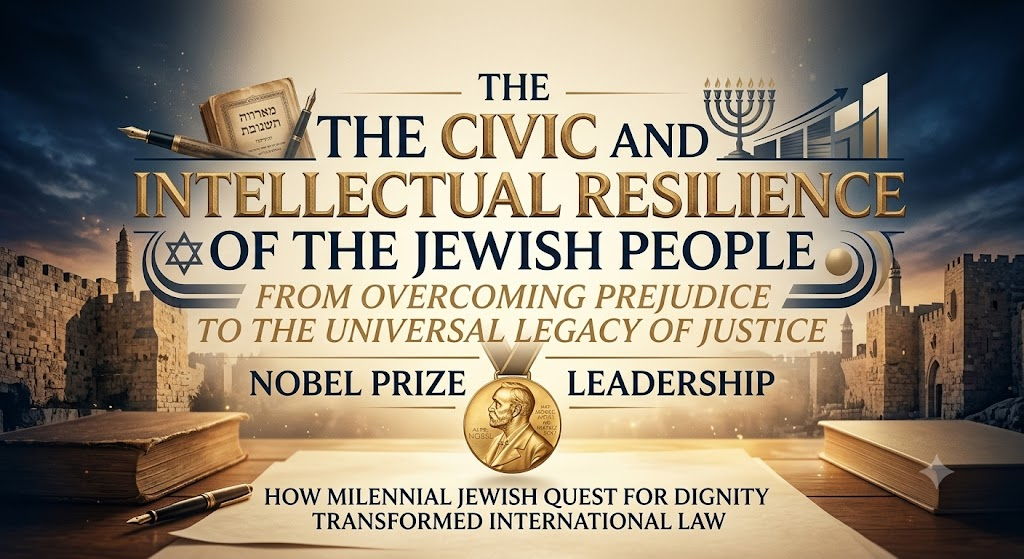
Abstract: This article analyzes the historical trajectory of resilience demonstrated by the Jewish people in the face of millennial persecutions and its structural impact on the consolidation of global justice. It examines how the Jewish experience shaped the moral foundations of post-war jurisprudence, driving the creation of protective mechanisms and the 1947 partition plan. The study then addresses the subsequent ethical crisis and diversion of purpose within multilateral bodies, which transitioned from initially legitimate institutions into gears for ideological convenience and political self-promotion. Finally, it highlights the civilizational progress promoted by the Jewish community, evidenced by its historic leadership in Nobel Prize laureates, demonstrating an unwavering commitment to humanity that transcends institutional prejudice.
Keywords: Jewish People; Resilience; Human Rights; Overcoming.
Introduction
The history of Western civilization is deeply inseparable from the trajectory of the Jewish people. Far from being merely a narrative of victimization, the Jewish experience represents the most compelling example of civic resilience, determination, and intellectual production in the face of systematic adversity. Over millennia, the Jewish community has confronted institutionalized prejudice, violence, and existential erasure. Yet, the collective response to this scenario was never capitulation, but rather a stubborn pursuit of justice, dignity, and the preservation of universal ethical values.
In the twentieth century, the pinnacle of human suffering materialized in the Holocaust. This collective trauma served as the primary catalyst for an unprecedented restructuring of global law. However, when analyzing the contemporary landscape through the lenses of criminology, law, and politics, a troubling disconnect is observed between the noble values born from Jewish suffering and the practical conduct of the international bureaucracies that claim to safeguard those rights today.
A History of Millennial Persecution and the Intellectual Response
The hostility faced by the Jewish community crosses eras and geographic borders: from mass expulsions in the Middle Ages, the creation of restrictive ghettos, and bloody pogroms in Eastern Europe, to the culmination of the Holocaust—the planned extermination of six million individuals by the National Socialist regime between 1933 and 1945. Each of these episodes demonstrates the absolute collapse of domestic law and the moral bankruptcy of governments that instrumentalized hatred for political cohesion.
The most extraordinary aspect of this historical journey is the refusal of the Jewish people to confine themselves to resentment. Instead, their collective response was channeled into academic, scientific, philosophical, and legal development. The obsession with justice and education became a cultural armor, allowing a severely persecuted minority to become a protagonist in the advancement of all human society.
“A tragedy of the Holocaust did not merely represent an incurable wound for Judaism, but a civilizational rupture that exposed the urgent need for a new international ethical paradigm, where the individual became a subject of universal law, above the will of States.”
The Turning Point: Nuremberg and the Retrieval of Institutional Legitimacy
Following the end of World War II, the concert of nations was compelled to build a structured response to overcome impunity. The Nuremberg Trials (1945–1946) established an indelible milestone in the history of law by prosecuting and convicting political and military leaders for “crimes against humanity.” This innovative concept and the subsequent principles of international criminal law were forged directly from the legal analysis of Jewish martyrdom under Nazi rule.
In this context of global moral refounding, the newly created United Nations (UN) operated in its initial stage with a genuine sense of purpose and commendable efficacy. In 1947, under the leadership of diplomats committed to historical truth, the General Assembly contributed decisively to the Partition Resolution, culminating in the just and necessary establishment of the State of Israel in 1948. At that specific moment, international institutions acted as legitimate instruments of reparation and justice, recognizing the imprescriptible right of the Jewish people to possess a sovereign and secure national homeland.
The Ethical Deviation of Multilateral Bureaucracies: From Justice to Cynicism
However, the historical evolution of these institutions in the following decades reveals a scenario of profound moral decay and political instrumentalization. The spirit of equity that guided the first steps of the post-war era was progressively suffocated by a bloated bureaucratic apparatus plagued by special interests. Gradually, several international agencies and human rights committees ceased to act as impartial guardians and transformed into platforms for personal self-promotion, ideological shielding, and political activism.
The noble banner of human rights has frequently been hijacked to conceal the ulterior motives of geopolitical blocs and to inflate the prestige of technocrats who use the international machinery for their own benefit. On a macro scale, this mirrors the dynamics of certain corrupt domestic institutions that use the discourse of morality to cover up misconduct, capture public resources, and treat ordinary citizens as an alienated, disenfranchised mass. Contemporary institutional cynicism erodes the credibility of international justice, transforming forums that ought to combat antisemitism and prejudice into stages for rhetorical convenience.
Human Progress as an Unshakeable Legacy: The Nobel Prize Phenomenon
It is precisely in contrast to this bureaucratic cynicism that the greatness of the Jewish people shines brightest. Even in the face of the distortion of multilateral agencies and the persistence of structural prejudices disguised beneath diplomatic jargon, the Jewish community has maintained its unwavering commitment to global progress. The Jewish people have never ceased to care for the well-being and advancement of humanity, even when the world turned its back on them.
The Productive Power of Cultural Overcoming: This civilizational commitment finds its most impressive statistical expression in the Nobel Prize. Representing a tiny fraction of the world’s population, Jewish individuals have historically won more than 20% of all laureates awarded in the fields of Physics, Chemistry, Medicine, Economics, and Literature. This undeniable fact is not a matter of chance; rather, it reflects a culture built upon intellectual effort, resilience, and a determination to overcome oppression through excellence. While political power structures often promote regression and division, the Jewish contribution remains a beacon of scientific, medical, and humanitarian development for all nations.
Historical Milestones in Legal Evolution
- 1945 | The Nuremberg Tribunal: A clean break from the absolutism of state sovereignty, establishing individual criminal responsibility for atrocities committed against civilian populations.
- 1947 | UN Resolution 181: The legitimate action of the international community providing legal and political support for the reconstitution of the Jewish National Home.
- 1948 | Proclamation of the State of Israel and the Universal Declaration: The restoration of Jewish sovereignty and the publication of the foundational document of modern human rights, both inherently linked to the lessons of the Holocaust.
- 21st Century | Corporatist Degeneration: The phenomenon of institutional capture within international agencies, which begin to prioritize self-preservation agendas, ideological narratives, and selective targeting over actual justice.
Conclusion
The drafting of the Universal Declaration of Human Rights in 1948 is, in essence, a tribute to resilience and to the moral mandate that the suffering of the Jewish people should be converted into a safeguard for all of humanity. The great contemporary challenge lies in rescuing the purity and legitimacy of these original values, categorically separating them from the opportunistic narratives and backroom maneuvers conducted by contemporary bureaucracies. For jurists, criminologists, and political scientists, the perennial lesson of Jewish history is clear: true justice does not emanate from the corporate cynicism of international committees, but rather from the courage, integrity, and relentless triumph of a people dedicated to the preservation of life and universal progress.
It is visible, therefore, that during all these years—and despite all the difficulties, all the systemic violence, and everything the Jewish people went through—they still offer humanity the highest number of Nobel Prizes in history. This finding is not a mere matter of pride or an assertion of superiority, but rather a factual reference to the deep benefits and revolutions born from the intellectual rigor promoted by the Jewish Community worldwide. Such dedication not only enabled the prompt reestablishment and consolidation of the State of Israel, but also continues to assist all of humanity in reaching the future with more wisdom and progress, fostering more intense lives and promoting global dignity. This outcome is the direct reflection of a culture focused on education, rigorous study, and the cultivation of influential personalities. Yet, all of this intellectual capital would be in vain if they had not had faith, if they had not believed, and if they had not maintained an unshakeable insistence. Persistence is, fundamentally, the driving element that enables this people to achieve the highest civic and civilizational goals.
References
ALEXANDER, Edward. The State of the Jews: A Chronicle of a People Delayed. New York: Routledge, 2012.
ARENDT, Hannah. Eichmann in Jerusalem: A Report on the Banality of Evil. New York: Penguin Books, 1994.
BOBBIO, Norberto. The Age of Rights. Cambridge: Polity Press, 1996.
CASSESE, Antonio. International Law. Oxford: Oxford University Press, 2005.
GILBERT, Martin. The Holocaust: A History of the Jews of Europe During the Second World War. New York: Henry Holt & Co., 1987.
GLENDON, Mary Ann. A World Made New: Eleanor Roosevelt and the Universal Declaration of Human Rights. New York: Random House, 2001.
HERZL, Theodor. The Jewish State. New York: Dover Publications, 1989.
KORMAN, Sharon. The Right of Conquest: The Acquisition of Territory by Force in International Law and Practice. Oxford: Clarendon Press, 1996.
LAQUEUR, Walter. A History of Zionism: From the French Revolution to the Establishment of the State of Israel. New York: Schocken Books, 2003.
MORGENTHAU, Hans J. Politics Among Nations: The Struggle for Power and Peace. New York: Knopf, 1993.
SANDS, Philippe. East West Street: On the Origins of “Genocide” and “Crimes Against Humanity”. New York: Vintage Books, 2016.
SHIRER, William L. The Rise and Fall of the Third Reich. New York: Simon & Schuster, 2011.
ZUCKERMAN, Harriet. Scientific Elite: Nobel Laureates in the United States. New Brunswick: Transaction Publishers, 1996.
