
Law · Politics · Organized Crime
By Marcelo Salamon
May 31, 2026
Abstract
This article analyzes the economic metamorphosis of Comando Vermelho (CV), mapping the transition of its revenues from bank robberies in the 1970s to the consolidation of a transnational organized crime holding valued at billions of dollars. The central focus lies on the organization’s contemporary financial engineering: its high-profitability methods along international routes, the shielding of assets through money laundering in the legitimate economy, and the intelligence division of its board of leaders.
1. Introduction: The Financialization of Organized Crime
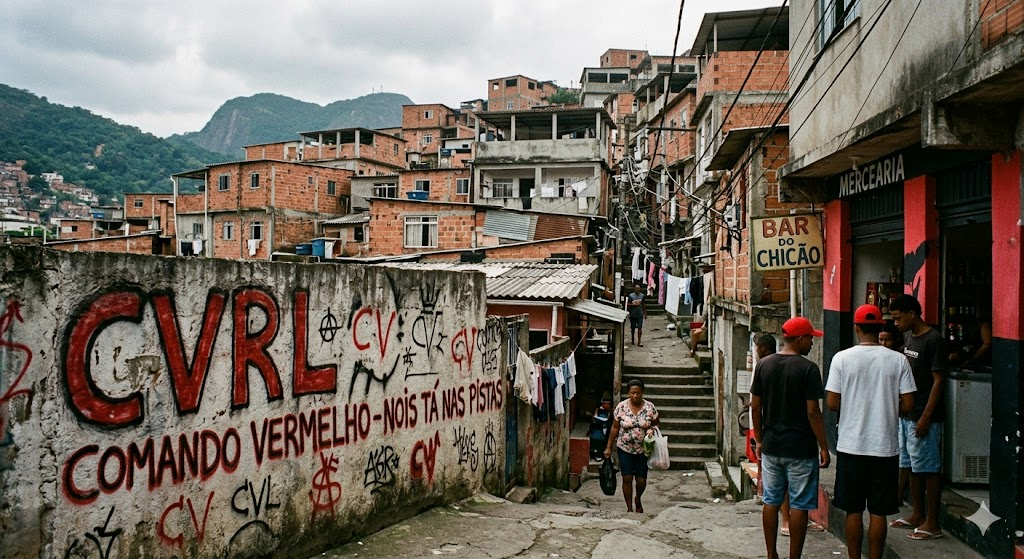
Modern organized crime is not measured by the number of rifles, but by the capacity for capital circulation and liquidity. Although frequently associated by mainstream media solely with urban violence and territorial control of favelas in Rio de Janeiro, Comando Vermelho (CV) operates today as a complex market structure. By verticalizing its supply chain and modernizing its money laundering mechanisms, the faction converted geographical control into a commercial monopoly, challenging global financial intelligence systems.
2. The Three Stages of Economic Evolution and the High-Profitability Turning Point
The financial trajectory of Comando Vermelho is divided into three main phases of operational maturity and capital accumulation:
Stage 1: The Genesis and Initial Survival Capital (1970s)
Born in the Cândido Mendes Penal Institute on Ilha Grande, Rio de Janeiro, from the cohabitation of common prisoners and left-wing political militants, the group—initially dubbed the “Falange Vermelha”—had a rudimentary economy based on survival and internal solidarity (the well-known “caixinha”). The faction’s initial capital and financial bedrock were amassed during the late 1970s and early 1980s through a series of bank robberies and armored car heists in the state of Rio de Janeiro, utilizing urban guerrilla tactics and armed expropriation.
Stage 2: The Conquest of Retail Territories and the Syndicate System (1980s and 1990s)
With the reinforcement of bank security and the suppression of guerrilla actions, the faction rapidly migrated to the emerging market of refined cocaine originating from Andean countries. During this period, the CV established a monopoly over retail drug sales across major communities in Rio de Janeiro. The economy relied on fragmentation: each hill or housing complex operated as an autonomous franchise, generating local revenue and paying fees and “syndicates” to the founding leaders, reinvesting these funds into purchasing heavy weaponry to defend the borders of the favelas.
Stage 3: The Transnational Route and High-Profitability Wholesaling (21st Century)
The major economic turning point for Comando Vermelho occurred when the faction ceased to be just a retail buyer from intermediaries and began operating directly in the international wholesale market.
- Eliminating Middlemen: The exponential leap in profits took place when the CV expanded its tentacles to producer borders—specifically the Bolivia-Paraguay connection and the Amazonian route on the borders with Peru and Colombia.
- Multiplying Margens: By controlling fluvial corridors in the Northern Region and establishing alliances in the Midwest, the CV began purchasing drugs directly at cost from the source. Cocaine acquired at low base prices along the borders began supplying large urban centers and was exported to Europe and Africa through strategic ports, multiplying profit margins tenfold and injecting billions of dollars annually into the organization.
3. Money Laundering Engineering and Infiltration into the Legitimate Economy
Comando Vermelho has structured a financial intelligence apparatus that emulates legitimate corporations to conceal its illicit assets. The circulation of money no longer occurs amateurishly; it exploits vulnerabilities within the commercial system.
The Nexus with the Recycling and Scrap Metal Sector
Recent financial investigations reveal that the faction utilizes recycling companies, junkyards, and scrap metal businesses as one of its primary laundering engines. These companies serve as a perfect front because they natively handle high volumes of cash transactions and possess highly fragmented supply chains. The scheme integrates the illicit burning of stolen copper cables and the mixing of licit and illicit capital.
Dissimulation Mechanisms and Banking Circulation
To bypass automatic alerts from COAF (Council for Financial Activities Control), the faction’s financial core adopts strict strategies:
- Pass-Through Accounts and Straw Buyers: Utilizing networks of shell companies and bank accounts opened under the names of third parties (“laranjas”) with no apparent links to the criminal syndicate.
- Fractionated Deposits (Smurfing): Cash deposits made in low amounts, pulverized across various bank branches and ATMs to avoid mandatory identification thresholds for large transactions.
- Issuance of Fraudulent Invoices: Simulating commercial transactions of buying and selling goods (such as recyclable materials) to justify the entry of dirty money into the official banking system, distributing these flows across strategic states like Rio de Janeiro, São Paulo, Paraná, Minas Gerais, and Mato Grosso do Sul.
4. Strategic Profile Analysis: The Intelligence Division of the Board
Unlike a traditional enterprise with a single CEO, Comando Vermelho operates through a governing board where each historical and operational leader excels in a specific branch of strategic intelligence and business management.
Intelligence of Strategy and Institutional Cohesion: The Profile of Marcinho VP
Márcio dos Santos Nepomuceno (“Marcinho VP”) has consolidated his position as the central leader and primary ideological advisor of the organization. His strategic intelligence lies in his capacity for survival and institutional cohesion. Despite being isolated for decades in maximum-security federal prisons under extreme surveillance, he governs and keeps Rio de Janeiro’s largest faction unified. His focus is on mediating conflicts among different housing complexes and enforcing compliance with the organization’s bylaws, preventing internal fragmentation and ensuring business stability.
Intelligence of Logistics and Market Connections: The Profile of Fernandinho Beira-Mar
Luiz Fernando da Costa (“Fernandinho Beira-Mar”) represents the economic pioneering spirit of the group. His intelligence and competitive edge reside in his market vision and supply chain expansion. Back in the 1990s, Beira-Mar understood that real profit and autonomy lay not in controlling retail sales on the hills, but in dominating the sources of production. He established direct connections with the FARC in Colombia and trafficking clans in Paraguay, drawing the import map and transnational wholesale routes that sustain the faction’s high profitability to this day.
Intelligence of Financial Operations and Asset Shielding: The Profile of Rabicó
Antônio Ilário Ferreira (“Rabicó” or “Coroa”), a fugitive since 2019, is designated as the contemporary financial mastermind of Comando Vermelho. His intelligence is defined by an ability to create a symbiosis with the legitimate economy. Under his command, the faction sophisticated its asset concealment by integrating narcotics cash flows into high-liquidity industrial commercial sectors, such as the scrap and recycling market. Rabicó structured the network of fractionated deposits and the decentralization of bank accounts across multiple states, making asset tracing an extremely complex task for law enforcement.
Military Intelligence and Territorial Expansion: The Profile of Doca
Rodrigo da Silva Caetano (“Motoboy” or “Doca”) leads the operational and military arm of the faction on the streets. His intelligence is concentrated in guerrilla tactics and weapon logistics. He manages arsenals of assault rifles and coordinates territorial invasions against militias and rival factions to open new drug retail points. His indirect financial contribution guarantees the physical security of key complexes (such as the Complexo da Penha), erecting technological barricades and urban containment systems that shield the faction’s internal refineries and distribution hubs.
5. Conclusion: The Challenge of Asset Enforcement and the Global Comparative Landscape
Comando Vermelho has survived and expanded over five decades because it successfully adapted its economy to global shifts in capital markets. However, when placed in a macroeconomic perspective alongside the world’s largest transnational crime powers, the CV’s business model reveals distinct vulnerabilities and geographical strengths. While Comando Vermelho generates estimated annual revenues between $2 billion and $4 billion, concentrating its absolute dominance on fortified retail sales and territorial control of urban complexes in Rio de Janeiro and the North and Northeast regions of Brazil, its competitors and partners operate on vastly different financial scales and territories.
For comparative purposes, the Primeiro Comando da Capital (PCC) has converted itself into an international wholesale logistics holding whose annual revenue reaches astronomical marks between $5 billion and $20 billion. The PCC’s zone of hegemonic dominance encompasses the state of São Paulo, operational control of exports through the Port of Santos, and an aggressive footprint in Paraguay, Bolivia, and Peru. On a continental level, the Sinaloa Cartel maintains a monopoly over transborder routes of synthetic drugs (such as fentanyl) and cocaine into the United States, generating estimated annual revenues between $12 billion and $15 billion, with deep-rooted dominance in northwestern Mexico and extensive distribution cells across the U.S. market.
Modern enforcement against Comando Vermelho requires the state to comprehend this monetary geopolitics, abandoning an exclusive focus on armed conflict in the peripheries and instead concentrating efforts on cash-flow audits, blocking pass-through accounts, and suffocating the legitimate businesses serving as laundromats for narco-capitalism.
References
- UNODC World Drug Report 2025: Global analysis on record-breaking cocaine production levels in the Andean region and the impact of wholesale trafficking on South American economies.
- COAF Intelligence Reports (2024–2026): Transactional patterns, cash circulation flow, and smurfing alerts linked to front companies in the recycling and scrap metal industries.
- Investigative Files of the Brazilian Federal Police and Rio de Janeiro State Civil Police: Assets tracking, corporate infiltration data, and straw-buyer networks attributed to contemporary syndicate directors.
- Brazilian Forum on Public Security (FBSP): Statistical studies on the economics of crime, territorial governance, and the financial cost of heavy weaponry maintenance within Brazilian factions.
