The New Geopolitics of Power, Technological Breakthroughs, and the Guardians of Stagnation–Part I
By Marcelo Salamon
june 23, 2026.
ABSTRACT
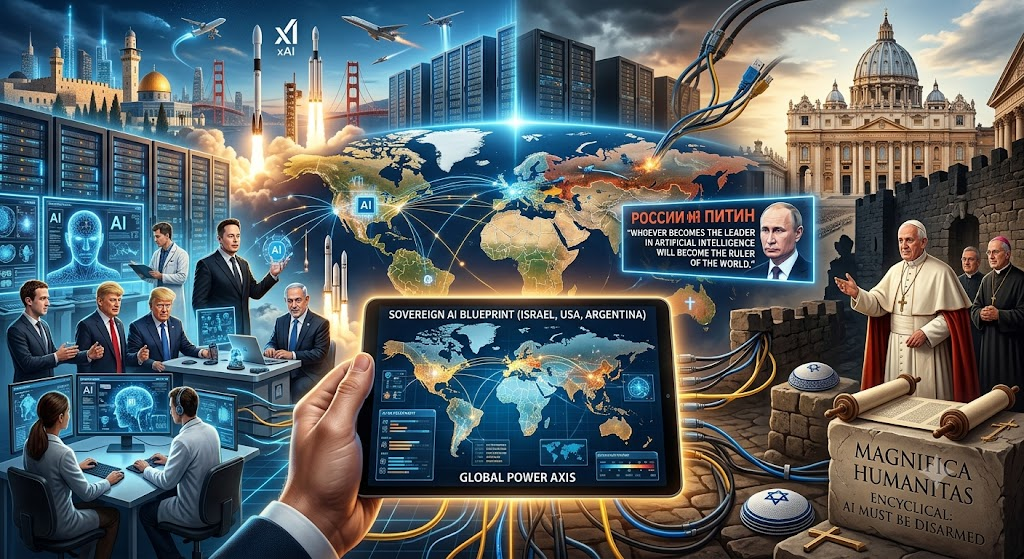
This article analyzes the civilizational rift defining the twenty-first century. On one side stands a bloc of nations, leaders, and corporations betting unconditionally on technological development and artificial intelligence as the ultimate vector of sovereign power. On the other side are traditional religious institutions seeking to pull the brakes on this progress under the guise of protecting human dignity. The central protagonists of this clash are identified—Netanyahu and Israel’s national AI blueprint, Elon Musk and xAI, Mark Zuckerberg and Meta, Donald Trump and his deregulation agenda, and Javier Milei representing Latin American techno-conservatism—contrasted against Pope Leo XIV’s encyclical, Magnifica Humanitas. This debate is not merely technical or ethical; it is, at its core, a battle for the control of the next century.
Keywords: artificial intelligence, technological geopolitics, Israel, Judaism, Netanyahu, Elon Musk, Zuckerberg, Trump, Milei, Pope Leo XIV, Catholic Church, Big Tech, global power, technological revolution, Silicon Valley
INTRODUCTION
The world as we know it is ceasing to exist. This is neither poetic metaphor nor cheap doomsday predictions. It is a factual diagnosis, verifiable through data, government policies, and the billions of dollars quietly poured into the tech labs reshaping the architecture of civilization. Artificial intelligence is no longer a future promise. It is the present—and for those who take it seriously, it will be the most powerful instrument of dominion humanity has ever known.
In this landscape, a sharp dividing line emerges that is neither geographic nor ideological in the traditional sense. On one side are nations, leaders, and corporations that grasped the strategic scale of the technological revolution and raced to lead it. On the other are institutions that, for reasons we will examine in depth, insist on resisting—and by doing so, condemn the populations under their influence to watch the future from the sidelines.
Russian President Vladimir Putin delivered one of his most lucid and technically accurate assessments in recent years, articulating what few world leaders have had the courage or clarity to state publicly when he asserted that “whoever becomes the leader in artificial intelligence will become the ruler of the world.” This is not rhetoric. It is high-level geopolitics, and it deserves to be treated as such.
This article identifies the main protagonists of this civilizational clash, analyzes their concrete positions and actions, and critically examines the role of the institutions attempting to stall or condition this progress. The goal is not an uncritical celebration of technology, but rather analytical clarity regarding the forces shaping our century. Inspired in part by the sharp insights of analyst and YouTuber Peter Jordan from the Nerds de Negócios channel—who in June 2026 accurately highlighted the dimensions of this looming religious and technological warfare—this article deepens and expands that reflection with an independent voice anchored in facts.
I.I Israel: The Silent Powerhouse No One Should Underestimate
In June 2026, the Israeli government approved a national artificial intelligence blueprint. This was no routine piece of legislation; it was a declaration of technological sovereignty. Proposed directly by Prime Minister Benjamin Netanyahu and drafted under the leadership of the National AI Headquarters within the Prime Minister’s Office, the plan explicitly aims to position Israel as a global AI leader—mirroring what the country previously achieved in cybersecurity.
Netanyahu was blunt: “Artificial intelligence is no longer just a technology—it is a revolution. It will impact the economy, security, science, industry, healthcare, education, and the international standing of the State of Israel.” The plan outlines a target of 100,000 processing units for sovereign research, the creation of a national quantum computer, heavy investment in education and workforce training, and the establishment of a National AI Institute to bridge government, academia, industry, and investors.
Brig. Gen. Erez Eskel, head of the National AI Headquarters, was even more precise: “In the coming years, it will become clear which countries succeed in securing their position at the global forefront of the AI era and which will be forced to depend on technologies developed by others. The decisions we make today will determine Israel’s standing for many years to come.”
Israel is a small nation in terms of landmass. Its power is intellectual, strategic, and technological. The country boasts one of the highest numbers of startups per capita in the world, leads in cybersecurity and biotech, and trains engineers and scientists at a ratio that would humble nations ten times its size. This is no accident. It is the result of a worldview that directly links knowledge, autonomy, and survival—a vision deeply rooted in the culture and values of the Jewish people.
I.II The Protagonists: Who Is Leading the Revolution
- ELON MUSK: Musk’s AI venture, xAI, represents one of the most aggressive bets in the sector. In recent statements, Musk projected that his company could achieve artificial superintelligence as early as 2026, backed by annual funding between $20 billion and $30 billion. For Musk, AI is not just a business; it is the ultimate frontier of human evolution. His recent integration of SpaceX and xAI points toward an even bolder vision—orbital AI datacenters designed to bypass terrestrial energy and computing constraints. While it is accurate to state that Musk does not belong to any specific religious community, his presence and weight within this technological ecosystem transcend traditional categories. To say someone “belongs” or “does not belong” to a group is always reductive; what can be stated with certainty is that Musk’s presence in any space elevates its significance to a level few others can offer.
- MARK ZUCKERBERG: The Facebook founder has turned Meta into one of the most formidable AI investment engines on earth. In 2026, the company projects spending between $125 billion and $145 billion purely on artificial intelligence infrastructure. Zuckerberg declared in July 2025 that his vision is a superintelligent, personalized AI for everyone—a system that does not merely answer questions but acts as an autonomous agent in the world. The Meta Superintelligence Labs, his cutting-edge unit, is led by Alexandr Wang, the former CEO of Scale AI, which Meta acquired for $14.3 billion in 2025. The wager is clear: whoever builds the most powerful and widely adopted intelligence platform will control the perception, consumption, and ultimately, the behavior of billions of people.
- DONALD TRUMP: In December 2025, Trump signed a historic executive order blocking any state-level regulation of AI in the United States, establishing a federal task force to challenge laws that restrict the sector. Upon signing, he told reporters that “there will only be one winner” in the global AI race, and that the U.S. required a single point of approval to effectively compete with China. The message was clear: excessive regulation is the fastest path to losing technological hegemony. In June 2026, he went further, signing a new executive order granting the White House early access to AI models prior to their public release. Trump understands, perhaps more intuitively than technically, that AI is a core instrument of national power.
- JAVIER MILEI: The Argentine president, who swept into power in 2023 on a radical libertarian platform, has become one of the most visible symbols of the convergence between economic conservatism and technological enthusiasm. In May 2026, his government launched the “Social Digital Twin,” an AI platform designed to anticipate social issues, map the country’s human capital, and optimize public policies in real time. The announcement concluded with the words “MAGA. VLLC!”—a deliberate nod to Trump’s political universe, signaling a strategic alignment. Milei visited Israel, signed the so-called “Isaac Accords” with Netanyahu, and reiterated his intention to move the Argentine embassy to Jerusalem. His administration serves as a prime example of how the new global conservative axis aligns itself with both Israel and rapid technological advancement.
This alignment among Trump, Milei, and Israel—symbolized by these leaders wearing the kippah in Jewish contexts—is not merely ceremonial. It represents a shared worldview: that prosperity, sovereignty, and technological progress are mutually reinforcing values, and that the state’s role is to cultivate the conditions for progress to happen, rather than creating bureaucracy to slow it down.
2. JUDAISM, TECHNOLOGY, AND THE VOCATION FOR KNOWLEDGE
It would be a mistake to analyze Israel’s technological leadership purely through an economic or geopolitical lens. There is a deeper dimension at play, one engineered by centuries of culture, values, and daily practice: the Jewish love for knowledge.
The Talmud is not simply a religious text. It is a system of thought that prioritizes discussion, questioning, a plurality of interpretations, and the constant refinement of understanding. From childhood, Jewish individuals are taught to ask questions, to debate, and to refuse dogmas without critical examination. This pedagogy, practiced for centuries in diaspora contexts where survival depended on intellect rather than physical force, has produced an undeniable culture of innovation.
This explains, in part, why Jewish individuals are disproportionately represented among the founders of the world’s leading tech companies, Nobel Prize laureates, and thinkers pushing the boundaries of human knowledge. This is not a conspiracy; it is culture. It is education. It is a worldview that treats the intellect as the most precious asset a human being can cultivate.
The Ashkenazi tradition from Eastern Europe and the Sephardic tradition from the Iberian Peninsula and the Mediterranean, while distinct in liturgical practices and certain customs, share this core foundation: study as a sacred act, and knowledge as a duty rather than a privilege. In both traditions, material prosperity is viewed not as spiritual corruption, but as a blessing—provided it is achieved honestly and managed responsibly.
This stands as the complete antithesis to the discourse we will examine next.
3. THE UNDENIABLE BENEFITS OF PROGRESS
Before examining the institutional resistance to technological advancement, one must be honest about what artificial intelligence has already delivered—and what it means to reject this progress.
In education, AI has shattered barriers that centuries of institutionalized systems failed to remove. Today, a young student in Bento Gonçalves, a small city in southern Brazil, has access to the exact same content and learning tools as a student at Cambridge or MIT. The democratization of knowledge, which historically moved at a slow and unequal pace, has become instantaneous and global.
In healthcare, AI algorithms already outperform human doctors in diagnostic imaging, detecting early-stage cancers with unprecedented accuracy. Telemedicine has reached remote regions that previously lacked hospitals. Personalized medicine, which tailors treatments to an individual’s genetic profile, is successfully moving from the lab to clinical practice.
In the economy, new labor models and wealth creation mechanisms are emerging at a speed that no central planner could predict or control. Digital entrepreneurship, supercharged by AI, allows individuals to build companies with global reach using nothing more than a laptop and an internet connection.
In culture and communication, global connectivity has erased geographic isolation as a limiting factor for accessing information, art, and philosophy. The world has grown smaller, yet vastly richer.
To deny these benefits is not humility or ethical caution. It is, at best, naivety. At worst, it is intellectual dishonesty serving interests that have nothing to do with protecting the population.
4. THE CATHOLIC CHURCH, THE ENCYCLICAL, AND THE DISCOURSE OF CONTROL
On May 25, 2026, Pope Leo XIV published his first encyclical, titled Magnifica Humanitas. The document, spanning over 100 pages, references artificial intelligence roughly 85 times. Its central directive states: “Artificial intelligence must be disarmed.”
To be fair to the text, it is not a blanket condemnation of technology. Leo XIV recognizes AI as a “precious aid” and explicitly states that the Church does not adopt a technophobic pessimism. However, his critique of what he terms “technocracy”—the concentration of technological power in the hands of a few, the lack of democratic oversight, and the risk of algorithmic dehumanization—raises issues that merit serious debate.
The problem lies not within the ethical concern itself, but in the entity pronouncing it, given its historical track record. The Catholic Church condemned Galileo. It condemned the printing press. It resisted democracy. It justified slavery for centuries—an historical delay for which Pope Leo XIV himself apologized in this very encyclical. When this same institution raises its voice to warn against the “risks” of a technology that democratizes knowledge, includes the marginalized, and empowers individuals, it is legitimate to ask: who does this warning actually serve?
For centuries, the Church conditioned the masses to believe that poverty is a virtue, suffering is a path to holiness, and material wealth is inherently suspect. Meanwhile, its cathedrals accumulated gold, its elite curias lived in refinement, and its alliances with temporal rulers secured top-tier political influence. The vocabulary has shifted; the mechanism remains unchanged.
Today, the terminology is modernized to talk about “human dignity,” the “common good,” and “digital equity.” Yet the underlying logic is identical to the past: the common people must not hold too much power. Knowledge must be mediated by an authority. The autonomous, technologically empowered individual represents a threat to those whose existence relies on the dependency of others.
There is something telling about the fact that the encyclical was presented alongside Chris Olah, co-founder of Anthropic—an AI company currently locked in a legal dispute with the Trump administration over military applications. The Vatican is not standing outside the arena of tech politics; it is fully inside, operating with its own interests and alliances. It simply prefers that this presence remain cloaked.
5. THE GEOPOLITICAL CLASH: POWER, NOT MORALITY
It would be naive to view this conflict solely as a philosophical debate over ethics and technology. At its core, what is at stake is control over the next configuration of global power.
China understood this long ago. Its AI development model is authoritarian, centralized, and strictly strategic. It does not seek permission from ethicists or pontiffs. It asks one question: how do we get there before everyone else? The United States, under Trump, responded with aggressive deregulation and massive capital investment. Israel responded with a national blueprint approved at the cabinet level. The urgent question that remains is: what is the fate of nations that stand by, waiting for moral permission to act?
Latin America is a textbook case of this dilemma. Swayed by heavy religious influence, cultures that historically distrusted entrepreneurship and wealth accumulation, and political institutions that preferred redistribution over growth, the region watches this world-defining revolution from afar. The current exception is Milei’s Argentina—which, despite any execution missteps, has at least understood that betting on a technological future is an unavoidable necessity rather than an ideological choice.
Political analyst and intellectual Eric Weinstein, during a visit to Buenos Aires in June 2026, hit the nail on the head: if Argentina perceives itself as non-interoperable with global tech flows, it can leverage that unique positioning to create something entirely its own instead of mourning its decline. But doing so demands intellectual courage and a willingness to break away from narratives that preach resignation as a virtue.
CONCLUSION: THE FUTURE DOES NOT WAIT
There comes a moment in every revolution when the window of opportunity snaps shut. Those who are inside experience growth; those left outside become dependents. The artificial intelligence revolution is no different. It is unfolding right now, with or without the consent of institutions that would prefer it to wait for their ethics committees.
Putin’s diagnosis may be cold, but it is accurate. Netanyahu’s blueprint is concrete and resolute. The investment velocity of Musk and Zuckerberg is staggering. Trump has stripped away regulatory brakes, and Milei has placed his chips on the tech chessboard as a core national project. The emerging axis is far from perfect—but it is the axis that is actively moving.
On the other side stands an institution that took centuries to apologize for slavery, historically aligned itself with temporal powers when convenient, and preached self-denial primarily to those at the bottom, now presenting itself as the guardian of human dignity against the machine. There is a profound irony in this posture, and it deserves to be named clearly.
To favor technological development is not to be anti-human; it is to be pro-human. It is to recognize that wealth, emancipation, and the intellect are the true pillars of human freedom. Attempting to throttle AI under the pretext of protecting humanity is, at its root, an effort to keep mankind hostage to old systems of mediation and control. In the chess match of this new century, progress will not ask permission from the guardians of the past; it will simply pass them by, cementing power in the hands of those who had the courage to build tomorrow.
REFERENCES
ARGENTINA. Ministry of Human Capital. Launch of the Artificial Intelligence Platform: Social Digital Twin. Buenos Aires, May 2026.
ESKEL, Erez. Directives and Strategic Implementation of the National AI Headquarters. Tel Aviv: Prime Minister’s Office, June 2026.
ISRAEL. National Artificial Intelligence Headquarters. National Blueprint for Global Leadership in Artificial Intelligence and Quantum Computing. Jerusalem: Office of Prime Minister Benjamin Netanyahu, June 2026.
JORDAN, Peter. The New Religious and Technological Warfare. Nerds de Negócios Channel, YouTube, June 2026.
LEO XIV, Pope. Encyclical Magnifica Humanitas: On Technology, Technocracy, and Human Dignity in the Age of Artificial Intelligence. Vatican City: Libreria Editrice Vaticana, May 25, 2026.
MUSK, Elon. Computational Projections and Strategic Financing of xAI. San Francisco: xAI Corporation / SpaceX Media Relations, 2026.
PUTIN, Vladimir. Official Address on Technological Sovereignty and Artificial Intelligence. Moscow: The Kremlin, 2026.
UNITED STATES. Executive Office of the President. Executive Order on Deregulating Artificial Intelligence and Early Access to Computational Models. Washington, D.C., Dec. 2025 / June 2026.
WEINSTEIN, Eric. Technological Singularity in Latin America and the Interoperability of Global Flows. Lecture delivered in Buenos Aires, Argentina, June 2026.
ZUCKERBERG, Mark. The Infrastructure of Meta Superintelligence Labs and the Acquisition of Scale AI. Menlo Park: Meta Platforms Inc., July 2025 / 2026.
