
By Marcelo Salamon
May 29, 2026.
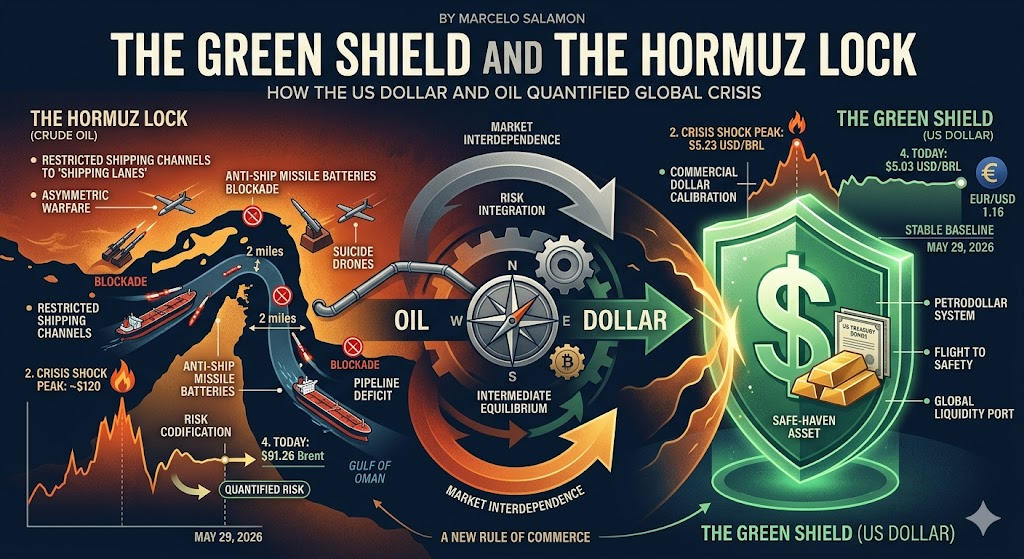
Abstract: The outbreak of conflict in the Persian Gulf did not merely destabilize the commodities market; it fundamentally redesigned the flow of global liquidity. Following the escalation of tensions, both oil prices and the US Dollar underwent extreme volatility—surging to critical panic peaks and testing sharp correction lows before settling into resilient, intermediate equilibrium bands. This article analyzes how the global financial architecture permanently encoded the “Hormuz Risk.” By examining the interplay between New York and European exchanges, we demonstrate how geopolitical stress has been digitized into a new baseline for global asset pricing, shaping foreign exchange (FX) and energy dynamics.
Introduction
In moments of acute geopolitical rupture, international financial markets operate under an unyielding mandate: the frantic search for absolute liquidity. When critical global energy chokepoints are threatened, major currencies and commodities react instantaneously, long before the first supertanker alters its physical route. The recent structural price movements of Brent crude and the US Dollar reveal a profound shift in market psychology. The global financial system has transitioned from treating geopolitical shocks as unpredictable “black swan” anomalies to integrating them as mathematically quantified variables within investment algorithms.
The Tactical Anatomy of Risk: Why It Is Easy to “Lock” Hormuz
To comprehend the new price floors established in the markets, one must bypass superficial commentary and analyze the hard military and logistical geography of the Persian Gulf. The Strait of Hormuz is the most critical maritime chokepoint on earth, handling roughly one-fifth of global petroleum consumption.
The technical ease with which regional friction can bottleneck this corridor stems from specific operational realities:
- Restricted Shipping Channels: Although the total strait spans roughly 21 miles (34 km) at its narrowest boundary, the deep-water channels required for Very Large Crude Carriers (VLCCs) are incredibly narrow. Traffic is confined to a 2-mile inbound lane and a 2-mile outbound lane, segregated by a tight 2-mile buffer zone. Naval mining, targeted drone strikes, or a single disabled vessel can halt transit immediately.
- Low-Cost Asymmetric Warfare: Modern maritime blockades no longer require dominant, conventional naval fleets. Market intelligence has internalized the reality that localized forces can freeze global shipping using inexpensive asymmetric tactics: land-based anti-ship cruise missile batteries, low-cost loitering munitions (suicide drones), and fast-attack craft for quick interceptions.
- The Pipeline Deficit: The bypass infrastructure cutting across Saudi Arabia and the United Arab Emirates possesses a combined overland capacity that can only service a small fraction of the daily maritime volume. If Hormuz is locked, the world’s primary energy supply is physically dammed.
Once global trading desks witnessed the practical execution of these t军事 tactics, the logistical vulnerability ceased to be an abstract risk premium—it became a permanent fixed cost in asset valuation.
The Financial Chronology: Four Phases of Market Stress
The synchronized fluctuations of crude futures and the US Dollar reveal a clear pattern of panic, overcorrection, and ultimate market maturity. The macroeconomic narrative has unfolded across four distinct, definitive phases:
- The Starting Point (Pre-Crisis Calmaria): Prior to the escalation of hostilities, the global economy operated under standard supply-and-demand fundamentals. Oil traded within standard industrial support levels (~$72.00), and the US Dollar sat at a calm baseline of R$ 4.85, reflecting regular trade flows.
- The Peak of the Shock (The Panic Surge): As conflict erupted and threats to shipping lanes became imminent, widespread panic fueled derivatives markets. Brent crude skyrocketed to a critical peak of nearly $120.00 per barrel. Concurrently, a massive flight to safety forced liquid capital out of emerging markets, driving the commercial US Dollar to a record high of R$ 5.23.
- The Correction Low (The Realization Phase): Once the market observed that a total, indefinite closure of the Strait had not immediately materialized, massive institutional profit-taking ensued. Oil plummeted sharply to test a wartime floor of $80.00, while the US Dollar decompressed rapidly down to R$ 4.92.
- Today’s Stabilization (The New Reality): Having exhausted both emotional extremes—panic buying and optimistic selling—the global financial architecture established a highly resilient intermediate equilibrium. As of today, May 29, 2026, Brent crude has consolidated around $91.26 per barrel, and the US Dollar has locked into R$ 5.03.
Market Interdependence: Dollar, Euro, and Crude Parities
The foreign exchange behavior across Wall Street and European bourses mirrors the pricing structure of the energy sector. Because oil is globally denominated and settled in US Dollars (the Petrodólar system), spikes in crude prices trigger a cascading structural demand for greenbacks.
The table below consolidates the macroeconomic metrics across all four definitive phases of the crisis:
| Market Phase | Oil Price (Brent) | US Dollar (USD/BRL) | Euro / US Dollar (EUR/USD) |
| 1. Starting Point (Pre-Crisis) | ~ $72.00 | $4.85 | 1.08 |
| 2. Crisis Peak (The Shock) | ~ $120.00 | $5.23 | 1.10 |
| 3. Correction Low | ~ $80.00 | $4.92 | 1.12 |
| 4. Today (May 29, 2026) | $91.26 | $5.03 | 1.16 |
The EUR/USD parity holding at 1.16 today indicates that after severe initial inflationary shocks to the Eurozone’s industrial core, continental supply chains have structurally adjusted. The current dollar valuation of R$ 5.03 acts as the new calibrated baseline for international trade, absorbing the ongoing friction.
Forward Outlook: Two Microeconomic Horizons
As the markets face the upcoming quarters, forward-looking algorithms are factoring in two distinct t军事 and diplomatic pathways for the US Dollar:
Scenario A: Prolonged Conflict (Higher for Longer)
If regional friction persists and the logistical threat to the Strait of Hormuz remains unresolved, the US Dollar will pivot back toward a hard bullish posture.
- The Mechanism: Extended shipping anxiety keeps oil elevated, fueling global cost-push inflation. This structural inflation will force the Federal Reserve to maintain higher interest rates for an extended period to protect the US domestic economy.
- The FX Impact: Capital will continuously rotate away from emerging economies back into US Treasuries. Under an environment of endless attrition, the US Dollar is projected to break its current intermediate support and re-test crisis ceilings, trading heavily within a volatile R$ 5.15 to R$ 5.30 band.
Scenario B: Diplomatic Resolution (Currency Decompression)
If international mediation achieves a permanent ceasefire, unlocking the Persian Gulf’s shipping corridors completely, the market will execute an aggressively fast “return-to-normal” trade.
- The Mechanism: The geopolitical risk premium will be instantly stripped from commodity corporate balance sheets. Oil will retreat toward baseline industrial demand, cooling global inflationary expectations and prompting immediate monetary easing cycles from the Federal Reserve.
- The FX Impact: Institutional money managers will unwind their defensive, cash-heavy positions in USD, rotating capital back into growth assets and emerging economies. The greenback will experience swift decompression, shedding its war premium to search for historical baselines within a R$ 4.75 to R$ 4.90 support range.
Conclusion
The consolidation of the US Dollar and Brent crude at intermediate plateaus is not a sign of market complacency; it is the definitive proof of risk codification. Global trading systems have fully digitized the geography of the Middle East, the structural vulnerabilities of maritime choke points, and the cost of military gridlocks into the price of liquid cash. For traditional asset managers, FX corporations, and macro analysts tracking decentralized hedges like Bitcoin, the framework is set: the global economy has digested the conflict, and this integrated risk is the new rule of global commerce.
References
- Bloomberg Markets. (2026). Currency Volatility, Flight to Safety, and Geopolitical Risk Premiums. Bloomberg L.P.
- Investing.com. (2026). Historical Data Index: Brent Crude Futures and Global Cập nhật Câmbio (May 2026). Financial Market Data.
- Reuters Business. (2026). Asymmetric Warfare in Maritime Chokepoints: Economic Implications for Global Shipping Lanes. Thomson Reuters.
- U.S. Energy Information Administration (EIA). (2026). World Oil Transit Chokepoints: A Strategic and Logistical Assessment of the Strait of Hormuz. U.S. Department of Energy.
