Institutional Resistance to Progress, the Discourse of Submission, and the Price the Masses Pay
“Ignorance is never a good counselor for virtue.” — Baruch Spinoza, philosopher (1632–1677)
By Marcelo Salamon
june 23, 2026.
ABSTRACT
This article examines the historical and contemporary role of the Catholic Church as an institution that has systematically resisted the advancement of human knowledge, analyzing how this pattern repeats itself today in the face of the artificial intelligence revolution. Grounded in the encyclical Magnifica Humanitas, published by Pope Leo XIV in May 2026, it identifies the continuity of a narrative that uses new vocabulary to preserve a time-honored logic: conditioning access to progress, tutoring public consciousness, and keeping alive a notion of virtue that, historically, has served the control of the masses far more than their emancipation. Furthermore, it examines the impact of this discourse on nations with deep religious roots, with particular focus on Latin America, concluding that the true cost of resisting technological development is never paid by the elites who preach it—but by the people who listen to them.
INTRODUCTION
There is a question that is rarely asked with the seriousness it deserves: who benefits when a population fears progress? Who wins when knowledge is viewed with suspicion? Who prospers when individual autonomy is framed as sinful pride, and dependence on spiritual authority is sold as humility?
The uncomfortable but necessary answer is: those who rely on that dependence to exist benefit. The institution that has built its power for two thousand years on mediating between humanity and the transcendent benefits—an institution that instinctively knows that a truly autonomous, informed, and empowered individual is an individual who no longer needs intermediaries.
In this second article of the series, we do not settle for a superficial analysis. We intend to go deep. We want to examine the history, the mechanics, and the tangible impact of an institutional discourse that, at every great leap forward for humanity, has appeared to say: be careful, this is dangerous, you are not ready, let us handle this.
The artificial intelligence revolution is merely the latest chapter in this ancient saga. And it is the most revealing of all—because now, for the first time, we have the data, the speed, and real-time comparisons to see exactly who advances and who falls behind.
Keywords: Magnifica Humanitas, artificial intelligence, technology and religion
1. A HISTORY THAT CANNOT BE FORGOTTEN
The Catholic Church did not recently stumble into a sudden concern regarding the side effects of progress. It possesses a long, documented, and undeniable track record of resisting the advancement of human knowledge. This history must be brought to the table when analyzing its current stance on artificial intelligence.
Galileo Galilei was condemned by the Inquisition in 1633 for defending heliocentrism—the idea that the Earth revolves around the Sun. An elementary scientific truth, which any elementary school student learns today, forced its defender to publicly recant under the threat of torture. The Church took nearly four centuries to formally acknowledge this error, doing so only in 1992.
Gutenberg’s printing press in the 15th century was met with deep institutional suspicion, prompting the Church to establish the Index Librorum Prohibitorum—the list of prohibited books—to control what the public could and could not read. Information control was, quite literally, official institutional policy.
Democracy was condemned by Pope Pius VI as a “pernicious chimera” in the 18th century. The separation of church and state, freedom of the press, and freedom of conscience were later dismissed as “delusions of modernity” by Pope Gregory XVI in the 19th century.
And what about slavery? The Church not only tolerated but teologically justified slavery for centuries. Religious orders owned slaves, and Popes issued bulls authorizing the slave trade. Pope Leo XIV himself—the very same Pontiff who now warns against the risks of AI—acknowledged in his encyclical Magnifica Humanitas the Church’s “long delay” in condemning slavery, issuing an apology for omissions that spanned centuries. While this confession is commendable in itself, it is equally revealing: the institution currently presenting itself as the moral guardian of technological progress is the same one that required centuries to realize that keeping human beings in chains was inherently wrong.
The pattern is unmistakable: the Church resists, then it yields, and finally, it rewrites history to look as though it was on the right side all along. This cycle is now repeating itself with artificial intelligence.
2. THE ENCYCLICAL MAGNIFICA HUMANITAS: WHAT IT SAYS AND WHAT IT LEAVES UNSAID
The encyclical Magnifica Humanitas, signed on May 15, 2026, and presented to the world on May 25 by Pope Leo XIV, is a massive document of over 200 pages that references artificial intelligence roughly 85 times. It is undoubtedly the most ambitious document of the current pontificate, and it demands to be read with a critical eye, rather than automatic reverence or summary rejection.
Substantively, the document argues that technology is not morally neutral, as it carries the biases and interests of those who fund and create it. It rightly points out that the concentration of technological power within a handful of corporations poses a real threat to democracy, that workers displaced by automation deserve protection, that AI-driven warfare requires strict ethical constraints, and that technological development must not devastate the environment.
These assertions deserve serious debate. Any intellectually honest observer recognizes that the concentration of power within tech oligopolies is a legitimate concern. The issue, however, does not lie within the warnings themselves. It lies in who is making them, with what moral authority, and through what concrete proposals.
The document calls for the “disarmament” of AI—a deliberate and strong phrasing chosen by Leo XIV himself. In practice, this is framed as removing AI from systems of domination, exclusion, and warfare, ensuring it serves the “common good” rather than narrow corporate interests through independent oversight and robust legal frameworks.
But this raises an inevitable question: who defines the “common good”? Who watches the watchmen? Who drafts these legal frameworks? If the implied answer is “the Church” or “institutions like the Church,” then we are not witnessing a critique of technocratic power, but rather a text-book dispute for power. It is an effort by an institution that controlled knowledge for centuries to reclaim its position as a moral arbiter in an era where knowledge has definitively escaped its grasp.
A telling details underscores this: the encyclical was rolled out alongside Chris Olah, co-founder of Anthropic—an American AI firm heavily entangled in a legal battle with the Trump administration over the military deployment of its technology. By aligning itself with a specific market competitor under the guise of an ethical critique, the Vatican proves it is not standing above the messy geopolitics of tech. It is actively playing the game, utilizing corporate allies to advance its own institutional influence.
3. THE DISCOURSE OF POVERTY AS VIRTUE: A HYPOCRITICAL MECHANISM OF CONTROL
Among the most sophisticated and enduring mechanisms of social control ever devised is the notion that material poverty is a spiritual virtue, that physical suffering draws human beings closer to God, and that wealth is inherently morally suspect.
This narrative, preached for centuries from medieval Europe to colonial Latin America, served a highly precise function: keeping the masses resigned to their hardships. It convinced them that questioning the established order was not just dangerous, but sinful, ensuring that actual material wealth—the kind found inside cathedrals, monasteries, and the coffers of religious orders allied with European crowns—remained concentrated exactly where it always was.
The poor were taught to accept their lot, while the wealthy who allied with the Church were blessed, and those who challenged it were condemned. The mechanism is elegant in its perversity: you design an ethical framework that immobilizes those at the bottom while liberating those at the top, and you label it “spirituality.”
This is not to say the Church has never done good. Its charitable works, hospitals, and educational institutions are real contributions that deserve acknowledgment. But recognizing these contributions shouldn’t blind us to the parallel machinery of control.
Material, intellectual, and economic prosperity is not contradictory to a well-lived life. Wealth achieved through honesty, intelligence, and hard work is an achievement to be celebrated—it is the fruit of labor, creativity, and vision. Any doctrine teaching the opposite—that the poor are inherently more virtuous simply by virtue of being poor, or that ambition is a sin—does not serve human well-being. It serves those who need human beings to remain small, dependent, and manageable.
4. NEW VOCABULARY, SAME OLD LOGIC
A hallmark of a truly sophisticated institution is its ability to update its vocabulary without ever altering its underlying logic. The Catholic Church is a master of this craft.
- In the 19th Century: The vocabulary was: “Modernity is dangerous, autonomous reason is pride, and the individual must submit to the authority of the Church.”
- In the 20th Century: The phrasing shifted to: “A preferential option for the poor,” “liberation theology,” and interfaith dialogue.
- In the 21st Century: The buzzwords are: “Human dignity,” “the common good,” “digital equity,” and the “disarmament of AI.”
The words evolve, but the core mechanism remains identical: positioning the institution as the necessary arbiter between humanity and a force it supposedly cannot handle alone. First it was sin; then it was unbridled capitalism; today it is artificial intelligence.
While the warnings about the concentration of tech power are genuinely relevant, they do not require an implicit offer of institutional guardianship. Instead, they should be met with concrete solutions centered on tech education, democratic legislation, decentralized access, and the radical expansion of individual autonomy.
The problem with the encyclical is not what it says, but what it leaves out. It offers no roadmap for how individuals can empower themselves technologically, nor does it discuss how developing nations can build independence from foreign oligopolies. It warns, it denounces, and it begs for “disarmament”—but it never summons humanity to master the tool. It summons them to be cautious, and there is a vast gulf between caution and capability.
5. THE GEOPOLITICAL IMPACT: THE REAL PRICE OF CAUTION
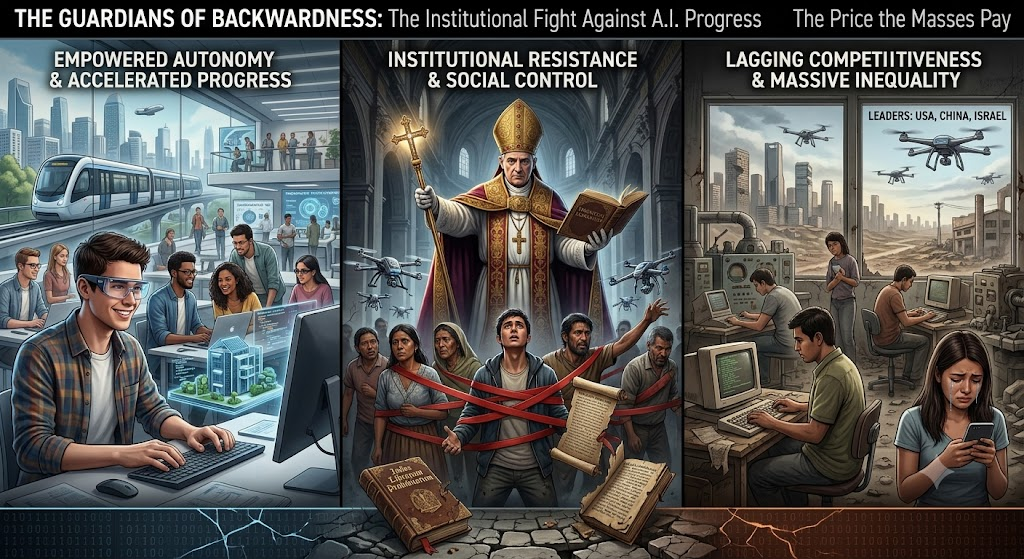
Resistance to technological progress is not a harmless philosophical debate; it carries concrete, measurable, and highly unequal consequences. Crucially, the cost is never borne by the elites preaching caution—it is paid by the populations who heed their warnings.
Consider the real-world metrics:
- A nation that delays integrating AI into its education system by just five years will raise a generation entirely unprepared for the competitive global job market.
- A healthcare system that resists adopting AI-driven diagnostic tools will suffer higher rates of preventable deaths.
- An economy that fails to rapidly digitize its infrastructure will permanently lose its competitive edge.
Meanwhile, leading technological powers—such as the United States, Israel, China, South Korea, and Japan—accumulate compounding advantages. In the digital age, delay is not linear; it is exponential. Because technology advances on an exponential curve, starting late means falling further behind at an accelerating rate.
The institutions preaching excessive regulation or tech “disarmament” face none of these penalties. Their leaders enjoy access to the finest healthcare systems in the world, their encyclicals are drafted using cutting-edge digital tools, and their messages are broadcast to billions via the exact Big Tech platforms they publicly condemn. The asymmetry between what they preach and how they live is staggering.
6. LATIN AMERICA: A CASE STUDY IN ENGINEERED BACKWARDNESS
No region on Earth illustrates the heavy cost of institutional dependence better than Latin America. Enduring over 500 years of profound Catholic influence, the region’s cultural fabric deeply reflects the exact discourse analyzed here: a deeply ingrained suspicion of wealth, guilt over personal ambition, absolute deference to authority, and a passive resignation to systemic inequality.
It is no coincidence that the region with the world’s highest density of practicing Catholics is also plagued by severe inequality, dismal investment in research and development, and a total reliance on imported technology. While religion is not the sole cause—as historical colonialism, political instability, endemic corruption, and gross mismanagement of public funds play massive roles—it is intellectually dishonest to ignore the compounding effect of an institutional worldview. For centuries, it taught that earthly prosperity is secondary, that scientific inquiry is dangerous without theological permission, and that status quo inequality should be accepted with meekness.
In the modern political landscape, this cultural mindset translates directly into bureaucratic drag. The institutional fear of progress manifests as paralyzing over-regulation, red tape, and an aversion to risk that suffocates local tech ecosystems before they can even start.
The most visible outlier right now is Milei’s Argentina. Despite execution controversies, his administration recognizes that betting heavily on a technological future is an absolute necessity. Initiatives like the “Social Digital Twin,” tight alignments with tech hubs like the US and Israel, and actively opening doors to Silicon Valley investors demonstrate an understanding that the global map of power has shifted.
Meanwhile, regional giants like Brazil, Mexico, and Colombia remain bogged down in archaic bureaucratic debates, focusing on the grievances of yesterday while the world of tomorrow is built elsewhere. The price of this stagnation will not be paid by the politicians who govern them—it will be paid by the youth born into these stalling economies.
CONCLUSION: THE FUTURE DOES NOT ASK FOR PERMISSION
Throughout this analysis, the target has not been personal faith, but an institution. There is a fundamental difference: faith belongs to the intimate, personal realm of the individual. The Catholic Church, as a political, economic, and cultural juggernaut influencing over a billion followers and shaping national policies, is an entirely legitimate subject for rigorous structural critique.
The historical data is clear: this institution consistently resists what it cannot control, pivots its rhetoric when resistance becomes unsustainable, and repositions itself as the moral guide of the very processes it tried to halt. We are watching this play out in real time with artificial intelligence.
However, this time there is a catch. The sheer velocity of the AI revolution does not afford the Vatican the luxury of time it enjoyed when processing Galileo or digesting the rise of modern democracy. The decisions made today regarding technological adoption will lock in irreversible consequences within the decade. Societies cannot afford to wait for a millennial institution to complete its sluggish cycle of resistance, adaptation, and historical revisionism.
The future does not ask for permission, it does not pause for the next synod, and it will not wait for an encyclical. It happens regardless of those who wish it would move slower and remain dependent on traditional mediators.
Humanity has broken through these gates before. When Gutenberg invented the printing press, knowledge shattered ecclesiastical monopolies, paving the way for the Reformation, the Enlightenment, and the Scientific Revolution. When the Industrial Revolution arrived, it transformed labor, urbanization, and human consciousness in ways that no papal decree could stop. Artificial intelligence is the next disruption of this civilizational magnitude. And history teaches us one definitive lesson: the guardians of backwardness always lose.
The question is not whether this revolution will happen—it is already well underway. The real question is: which side of history will you be standing on when the dust settles?
REFERENCES AND SOURCES
- JORDAN, Peter. The Most Important Religious War in History Has Just Begun! YouTube Channel: Nerds de Negócios. June 7, 2026.
- VATICAN NEWS. Leo XIV: Address on the Presentation of the Encyclical Magnifica Humanitas. May 25, 2026.
- CNN BRAZIL. Pope Leo XIV Warns of AI Power in Warfare in First Theological Document. May 25, 2026.
- CARTA CAPITAL. What the Pope Means When He Speaks of AI and Humanity. May 2026.
- O POVO. Understanding Pope Leo XIV’s Warning on the Use of Artificial Intelligence. May 27, 2026.
- EXTRA CLASSE. Pope Aims to ‘Disarm’ AI and Place Human Dignity at the Center of the Digital Era. May 25, 2026.
- SPINOZA, Baruch. Ethics, Demonstrated in Geometrical Order. Amsterdam, 1677. Multiple editions.
- DRAPER, John William. History of the Conflict between Religion and Science. New York: Appleton, 1874.
- RUSSELL, Bertrand. A History of Western Philosophy. New York: Simon & Schuster, 1945. DOCX
- ACESSA.COM. Between Algorithms and Humanity: Pope Leo XIV Warns of the Limits of AI. June 2026.
