
By Marcelo Salamon
June, 15, 2026.
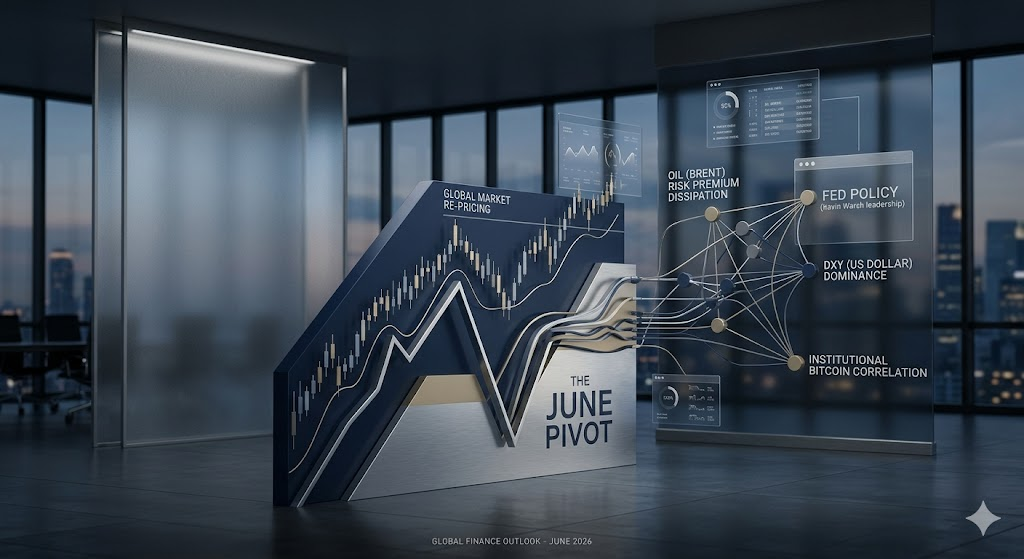
EXECUTIVE SUMMARY: The peace agreement between the U.S. and Iran has removed the geopolitical fog surrounding the Strait of Hormuz, forcing a global repricing of assets. However, the market now faces a new “white swan”: a monetary stress test under Kevin Warsh’s new leadership at the Fed, in a landscape where institutional liquidity has retracted severely over the last 30 days.
Introduction: The End of Geopolitical Anesthesia
For the past four months, the international financial market has lived under the tyranny of uncertainty. The fear of a conflagration in the Middle East acted as anesthesia, masking the structural problems of the global economy: persistent inflation, elevated corporate debt, and the depletion of the post-pandemic liquidity cycle. The memorandum of understanding between Washington and Tehran, mediated by Pakistan, is the event that removes this anesthesia.
What follows is not necessarily a classic bull market, but a brutal adjustment of expectations. The risk premium, which kept oil above $95/barrel and the dollar at “safe haven” levels, is being dismantled in real-time. For high-level investors, the question is no longer whether the war is over, but how much “war inflation” is still embedded in the prices of risk assets and how much of this pricing will be reversed in the next 90 days.
The Anatomy of Oil and the Cascade Effect
The drop in Brent to the $83/barrel range is merely the first domino. By removing the specter of a blockade at the Strait of Hormuz, the market eliminates the fear of a “supply crisis” that could have pushed the barrel into triple digits.
For Europe, the impact is direct: a reduction in energy costs that, until last week, threatened the bloc’s industrial viability. For the U.S., the impact is on the Consumer Price Index (CPI). However, the astute reader should note the trap: at $83, oil is still well above historical pre-crisis averages. The market is pricing in a “fragile peace,” where any diplomatic spark could return 10% or 15% to the barrel price in hours. The implied volatility of oil remains high, signaling that peace is priced in, but not taken for granted by options traders.
The Stress Test: Warsh and the Iron Hand
The appointment of Kevin Warsh to lead the Federal Reserve is not a mere bureaucratic reshuffling; it is a regime change. Unlike the previous management, which relied on “expectation management” to avoid panic at any cost, Warsh brings a legacy of structural austerity.
Warsh has always been a critic of the market’s dependence on the “Fed Put.” For investors, this means the era of “transparent communication” may be coming to an end. Under Warsh, uncertainty returns as a control tool. If employment data continues to diverge from the target, the probability of a “higher for longer” interest rate policy is not just a risk; it is the core strategy. The absence of cheap liquidity makes the S&P 500 and Nasdaq extremely vulnerable, and an aggressive posture of liquidity withdrawal will force a repricing of valuation multiples.
The Contract Under Pressure: Reinterpreting “Force Majeure”
The transition from the “War Premium” to “Fragile Peace” imposes an unprecedented legal and commercial challenge for companies operating with long-term commodity supply contracts. Contract Law, often neglected in moments of high liquidity, becomes the epicenter of risk management when oil corrects from $95 to $83.
The Force Majeure clause, invoked exhaustively during the blockade or the threat of one at the Strait of Hormuz, loses its immediate legal foundation with the Washington-Tehran memorandum. However, “peace” does not equate to an absence of logistical risks. Investors and legal managers must be wary of the concept of Hardship (excessive onerousness). If shipping and maritime insurance costs remain distorted by implied volatility—even with the commodity price in decline—the economic-financial equilibrium of take-or-pay contracts is under threat.
Law firms and legal departments must actively monitor price renegotiations and price tolerance margins. We are entering a period where “priced-in peace” can be suddenly invalidated by a diplomatic failure, and contracts lacking price review triggers based on external volatility (not just the commodity spot price) will leave parties exposed to technical insolvency. The tactical recommendation is a rigorous audit of all hedge instruments contained in supply contracts: if the structure does not protect against a rapid price drop (the opposite of what was seen two months ago), the exposure to balance sheet risk is unacceptable.
The Strength of the Dollar (DXY) and the Liquidity Drain
The correlation between the U.S. Dollar Index (DXY) and equities, especially in emerging markets, has become the highest-weighted metric for institutional flows under Kevin Warsh’s tenure. The logic is relentless: in a regime of high real dollar interest rates, capital migrates from risk (emerging market stocks and speculative assets) to risk-free returns (U.S. T-Bills).
Statistical data from the last six months reveals a concerning pattern: each 1% rise in the DXY coincides, on average, with a 2.5% correction in emerging market equity indices and a liquidity withdrawal of approximately $12 billion from global allocation funds. This “liquidity suction” by the dollar is not a passing phenomenon; it is the direct consequence of a monetary policy that prioritizes the stability of the U.S. currency over global growth.
Under Warsh’s leadership, the expectation is that the DXY will remain at elevated levels, acting as a “vacuum” for global capital. For investors, this means there is no room for “bargain hunting” in emerging markets until the DXY demonstrates clear signs of reversal or stabilization. Institutional capital, aware of this pattern, is holding cash positions in dollars, waiting for the liquidity flush that will force risk asset valuations lower, creating an ideal “entry point” only after the purging of all leverage excesses. The sovereignty of the dollar, at this moment, imposes a simple reality: if the DXY rises, the price of risk must fall; if it does not fall, the correction will be abrupt, not gradual.
The Bitcoin Dossier: The Hidden Divergence
Bitcoin has reached a level of technical maturity but suffers from a flow identity crisis. The $59,000 to $60,000 range acted as a wall, defended by institutional capital. However, the $5 billion exit from ETFs is not statistical noise; it is a deliberate risk management decision.
- Bullish Scenario (35% Probability): If Bitcoin breaks conviction above $76,000, we validate the thesis that “institutional” has replaced “retail” as the engine of the cycle. In this case, a 20% to 25% appreciation over the next 90 days is technically sustainable, pushing the asset toward the $90,000 mark.
- Bearish Scenario (65% Probability): If the market fails to overcome $70,000 in the next three weeks, a retest of the $59,000 support becomes inevitable. A loss of this support, under pressure from an aggressive Fed, could lead the asset to a technical flush to the $52,000 – $54,000 range, purging remaining leverage.
Why the “Retail Strategy” Failed
Retail has exited the market. Data shows that social engagement and small-wallet transaction volumes are at their lowest levels since 2023. This makes the market less volatile in a “frenetic” sense, but much more susceptible to institutional flash crashes. Bitcoin is now an asset with direct correlation to dollar liquidity (M2 Money Supply). Until the Fed prints more money or cuts rates, Bitcoin will struggle to find a “new all-time high” without a base of new retail investors.
Conclusion: The Era of Selectivity
We are leaving a phase where “everything went up” out of fear of war and entering a phase where “only what has fundamentals resists” out of fear of recession. The next 90 days require tactical allocation:
- Risk Exposure: Reduced. The recent short squeeze does not represent a healthy bull market.
- Cash Management: Increase positions in short-term instruments (U.S. T-Bills) while the Fed does not signal a clear pivot.
The $59k “retest” for Bitcoin should not be viewed with panic, but as the final accumulation opportunity before the final bull cycle, which, historically, should occur post-October. The investor seeking the “easy profit” of 2021 is making a grave error. The current market rewards analytical precision and respect for the opportunity cost of capital. The U.S.-Iran peace was the starting gun for a race where the winner will not be the one who arrives first, but the one with the greatest balance sheet resilience when interest rates dictate the next movement of global capital.
Bibliographic References
- Federal Reserve System (2026). FOMC Policy Statements and Minutes – June 2026 Transition Period. Board of Governors of the Federal Reserve System.
- International Monetary Fund (IMF) (2026). Global Financial Stability Report: Q2 2026 Update – Liquidity Constraints and Market Volatility.
- BlackRock iShares & Fidelity Digital Assets (2026). Digital Asset Flow Analysis: Institutional Capital Movement (May–June 2026). Investment Research Division.
- International Energy Agency (IEA) (2026). Oil Market Outlook: Geopolitical Risk Premium and Supply Chain Dynamics post-Ormuz Resolution.
- World Bank (2026). Global Economic Prospects: Structural Debt and Corporate Leverage in a High-Interest Environment.
- Criminology & Forensic Financial Oversight (2026). Studies on Market Manipulation: Patterns of Capitulation and Institutional Flow Dynamics. Advanced Analytical Review.
