
By Marcelo Salamon
May 27, 2026.
Executive Summary
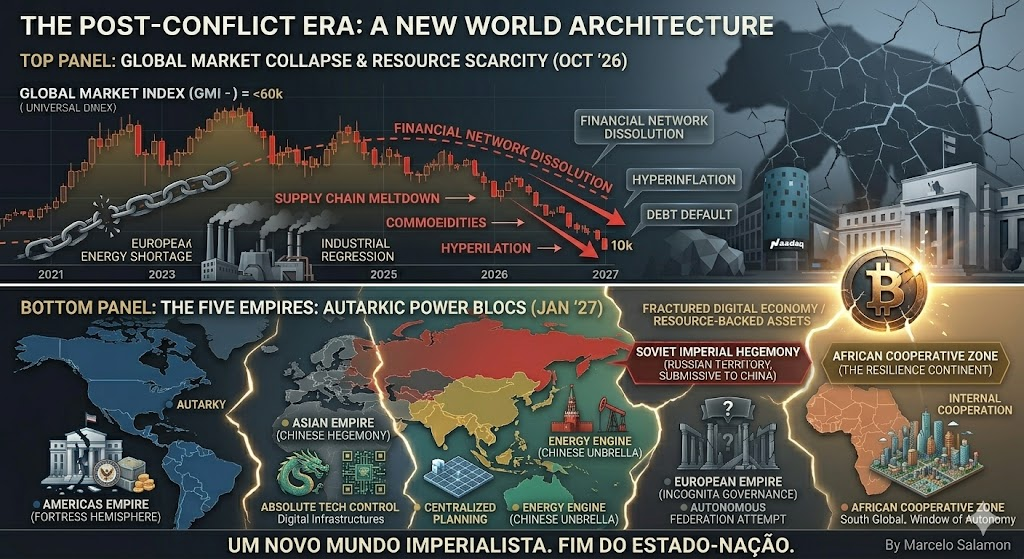
This article explores the deconstruction of the modern nation-state model and the subsequent transition toward a neo-imperialist global structure. Assuming a non-apocalyptic yet economically devastating World War III scenario, we examine the collapse of globalized financial networks and the rise of five distinct autarkic power blocs: the American Empire, the Chinese-dominated Asian Empire, a consolidated Russian territory operating under Beijing’s economic umbrella, a fragmented European governance model, and an autonomous African Cooperative Zone.
Introduction: The End of Linear History
For decades, modern political philosophy operated under the illusion that history marched in a straight line toward total integration. The “End of History” narrative suggested that borders would naturally dissolve under the influence of free-market capitalism and multilateral diplomacy. However, contemporary geopolitical crises and structural shifts demonstrate that globalism was merely a brief interlude.
Today, cyclical history theorists and macroeconomic risk analysts warn of a violent return to Neo-Imperialism. The critical question among elite think tanks is no longer if the current rules-based international order will collapse, but how humanity will organize itself in the aftermath. If this transition requires the catalyst of a major systemic conflict, the result will not be total extinction, but a profound metamorphic restructuring: the birth of the Era of the Five Empires.
1. Macroeconomic Cataclysm: The Midwife of the New Order
In classical political philosophy, the state justification rests on offering security in exchange for liberty. In a scenario of extended global conflict, this social contract is shattered by economic collapse. The financial trauma of a multi-theater war serves as the ultimate catalyst for autarky through several systemic shocks:
- The Dissolution of Financial Networks: Modern warfare targets intangible infrastructure. The weaponization of international clearing systems, mutual asset seizures, and the physical severance of supply chains would permanently break trust in fiat currencies.
- De-industrialization and the European Sacrifice: The European continent—the historical birthplace of state sovereignty via the 1648 Treaty of Westphalia—would bear the heaviest structural burden. Lacking energy independence and exposed to massive military and migratory pressures, Western Europe faces a severe industrial regression. This destruction forces a tragic philosophical choice: the dissolution of individual national identities in favor of bare-minimum collective survival.
The Dialectical Debate:
- The Pros (Creative Destruction Perspective): Economic realists argue that extreme crises are the only mechanisms capable of breaking the inertia of obsolete financial systems. The bankruptcy of the Western debt model would force a necessary return to intrinsic value rooted in tangible commodities (energy, arable land, and critical minerals).
- The Cons (Systemic Collapse Perspective): Liberal economists and humanitarian scholars counter that the destruction of global networks would not yield organized empires. Instead, it would trigger a digital “Dark Age” marked by hyper-fragmentation, where famine and technological loss would prevent the maintenance of stable megablocs.
2. The Geopolitics of the Five Empires: A New Global Map
Following the acute phase of violence, the world map would not revert to its previous configuration. International law would give way to raw political pragmatism. The planet would stabilize into five macroscopic spheres of influence:
I. The American Empire (The Hemispheric Fortress)
The United States would abandon its role as a global hegemon to consolidate a self-sufficient empire across the Americas. In a world defined by scarcity, the American Empire would close its borders and convert its economy into a radically protectionist, insular ecosystem.
- The American Reflection: Realist scholars in the U.S. (intellectual heirs to John Mearsheimer) view hemispheric isolationism as the only viable path to preserve American wealth and stability. Conversely, liberal internationalists in Washington warn that abandoning Eurasia would lead to long-term economic suffocation, turning the “Fortress” into a high-inflation prison.
II. The Asian Empire (The Chinese Manufacturing Core)
Led by Beijing, this bloc would inherit the primary industrial and productive capacity of the planet. Dominating Eurasian land routes and digital infrastructure, the Asian Empire would operate under a philosophy of absolute technological control and centralized planning.
- The Asian Reflection: State-aligned Chinese philosophers argue that bureaucratic centralization and Confucian pragmatism are superior to western democratic volatility for managing global crises. However, Indian and Taiwanese analysts point out that demographic strains and algorithmic authoritarianism create a brittle system prone to internal implosions due to a lack of social safety valves.
III. The New Russian Era (The Soviet Territorial Paradox)
In this new order, Russia would navigate a highly strategic dichotomy. Economically and financially, Moscow would accept a position of strategic submission to the Asian Empire, acting as the primary resource and energy engine for the Chinese industrial machine.
In exchange for this financial subordination, Moscow would secure geopolitical clearance and military backing to re-establish its political and normative authority over the entire geographical territory of the former Soviet Union. This territorial reclamation would not be a revival of communist ideology, but rather the creation of a massive militarized buffer zone—a neo-imperial shield protecting the western flank of the Asian bloc.
- The Russian and Eurasian Reflection: Eurasianist theorists (such as those influenced by Aleksandr Dugin) celebrate this territorial reclamation as the fulfillment of a distinct civilizatório destiny, viewing the alliance with Beijing as a necessary trade-off to eliminate Western encroachment. Meanwhile, exiled Russian liberals argue that this “voluntary submission” effectively reduces Russia to an extractive colony, where territorial sovereignty is merely a military illusion held at Beijing’s pleasure.
IV. The European Empire (The Existential Blank Canvas)
Rendered insolvent and structurally fractured by the conflict, the European continent becomes the ultimate wildcard of the century, caught between an austere internal technocracy and competing external pressures from both the American and Russian spheres.
- The European Reflection: Continental political philosophers (in the tradition of Jürgen Habermas and French sovereignists) view this scenario with deep anxiety. Pessimists fear a permanent “Balkanization” of Europe, reducing it to an impoverished geopolitical museum. Sovereignists counter that the trauma of destruction is the unique historical force required to finally forge a genuinely autonomous European Federation, completely independent of Washington’s military umbrella.
V. The African Continent (The Cooperative Resilience Zone)
Rejecting the colonial submission of past centuries, African nations would reorganize into a vast Internal Cooperation Zone designed to protect domestic assets from foreign exploitation.
- The African and Latin American Reflection: Post-colonial thinkers (following the frameworks of scholars like Achille Mbembe) offer a highly sophisticated view of this transition. They argue that the fragmentation of the Global North creates an unprecedented window for genuine autonomy. Africa and Latin America would shift from being geopolitical “backyards” to becoming the primary custodians of the biosphere’s resources. However, they warn of “neocolonialism by contract,” where local elites might simply trade traditional Western leverage for new Asian corporate monopolies.
Conclusion: The Analytical Imperative
Examining the probability of a major global conflict and the subsequent rise of a Five-Empire model is not an exercise in cynicism, but in philosophical realism. Human history demonstrates that perpetual peace is a structural myth and that political architectures are inherently transient.
The collapse of the global financial matrix and its reorganization into resource-backed blocs force us to confront the fragility of modern institutions. If the international system is drifting toward this neo-imperialist configuration, the role of the contemporary thinker is to understand these structural dynamics before the first domino falls—because the future belongs to those who decipher the logic of chaos before it becomes written history.
References for Strategic Analysis
- MEARSHEIMER, John J. The Tragedy of Great Power Politics. New York: W. W. Norton & Company. (Core framework for offensive realism and the inevitability of superpower competition).
- DUGIN, Aleksandr. The Fourth Political Theory. London: Arktos Media. (Foundational text for the Eurasianist perspective on territorial consolidation outside the Western paradigm).
- MBEMBE, Achille. Necropolitics. Durham: Duke University Press. (Crucial for understanding resource-based sovereignty and Global South systemic resistance).
- ZEIHAN, Peter. The End of the World Is Just the Beginning: Mapping the Collapse of Globalization. Harper Business. (Technical analysis on supply chain failure and the viability of an isolated American Fortress).
- HABERMAS, Jürgen. The Crisis of the European Union: A Response. Cambridge: Polity Press. (Analysis regarding the vulnerabilities of European sovereignty faced with severe external shocks).
- KAPLAN, Robert D. The Revenge of Geography: What the Map Tells Us About Coming Conflicts. Random House. (Geographical study on how physical territory dictates the boundaries and survival of historical Empires).
