

Salamon, Marcelo
04.28.2026
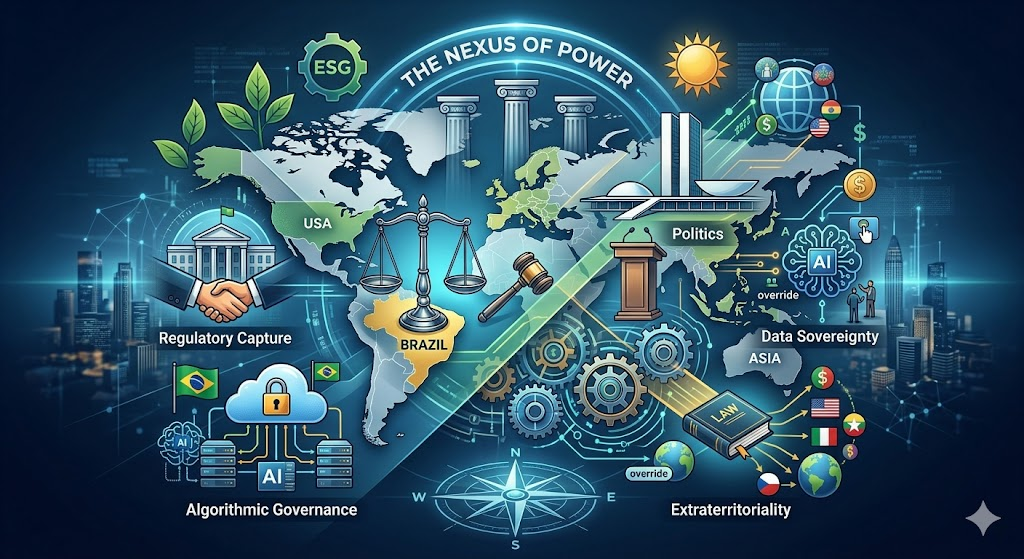
In the contemporary landscape, the distinction between a “legal issue” and a “political maneuver” has become increasingly porous. For global stakeholders, understanding this intersection is not merely an academic exercise—it is a prerequisite for sophisticated risk management and strategic foresight. To grasp the dynamics of 2026, we must examine the technical mechanisms where jurisprudence and statecraft collide.
1. The Strategic Instrumentality of Law: “Lawfare” and Institutional Stress
The concept of “Lawfare”—the strategic use of legal systems to achieve military or political objectives—has evolved into a central pillar of modern statecraft.
-
Weaponization of Anti-Corruption Frameworks: While anti-corruption statutes are fundamental to transparency, their application is increasingly scrutinized for selective enforcement. Technically, this involves the tactical timing of indictments to align with electoral cycles, necessitating a rigorous analysis of “procedural neutrality” vs. “political utility.”
-
Constitutional Hardball: This refers to the employment of high-court appointments and procedural maneuvers to achieve substantive outcomes that would be unattainable through traditional legislative channels. The technical challenge here lies in the tension between the “letter of the law” and the “spirit of constitutional norms.”
2. The Technical Engine: Regulatory Capture and Administrative Discretion
Deep within the administrative state, politics is translated into the technical rules that govern global markets.
-
Regulatory Capture: This phenomenon occurs when a regulatory body, intended to act in the public interest, instead advances the commercial or political agendas of dominant interest groups. This is often facilitated through complex “revolving door” employment practices and asymmetric information sharing during the rulemaking process.
-
The Shift in Deference Doctrines: Jurisdictions globally are reassessing the degree of “deference” courts should grant to administrative agencies. A shift toward stricter judicial review significantly alters the balance of power, moving authority from the executive branch back to the judiciary and impacting the predictability of long-term investments.
3. Geopolitical Jurisprudence and Extraterritoriality
International law serves as the primary arena where sovereign states negotiate power, yet the enforcement mechanisms are becoming increasingly localized.
-
Extraterritorial Reach: There is a marked increase in domestic laws that exert influence far beyond national borders. For instance, stringent environmental mandates or financial sanctions from dominant economies dictate the operational standards for firms globally.
-
Digital Sovereignty and Trade: The global pivot toward “Data Sovereignty” has forced a technical re-evaluation of international trade agreements. Political mandates now treat data as a strategic asset, leading to legal requirements for local data residency that can impact operational infrastructure costs by millions of dollars.
4. Algorithmic Governance and the Legal Frontier
The intersection of law and politics is now being mediated by technology, creating a new layer of technical complexity.
-
Automated Statecraft: Governments are increasingly deploying algorithms for public administration, from fiscal audits to predictive policing. The technical flashpoint here is “Algorithmic Transparency”—the legal requirement to disclose the logic behind automated decisions that carry significant political weight.
-
Liability Frameworks for Emerging Tech: The political debate regarding AI centers on whether to grant autonomous systems a unique “legal personality” or to hold developers and state actors strictly liable. This decision will define the legal landscape of the coming decade.
5. The Unified Theory of Governance
Law and politics are not separate spheres; they are a Venn diagram with a massive, overlapping center. For the professional in 2026, the objective is to identify the legal risks inherent in political trends and the political motivations embedded within legal reforms.
In an era where a single judicial ruling can shift billions of dollars in market value or fundamentally alter the trajectory of a nation, maintaining a technically informed perspective is the only viable defense against volatility.